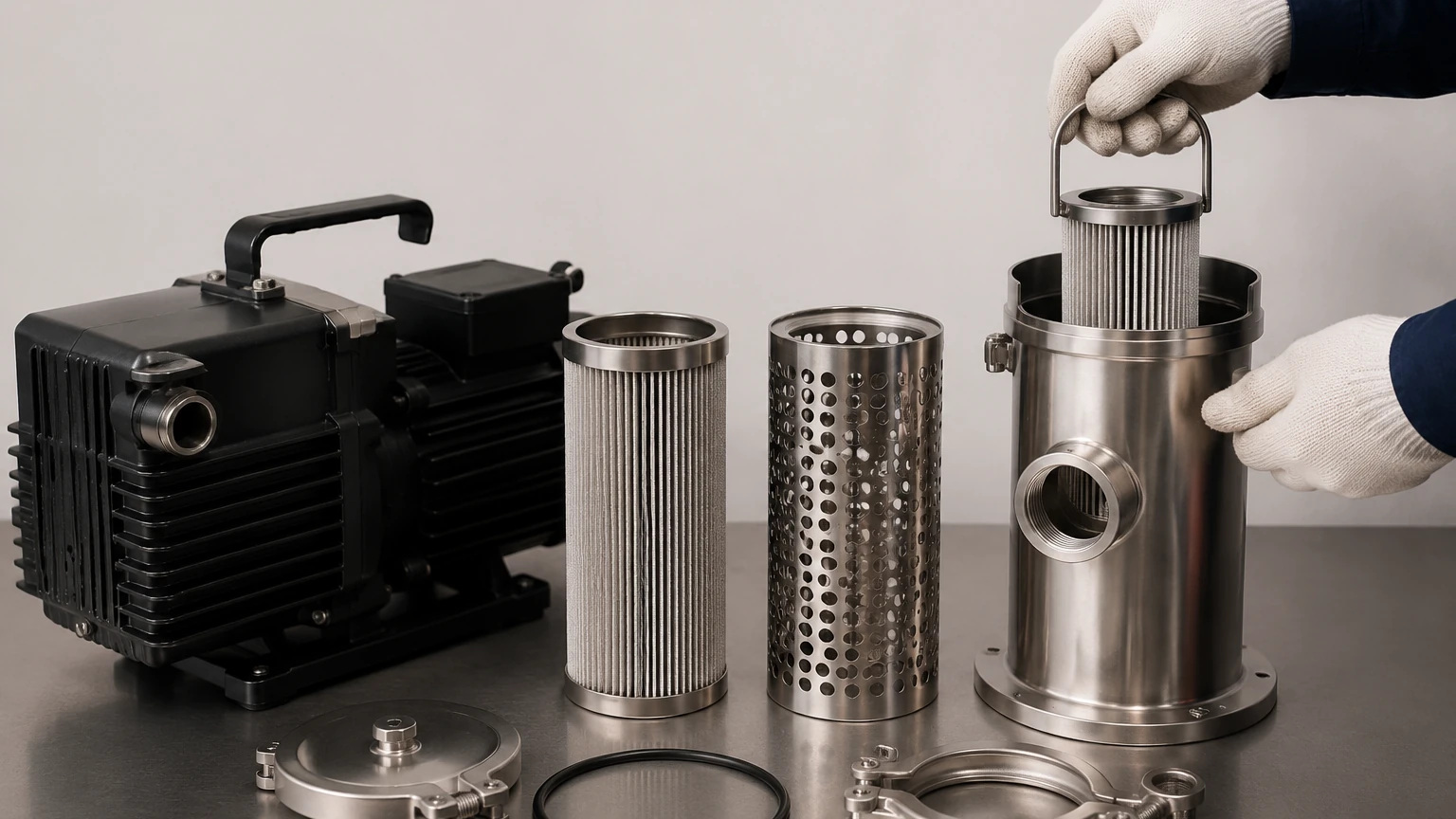
Vacuum Pump Filter Assembly
In industrial vacuum systems, the vacuum pump filter assembly serves as a critical line of defense, protecting sensitive machinery from contaminants while ensuring that the exhaust released into the environment or workspace is clean. Whether used in chemical processing, pharmaceutical manufacturing, or food production, the integrity of the filtration assembly directly impacts the longevity of the vacuum pump and the overall efficiency of the process. For engineers and procurement professionals, understanding the technical nuances of these assemblies—from material selection to micron ratings—is essential for optimizing system performance.
Understanding the Role of Vacuum Pump Filter Assemblies in Industrial Systems
A vacuum pump filter assembly is more than just a single component; it is a coordinated system designed to manage the flow of gases and capture particulates, liquids, or vapors. In a typical industrial setup, filtration occurs at two primary points: the inlet and the exhaust.
Inlet Filtration
The primary purpose of an inlet filter assembly is to protect the vacuum pump's internal components. Vacuum pumps, particularly rotary vane and screw types, are precision-engineered with tight tolerances. If dust, metal shavings, or abrasive particulates enter the pump chamber, they can cause catastrophic mechanical failure, increase wear on seals, and contaminate the pump oil. A robust inlet vacuum pump filter assembly captures these contaminants before they reach the pump, significantly extending service intervals.
Exhaust Filtration
On the discharge side, the filter assembly focuses on environmental and equipment protection. For oil-sealed vacuum pumps, the exhaust often contains oil mist or smoke. An exhaust filter assembly (often referred to as an oil mist eliminator) utilizes high-efficiency media to coalesce oil droplets, allowing the oil to be returned to the pump's reservoir while venting clean air. In dry pump applications, exhaust filters capture process-related particulates to prevent them from entering the facility’s ventilation system.
Engineering Components of a Durable Filter Assembly
To withstand the pressure differentials and potential chemical exposure inherent in vacuum applications, the construction of the filter assembly must be rigorous. High-performance assemblies typically consist of three main parts: the housing, the filter element, and the sealing mechanism.
1. The Filter Housing
For industrial applications, stainless steel is the preferred material for filter housings. Unlike plastic or carbon steel, stainless steel provides superior resistance to corrosion and can withstand the mechanical stresses of deep vacuum levels without deforming. Common configurations include L-style or straight-through designs, which allow for easy integration into existing piping. The housing must be designed for quick access, enabling maintenance teams to replace or clean the internal elements with minimal downtime.
2. The Filter Element
The heart of the vacuum pump filter assembly is the filter element. While disposable paper or fiberglass elements are common in light-duty applications, industrial processes often require stainless steel wire mesh or sintered metal cartridges. These elements offer several advantages:
* Durability: They can handle high temperatures and aggressive chemical vapors that would degrade synthetic media.
* Cleanability: Stainless steel mesh elements can often be cleaned via ultrasonic baths or back-flushing, reducing the total cost of ownership.
* Structural Integrity: Under high vacuum, soft filter media can collapse or migrate. Metal elements maintain their shape and pore structure even under significant pressure drops.
3. Sealing and Connections
Vacuum integrity is paramount. Assemblies utilize specialized gaskets and O-rings—often made of Viton, EPDM, or PTFE—to ensure a leak-tight seal. Connection types vary based on the vacuum level and industry standards, ranging from standard NPT threads to ISO-KF, ISO-K, and CF flanges for high-vacuum applications.
Key Performance Indicators: Micron Rating and Flow Capacity
When specifying a vacuum pump filter assembly, engineers must balance filtration efficiency with the pump's volumetric flow rate. Selecting a filter that is too restrictive will lead to an excessive pressure drop, forcing the pump to work harder and reducing the effective vacuum at the process point.
Micron Rating
The micron rating defines the size of particles the filter can effectively trap. For general industrial protection, a 5-micron to 10-micron rating is often sufficient. However, in precision applications like semiconductor manufacturing or laboratory research, sub-micron filtration may be required. It is important to distinguish between "nominal" and "absolute" micron ratings; absolute ratings provide a higher level of certainty that no particles above the specified size will pass through the media.
Flow Rate and Pressure Drop
Every filter assembly introduces some resistance to flow, known as pressure drop (ΔP). An ideal assembly is sized so that the initial pressure drop is negligible. As the filter accumulates contaminants, the ΔP increases. Engineers should select an assembly with a large surface area—often achieved through pleated wire mesh designs—to maximize the dirt-holding capacity and extend the time between maintenance cycles.
Material Selection for Demanding Environments
The choice of material for the vacuum pump filter assembly is heavily influenced by the chemical composition of the gases being processed.
* 304 Stainless Steel: Suitable for general-purpose applications where moisture is present but highly corrosive chemicals are not.
* 316L Stainless Steel: The standard for pharmaceutical and chemical processing. The addition of molybdenum provides enhanced resistance to pitting and crevice corrosion, particularly in the presence of chlorides or acidic vapors.
* Specialty Alloys: In extreme cases involving highly reactive gases, assemblies may be constructed from Hastelloy or other nickel-based alloys to ensure long-term stability.
Beyond the metal components, the compatibility of the elastomers (seals) is equally important. For example, while Viton is excellent for high temperatures and many chemicals, it may not be suitable for certain ketones or esters, where EPDM or Chemraz might be required.
Customization and OEM Integration
Standard off-the-shelf filter assemblies do not always meet the spatial or functional requirements of complex industrial machinery. This is where custom manufacturing becomes vital. A customized vacuum pump filter assembly can be engineered to fit within specific footprints, incorporate unique mounting brackets, or feature specialized inlet/outlet orientations to simplify piping.
For OEM manufacturers building vacuum-dependent equipment, partnering with a specialist like Kaifil allows for the development of proprietary filtration components. Customization options include:
* Bespoke Micron Sizes: Tailoring the wire mesh weave to capture specific process byproducts.
* Reinforced Cartridges: Adding internal supports or outer cages to prevent element deformation in high-pulse systems.
* Integrated Monitoring: Designing housings with ports for differential pressure gauges or sensors to enable predictive maintenance.
Maintenance, Cleaning, and Total Cost of Ownership
One of the primary engineering considerations when selecting a vacuum pump filter assembly is the long-term cost. While stainless steel assemblies have a higher initial purchase price compared to plastic or disposable units, their longevity and cleanability often result in a lower total cost of ownership (TCO).
Cleaning Procedures
Stainless steel wire mesh elements can be regenerated. Depending on the contaminant, cleaning methods include:
* Solvent Cleaning: Effective for removing oils or chemical residues.
* Ultrasonic Cleaning: Uses high-frequency sound waves to dislodge fine particulates trapped deep within the mesh layers.
* Burn-off: For organic contaminants, controlled heating can oxidize the material, leaving the metal mesh clean.
Replacement Cycles
Even with cleaning, filter elements eventually reach the end of their functional life due to mechanical wear or irreversible clogging. Monitoring the pressure drop across the assembly is the most reliable way to determine when maintenance is required. A sudden drop in vacuum performance at the process chamber is often a trailing indicator that the filter assembly is overdue for service.
Selecting the Right Filtration Solution for Your Application
To ensure the selection of the most effective vacuum pump filter assembly, engineers should confirm the following parameters before procurement:
1. Vacuum Level: Is the system operating in rough, high, or ultra-high vacuum?
2. Gas Composition: Are there corrosive vapors, high moisture levels, or flammable gases involved?
3. Particulate Load: What is the concentration and size distribution of the dust or debris?
4. Flow Requirements: What is the maximum SCFM or m³/h the pump will handle?
5. Connection Standards: Does the assembly need to match existing ISO, NPT, or flange specifications?
By addressing these technical requirements, purchasing teams can secure filtration solutions that provide reliable protection and maintain process integrity. For more information on custom stainless steel filtration components and industrial solutions, Review product options and application support to find the right fit for your specific vacuum system needs.
In conclusion, the vacuum pump filter assembly is a vital component that safeguards the heart of vacuum-driven processes. By prioritizing high-quality materials like stainless steel and focusing on precise engineering specifications, industrial facilities can achieve higher uptime, lower maintenance costs, and superior process outcomes. Whether you are replacing an existing unit or designing a new system, focusing on the technical details of the filtration assembly is an investment in the reliability of your entire operation.