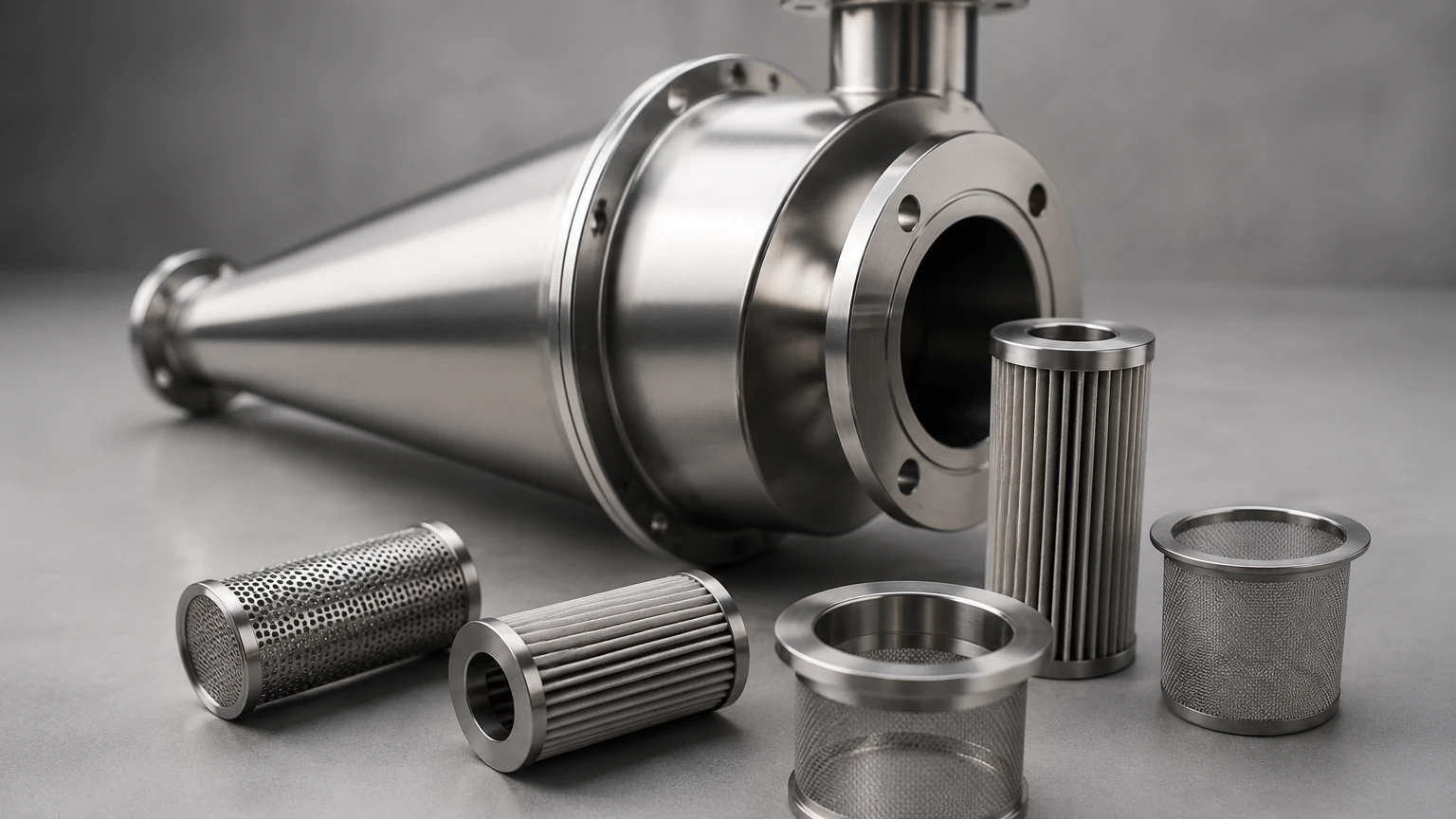
Cyclone Filtration
In the landscape of industrial separation, cyclone filtration stands as a fundamental technology for removing particulate matter from fluid streams—whether gas or liquid. By leveraging centrifugal forces rather than physical barriers alone, cyclone systems provide a robust, low-maintenance solution for high-volume primary separation. For engineers and procurement teams, understanding the mechanics, limitations, and integration requirements of cyclone filtration is essential for optimizing system longevity and protecting downstream precision components.
The Principles of Centrifugal Separation
Cyclone filtration operates on the principle of centrifugal sedimentation. Unlike a standard mesh filter that traps particles on a surface, a cyclone uses the velocity of the incoming fluid to create a high-speed rotating flow pattern within a cylindrical or conical chamber.
As the fluid enters tangentially at the top of the cyclone, it is forced into a downward spiral, often referred to as the outer vortex. The centrifugal force generated by this rotation flings heavier particles toward the outer walls of the chamber. Due to gravity and the downward flow, these particles migrate toward the bottom of the cone (the underflow). Meanwhile, the cleaned fluid reaches the bottom of the cone and reverses direction, forming a tighter inner vortex that moves upward through the center of the chamber to exit via the overflow or vortex finder.
In liquid applications, this process is specifically known as hydrocyclone separation. In gas applications, it is referred to as gas cyclone filtration. In both instances, the efficiency of the separation is dictated by the particle density, fluid viscosity, and the velocity of the flow.
Critical Design Parameters in Cyclone Systems
To evaluate a cyclone filtration system, technical professionals must look beyond simple flow rates and focus on the engineering variables that determine separation performance.
1. The Cut Point (d50)
The most critical metric in cyclone filtration is the "cut point," typically denoted as d50. This represents the particle size at which 50% of the particles are separated into the underflow and 50% remain in the overflow. A lower d50 indicates a more precise separation capability. Factors such as a smaller cyclone diameter and higher inlet pressure generally lead to a finer cut point, though this often comes at the cost of higher energy consumption.
2. Pressure Drop (ΔP)
The pressure drop across a cyclone is the energy cost of the separation process. It is the difference between the inlet pressure and the outlet pressure. A higher pressure drop usually correlates with higher separation efficiency because it implies higher internal velocities. However, excessive pressure drop can lead to increased pump wear and higher operational costs. Balancing ΔP with the required filtration accuracy is a core challenge in system design.
3. Geometry and Proportions
The ratio between the diameter of the cylindrical section, the length of the conical section, and the diameter of the vortex finder determines the residence time and the centrifugal force applied to the particles. Longer cones generally provide better separation of fine particles, while shorter, wider designs are better suited for high-volume, coarse separation.
Material Engineering: Stainless Steel in Cyclone Environments
Industrial filtration environments are often characterized by high temperatures, corrosive chemicals, and abrasive particles. Consequently, the material construction of the cyclone and its internal components is a primary factor in the total cost of ownership.
Stainless steel, particularly grades 304 and 316L, is the industry standard for high-performance cyclone filtration. These materials offer the structural integrity needed to withstand high-pressure differentials and the chemical resistance required for pharmaceutical or food-grade applications. In many custom industrial setups, the internal surfaces of the cyclone are polished or treated to reduce friction and prevent particle adhesion, which can lead to turbulence and decreased efficiency.
Furthermore, using stainless steel allows for the integration of precision-engineered components, such as custom-sized vortex finders or specialized inlet nozzles, which can be manufactured to tight tolerances to ensure predictable flow dynamics.
Synergistic Filtration: Combining Cyclones with Precision Metal Filters
While cyclone filtration is highly effective at removing the bulk of solid contaminants, it is rarely used as a standalone solution for applications requiring high-purity output. In a typical multi-stage filtration system, the cyclone acts as a "pre-filter" or "scalper," removing 90% or more of the heavy solids. This protects the secondary, more sensitive filtration stages from premature clogging and mechanical damage.
For instance, in a hydraulic system or a chemical processing line, a hydrocyclone might remove sand and metal shavings, while a downstream stainless steel wire mesh filter or a pleated filter cartridge provides the final polish, capturing the remaining fine particles. This staged approach significantly extends the service life of the more expensive precision filter elements and reduces the frequency of manual cleaning or replacement.
Engineers looking to optimize these integrated systems can find comprehensive technical data and component specifications on the Main Page of the Kaifil website, which details how custom metal filtration components can be tailored to match the output characteristics of cyclone separators.
Operational Challenges and Troubleshooting
Despite their lack of moving parts, cyclone filtration systems are not immune to operational issues. Technical teams should be aware of the following risks:
* Abrasive Wear: Because particles are forced against the outer walls at high speeds, the conical section of the cyclone is prone to erosion. Regular wall-thickness inspections are necessary, especially when handling silica, metal fines, or other hard particulates.
* Air Ingress: In hydrocyclones, if the underflow discharge is not properly sealed or managed, air can be drawn into the center of the vortex. This disrupts the flow pattern and significantly reduces separation efficiency.
* Flow Rate Sensitivity: Cyclones are designed for a specific flow range. If the flow rate drops too low, the centrifugal force becomes insufficient to move particles to the walls, and the separation efficiency plummets. Conversely, over-pumping can cause excessive turbulence and increased wear.
* Clogging of the Underflow: If the concentration of solids in the feed increases unexpectedly, the underflow orifice may bridge or clog. This forces all solids into the overflow, potentially damaging downstream equipment.
Selection Guide for Industrial Applications
When selecting a cyclone filtration solution, engineers should prepare a detailed data sheet to ensure the equipment meets the application's specific needs. The following information is typically required for accurate sizing and material selection:
1. Fluid Characteristics: Viscosity, density, and temperature. For non-aqueous liquids, chemical compatibility with stainless steel and seal materials must be confirmed.
2. Particulate Profile: Particle size distribution (PSD), shape (spherical vs. angular), and specific gravity. Knowing the maximum particle size is vital to prevent inlet blockages.
3. Flow Requirements: Minimum, nominal, and peak flow rates.
4. Efficiency Targets: What is the required d50 cut point? What is the maximum allowable solids concentration in the overflow?
5. Downstream Sensitivity: What follows the cyclone? If the next stage is a 5-micron stainless steel cartridge, the cyclone must be tuned to remove as much material above 10-15 microns as possible to prevent rapid blinding of the mesh.
The Role of Customization in Filtration Performance
Off-the-shelf cyclone units often fail to meet the nuanced needs of specialized industries like pharmaceutical manufacturing or high-pressure hydraulics. Customization allows for the adjustment of inlet geometries to match specific pipe velocities and the selection of specialized stainless steel alloys for extreme environments.
By working with a manufacturer that understands both the centrifugal separation of the cyclone and the physical barrier filtration of wire mesh, engineers can design a holistic system. This ensures that the cyclone is not just an isolated component but a functional part of a larger strategy to maintain fluid purity and protect capital equipment.
In conclusion, cyclone filtration is an indispensable tool for bulk solids removal. When engineered with precision and paired with high-quality stainless steel secondary filters, it provides a reliable, cost-effective, and durable solution for the most demanding industrial fluid processing challenges. For those in the planning stages of a filtration project, confirming the compatibility of the cyclone's output with secondary filter ratings is the most critical step toward achieving optimal system performance.