


Petroleum Refining and Filtration
In the demanding environment of a modern refinery, the integrity of the process stream is paramount. Petroleum refining and filtration are inextricably linked; without precise separation technologies, downstream equipment such as hydrotreaters, catalytic crackers, and heat exchangers would succumb to rapid degradation. Industrial filtration in this sector is not merely a utility but a critical engineering safeguard designed to manage solids, protect expensive catalysts, and ensure the final product meets stringent purity standards.
For engineers and procurement teams, selecting the right filtration media involves balancing mechanical strength, chemical compatibility, and filtration efficiency. As a specialized manufacturer of stainless steel filtration solutions, Kaifil provides the technical expertise required to navigate these complex requirements, offering durable components that withstand the high temperatures and corrosive environments typical of the oil and gas industry.
The Critical Role of Filtration in Refinery Operations
Petroleum refining involves a series of complex physical and chemical transformations. At each stage, the presence of particulate matter—ranging from sand and pipe scale to catalyst fines—poses a significant risk. Effective filtration serves three primary functions in a refinery:
1. Equipment Protection: High-speed pumps, compressors, and valves are sensitive to abrasive particles. Even micron-sized contaminants can cause erosion, leading to mechanical failure and unplanned downtime.
2. Catalyst Preservation: Many refining processes, such as Fluid Catalytic Cracking (FCC) and hydrocracking, rely on expensive catalysts. Particulate buildup can "poison" or plug catalyst beds, reducing their surface area and shortening their operational lifespan.
3. Product Quality Control: Final products, including diesel, jet fuel, and gasoline, must meet international standards for clarity and particulate content. Filtration ensures these fluids are free of contaminants before they reach the consumer market.
Given these stakes, the choice of filter media is a critical engineering decision. While disposable filters may suffice for some low-pressure applications, the majority of refinery processes require the robustness of stainless steel wire mesh and metal cartridges.
Engineering Considerations for Filter Selection
When evaluating filtration solutions for petroleum refining, engineers must look beyond simple micron ratings. Several technical variables dictate the performance and longevity of a filter component in a refinery setting.
Material Compatibility and Corrosion Resistance
Crude oil and its derivatives often contain corrosive elements, including sulfur compounds, organic acids, and chlorides. Standard carbon steel is rarely sufficient. Stainless steel—specifically grades 304, 316L, and specialized alloys like Duplex—is the industry standard. 316L stainless steel is particularly valued for its superior resistance to pitting and crevice corrosion in sour (high-sulfur) environments.
Temperature and Pressure Extremes
Refinery processes often operate at temperatures exceeding 300°C (572°F) and under significant hydraulic pressure. Synthetic or polymer-based filter media often fail under these conditions. Sintered metal mesh and pleated stainless steel cartridges maintain their structural integrity at extreme temperatures, ensuring consistent filtration accuracy without the risk of media migration or thermal bypass.
Micron Rating: Nominal vs. Absolute
In petroleum refining and filtration, understanding the difference between nominal and absolute micron ratings is essential. A nominal rating indicates the filter's ability to retain a majority of particles of a certain size, whereas an absolute rating guarantees the retention of 99.9% of particles at that size. For critical applications like protecting a hydrotreater bed, absolute-rated stainless steel mesh is often required to prevent even the smallest fines from passing through.
Types of Stainless Steel Filters in Petroleum Applications
Kaifil specializes in manufacturing several types of metal filtration components that are widely used across the refining landscape. Each design offers specific advantages depending on the flow rate and the nature of the contaminants.
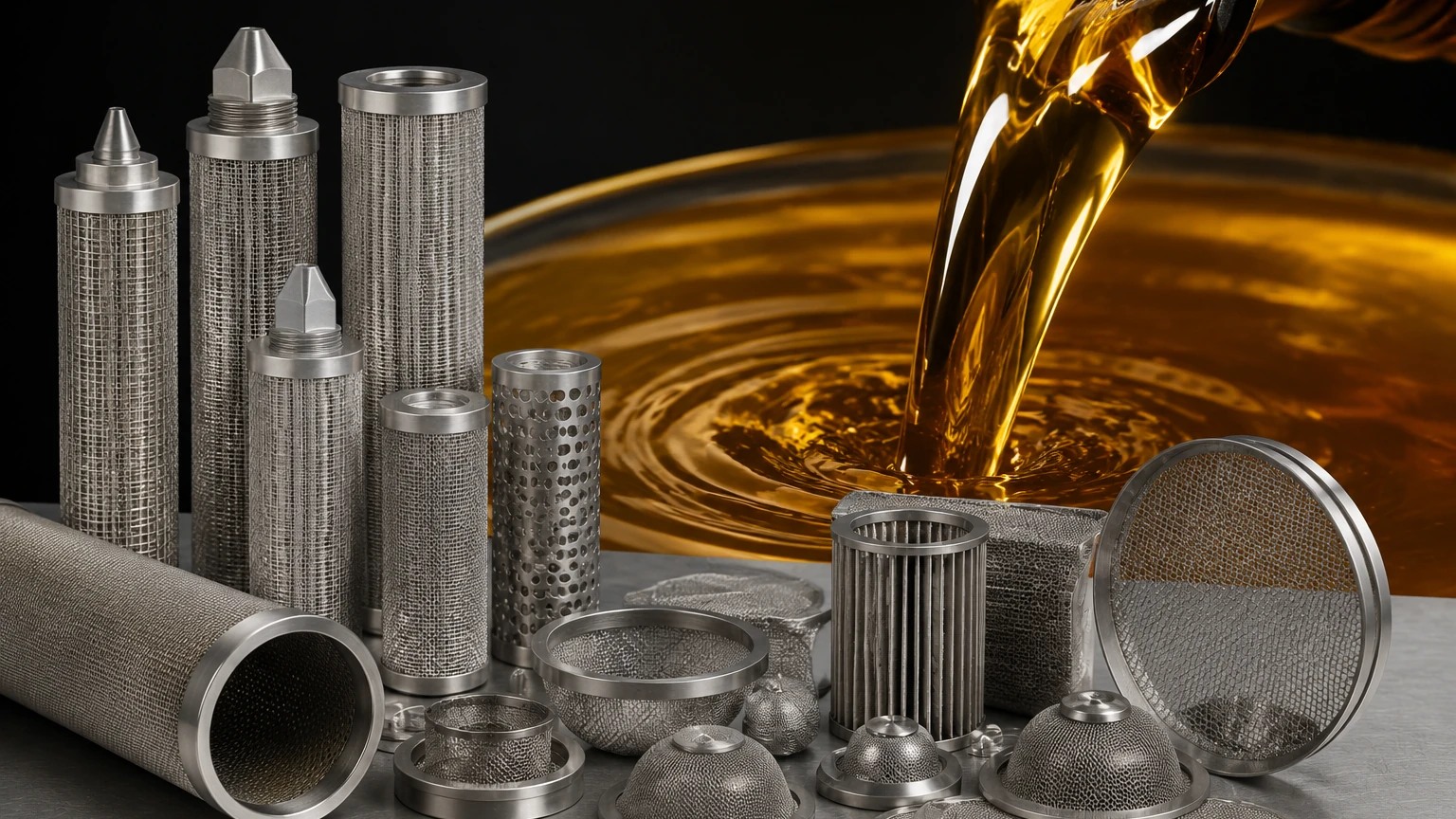
Stainless Steel Wire Mesh Filters
Wire mesh filters are highly versatile. They can be manufactured in various weaves, such as plain, twill, or Dutch weave, to achieve specific flow characteristics and particle retention. In refineries, these are often used as basket strainers or pre-filters to remove large-scale debris from crude oil feedstocks before they enter the atmospheric distillation unit.
Sintered Metal Filter Cartridges
For high-pressure applications, sintered metal cartridges offer unmatched strength. By bonding multiple layers of wire mesh through a heat-treatment process (sintering), the resulting media is incredibly rigid and porous. These cartridges are ideal for high-viscosity fluids and can be cleaned and reused multiple times, providing a lower total cost of ownership compared to disposable alternatives.
Pleated Metal Filters
To maximize the filtration surface area within a limited footprint, pleated stainless steel filters are employed. Pleating increases the available area for fluid passage, which lowers the initial pressure drop and extends the time between cleaning cycles. This is particularly beneficial in continuous flow processes where minimizing pressure loss is vital for energy efficiency.
Challenges in Petroleum Refining and Filtration
Refinery filtration is rarely a "set and forget" operation. Engineers must account for several operational challenges that can impact filtration performance.
Managing Pressure Drop ($ΔP$)
As contaminants accumulate on the filter surface, the differential pressure across the media increases. If the $ΔP$ becomes too high, it can lead to reduced flow rates or, in extreme cases, structural failure of the filter element. Monitoring $ΔP$ is a standard practice, and selecting a filter with a high dirt-holding capacity is essential for maintaining process stability.
Catalyst Fine Recovery
In FCC units, the recovery of catalyst fines from the slurry oil is a major challenge. These fines are extremely small and abrasive. Specialized metal filtration systems are required to capture these particles, allowing the refinery to recycle the catalyst and produce a cleaner decant oil. This process often involves backwashing—a technique where the flow is momentarily reversed to dislodge the filter cake.
Sludge and Wax Formation
Heavier petroleum fractions can precipitate waxes or asphaltic sludges, especially when temperatures drop. These substances can quickly blind a filter. Engineering the filtration system with heat-tracing or selecting a mesh weave that resists "plugging" is necessary to handle these challenging fluids.
Customization and OEM Solutions
Every refinery has unique process conditions, and off-the-shelf filtration products often fall short of specific performance requirements. This is where custom manufacturing becomes invaluable. At Kaifil, we work closely with engineering teams to develop bespoke filtration components tailored to specific dimensions, material grades, and filtration accuracies.
Customization options include:
* End Cap Configurations: Ensuring a perfect seal within existing filter housings to prevent bypass.
* Reinforced Cores: Designing internal supports that can withstand high-pressure surges or reverse-flow cleaning.
* Multi-Layer Composites: Combining different mesh counts to create a depth-filtration effect within a single metal element.
By focusing on the specific needs of the application, we help refineries optimize their filtration cycles and reduce the frequency of manual interventions. For more information on our engineering capabilities, you can visit our Main Page to review product options and application support.
Maintenance and Total Cost of Ownership
While the initial investment in stainless steel filtration media is higher than that of polymer alternatives, the total cost of ownership (TCO) is significantly lower in industrial refining. The durability of metal filters allows for repeated cleaning—either through ultrasonic baths, chemical cleaning, or backpulsing—which eliminates the recurring cost of purchasing and disposing of single-use cartridges.
Furthermore, the reliability of high-quality metal filters reduces the risk of "catastrophic" failures that could lead to millions of dollars in lost production. When evaluating a filtration partner, engineers should consider the manufacturer’s ability to provide consistent quality and technical documentation, ensuring that every replacement part meets the original design specifications.
Conclusion
Petroleum refining and filtration are fundamental to the safety, efficiency, and profitability of the oil and gas industry. From the initial processing of crude oil to the final polishing of refined fuels, stainless steel filtration components provide the necessary barrier against contaminants in the most demanding environments. By understanding the technical nuances of material selection, micron ratings, and structural design, refinery engineers can implement filtration strategies that protect their assets and optimize their processes.
Kaifil remains committed to delivering high-performance, customized filtration solutions that meet these industrial challenges. Whether you are addressing catalyst recovery, equipment protection, or product purity, our team provides the manufacturing precision and engineering insight required to achieve reliable results. To explore our full range of wire mesh filters and stainless steel cartridges, please visit our Main Page.
