


Filter Oil from Water
In industrial environments, the separation of oil from water is a critical process required for environmental protection, equipment longevity, and process efficiency. Whether managing cooling water in a power plant, treating wastewater in a chemical facility, or maintaining the purity of hydraulic fluids, engineers must understand the technical nuances of how to effectively filter oil from water. High-performance filtration systems, particularly those utilizing stainless steel components, offer the durability and precision necessary to handle these demanding applications.
Selecting the right filtration solution requires a deep understanding of the physical state of the oil within the water, the required flow rates, and the chemical environment of the application. This guide explores the engineering principles behind oil-water separation and the role of precision-engineered metal filters in achieving reliable results.
Understanding Industrial Oil-Water Separation Challenges
Before implementing a filtration system, it is essential to categorize the type of oil-water mixture present. Oil does not always behave the same way when mixed with water; its state determines the technology required for separation.
Free Oil
Free oil consists of large droplets that remain separate from the water phase. Due to the difference in specific gravity, free oil typically rises to the surface or sinks to the bottom, depending on whether it is lighter or heavier than water. While gravity separators can handle the bulk of free oil, fine stainless steel mesh filters are often used as a secondary stage to capture smaller droplets that remain suspended due to turbulence.
Dispersed and Emulsified Oil
Dispersed oil consists of smaller droplets (typically 10 to 100 microns) that are physically suspended but not chemically bonded. Emulsified oil, however, involves droplets smaller than 10 microns that are often stabilized by surfactants or chemical agents. To filter oil from water when it is in an emulsified state, mechanical filtration must often be combined with coalescing media or chemical treatment to encourage droplet growth before the final filtration stage.
For engineers, the challenge lies in the fact that industrial processes often involve a mix of these states. A robust filtration system must be designed to handle fluctuating concentrations and varying droplet sizes without frequent clogging or pressure spikes.
The Role of Stainless Steel Filtration in Oil Removal
Stainless steel is the material of choice for industrial oil-water separation for several technical reasons. Unlike synthetic or paper-based media, stainless steel filter cartridges and wire mesh components offer superior mechanical strength and chemical resistance.
Durability in Harsh Environments
Industrial filtration often occurs under high pressure and elevated temperatures. Stainless steel (specifically grades 304 and 316L) maintains its structural integrity where plastics might deform or degrade. This is particularly important in chemical processing and hydraulic systems where the presence of corrosive agents or high-velocity fluids is common.
Precision Pore Geometry
Advanced manufacturing techniques allow for the creation of wire mesh with highly precise pore sizes. This level of accuracy is vital when the goal is to capture specific droplet sizes. By utilizing multi-layered sintered mesh or pleated stainless steel designs, manufacturers like Kaifil can provide filters that offer a high surface area, which is essential for capturing dispersed oil while maintaining low-pressure drops. For more information on specific configurations, you can visit the Main Page to review product options and application support.
Technical Principles: How to Filter Oil from Water Effectively
The process of removing oil from water through mechanical filtration relies on two primary mechanisms: direct interception and coalescence.
Mechanical Interception
In this mechanism, the filter media acts as a physical barrier. Droplets larger than the pore size of the mesh are trapped on the surface. For this to be effective without rapid fouling, the filter must be designed with a specific micron rating tailored to the oil droplet distribution of the fluid. In many industrial setups, a multi-stage approach is used, starting with a coarse mesh to remove large debris and free oil, followed by a fine stainless steel cartridge for polishing.
Coalescence in Metal Media
Coalescence is the process where small oil droplets collide and merge into larger droplets. Stainless steel wire mesh can be engineered to promote this behavior. As the oil-water mixture passes through the tortuous path of a multi-layered sintered mesh, the oil droplets adhere to the wire surfaces (adsorption). As more droplets accumulate, they merge and eventually become large enough to break away and float to the surface for easy removal by a skimmer or overflow system. This dual-action—filtration and coalescence—makes stainless steel an exceptionally efficient medium for treating oily wastewater.
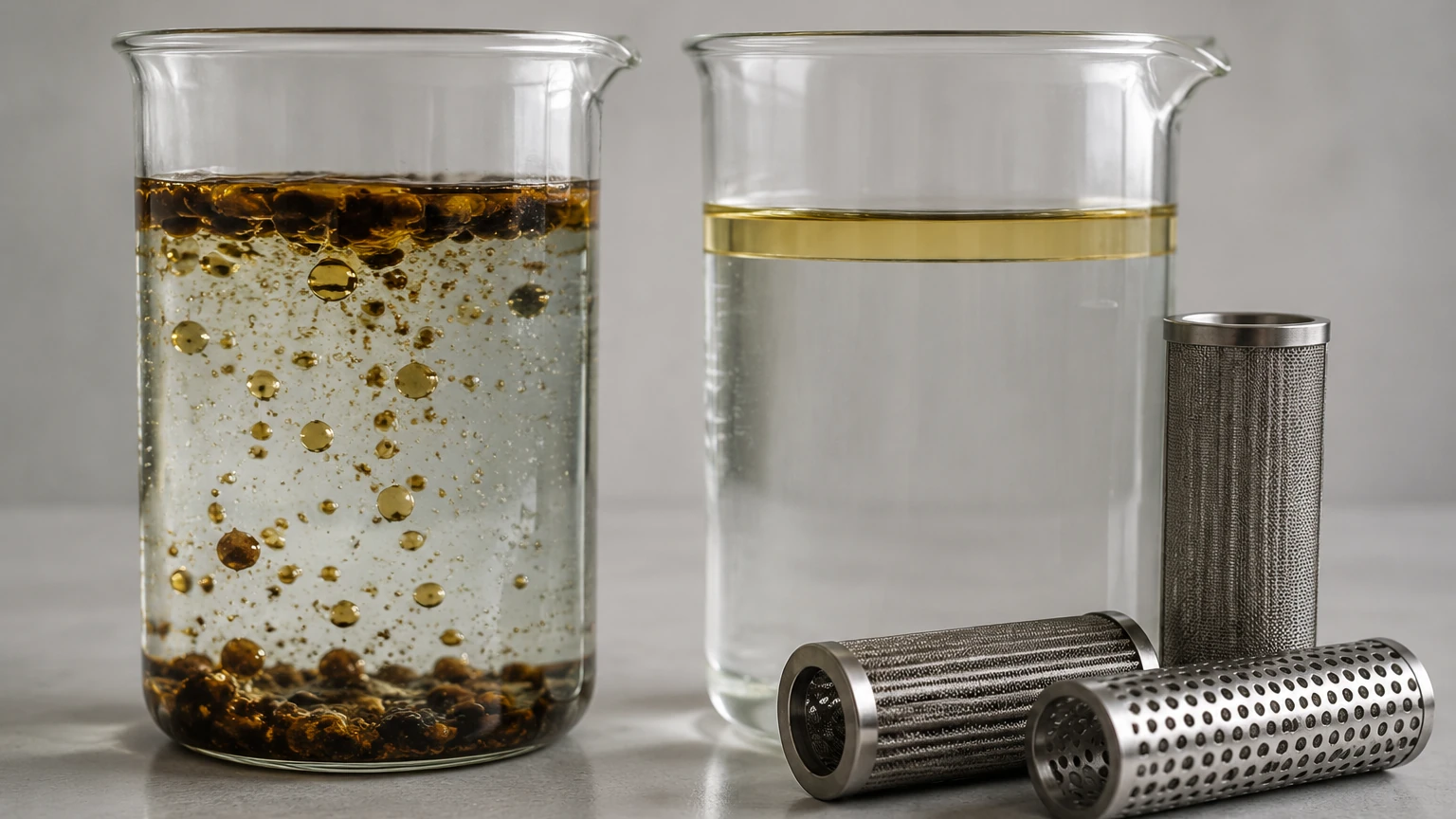
Engineering Selection Criteria for Industrial Filters
When specifying a filter to remove oil from water, engineers must evaluate several variables to ensure the system performs reliably over its intended lifespan.
1. Micron Rating and Efficiency: The pore size must be small enough to capture target droplets but large enough to prevent immediate blinding. In many oil-water applications, absolute ratings are preferred over nominal ratings to ensure consistent performance.
2. Flow Velocity and Pressure Drop: High flow velocities can shear oil droplets, breaking them into smaller, harder-to-filter emulsions. Designing the filter housing and element to maintain a laminar flow profile is critical. Additionally, the clean pressure drop (ΔP) must be calculated to ensure the system pump can handle the resistance as the filter accumulates contaminants.
3. Chemical Compatibility: While 304 stainless steel is suitable for many water-based applications, 316L is often required if the water contains chlorides or if the oil itself is acidic or chemically aggressive. Choosing the wrong alloy can lead to pitting corrosion and premature failure.
4. Cleaning and Reusability: One of the primary advantages of metal filters is the ability to clean and reuse them. Engineers should consider whether the system allows for backwashing or if the elements must be removed for ultrasonic cleaning. This significantly impacts the total cost of ownership compared to disposable plastic filters.
Custom OEM Solutions for Complex Filtration Requirements
Standard off-the-shelf filters often fall short in specialized industrial applications. For instance, a hydraulic system in a marine environment has different requirements than a food processing wash-water recovery system. This is where custom manufacturing becomes essential.
Kaifil specializes in providing tailored stainless steel filtration solutions that address these specific needs. By working closely with engineering teams, a manufacturer can customize the mesh weave (such as Dutch weave for high-pressure applications or Twill weave for fine filtration), the cartridge dimensions, and the end-cap fittings to integrate seamlessly into existing machinery. Customization also extends to the structural support of the filter, ensuring it can withstand the mechanical stresses of high-viscosity oils or high-flow water streams.
When a project requires a unique approach to filter oil from water, leveraging OEM expertise ensures that the filtration component is not a bottleneck but a reliable part of the industrial process. Detailed technical specifications and engineering guidance are available on the Main Page, providing a resource for those looking to optimize their filtration infrastructure.
Evaluating Total Cost and Maintenance Cycles
While the initial investment in stainless steel filtration components is higher than in disposable alternatives, the long-term economic benefits are substantial. Engineers must look beyond the purchase price to the Total Cost of Ownership (TCO).
Reduced Downtime
Disposable filters require frequent change-outs, leading to process interruptions. Stainless steel filters, designed for durability, can often operate for extended periods between cleaning cycles. In high-volume industrial applications, the labor costs and production losses associated with filter changes can quickly exceed the cost of the filter itself.
Waste Minimization
Environmental regulations are increasingly focused on reducing industrial waste. By using cleanable metal filters, facilities significantly reduce the volume of contaminated solid waste sent to landfills. This not only aids in compliance but also improves the facility's sustainability profile.
Performance Stability
Synthetic media can migrate or deform under pressure, leading to "bypass" where unfiltered oil passes through the system. Stainless steel maintains a rigid structure, ensuring that the filtration efficiency remains constant throughout the service life of the element. This reliability is vital for protecting downstream equipment like high-pressure pumps and sensitive analytical instruments.
In conclusion, the ability to effectively filter oil from water is a cornerstone of modern industrial fluid management. By selecting high-quality stainless steel filtration components and focusing on the specific engineering requirements of the application, technical teams can achieve superior separation efficiency, lower maintenance costs, and long-term operational reliability.
