


Cartridge Filter Nylon
In the landscape of industrial liquid and gas processing, the selection of filtration media is a critical engineering decision that directly impacts product purity, equipment longevity, and operational efficiency. Among the various polymer-based options, the cartridge filter nylon—typically utilizing Nylon 6 or Nylon 6,6 membranes—stands out for its specific chemical affinities and mechanical properties. This article provides a technical overview of nylon filtration media, exploring its material characteristics, industrial applications, and the engineering considerations necessary for optimizing filtration systems.
Understanding Nylon as a Filtration Medium
Nylon, or polyamide, is a synthetic polymer known for its high mechanical strength and thermal stability. In the context of cartridge filters, nylon is most frequently deployed as a microporous membrane. One of the most significant characteristics of a cartridge filter nylon is its naturally hydrophilic nature. Unlike hydrophobic materials such as PTFE (Polytetrafluoroethylene) or PVDF (Polyvinylidene fluoride), nylon does not require pre-wetting with alcohols or other solvents before filtering aqueous solutions. This inherent property simplifies operational workflows and reduces the risk of chemical contamination from wetting agents.
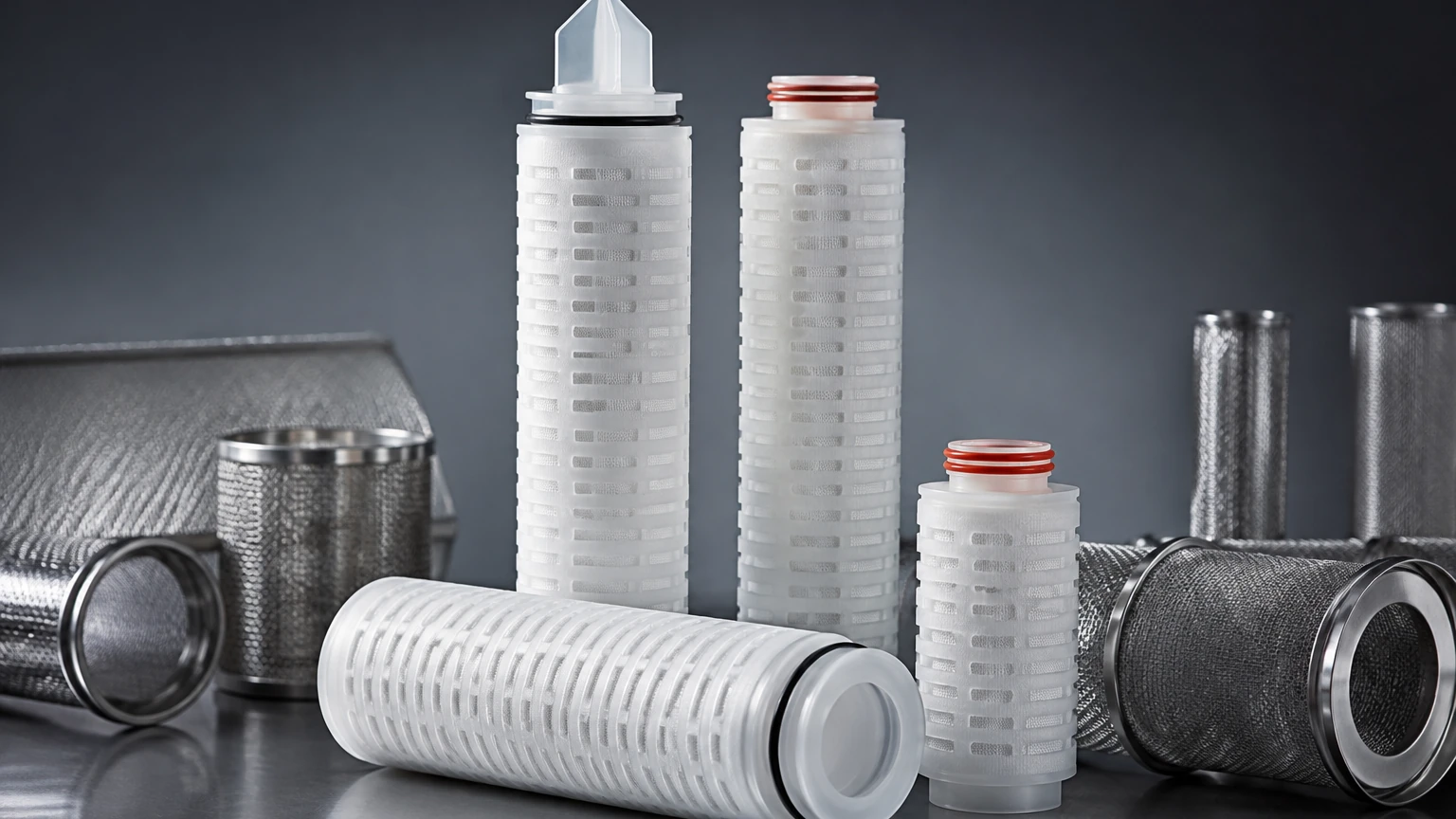
From a structural perspective, nylon membranes are typically produced through a controlled phase-inversion process. This allows manufacturers to create a highly uniform pore structure with high porosity, which translates to excellent flow rates and low pressure drops. In industrial B2B environments, these filters are often constructed in a pleated configuration to maximize the effective filtration area within a standard cartridge footprint, thereby extending the service life between change-outs.
Chemical Compatibility and Material Constraints
For engineers and procurement teams, understanding the chemical boundaries of a cartridge filter nylon is essential to prevent premature filter failure or filtrate contamination. Nylon exhibits excellent resistance to a wide range of chemicals, but it also has specific vulnerabilities.
Strengths in Compatibility
* Organic Solvents: Nylon is highly resistant to many organic solvents, including alcohols, esters, and ketones. This makes it a preferred choice for solvent clarification and the filtration of mobile phases in analytical and industrial chemistry.
* Alkaline Solutions: Unlike some other polymers, nylon maintains its structural integrity in the presence of many bases and alkaline cleaning agents.
* Low Extractables: High-quality nylon cartridges are engineered to have extremely low levels of extractables, ensuring that the filter itself does not introduce impurities into the process stream.
Limitations and Risks
* Acidic Environments: Nylon is generally not recommended for use with strong acids (such as concentrated sulfuric or hydrochloric acid) as they can cause the polymer chains to degrade, leading to membrane breakthrough.
* Oxidizing Agents: Exposure to strong oxidizing agents can weaken the nylon fibers over time, particularly at elevated temperatures.
* Temperature Sensitivity: While nylon has a higher melting point than many polyolefins, its mechanical properties can diminish under continuous high-temperature operation. In such cases, industrial facilities often transition to more robust materials. For high-temperature or high-pressure applications where polymers may fail, engineers frequently consult the Main Page of specialized manufacturers like Kaifil to explore stainless steel alternatives.
Engineering Design and Construction
The performance of a cartridge filter nylon is not solely dependent on the membrane material but also on the engineering of the cartridge housing and support components. A standard industrial nylon cartridge typically consists of several layers:
1. The Nylon Membrane: The primary filtration layer, available in various pore sizes ranging from 0.1 to 1.2 microns for sterile filtration and clarification.
2. Support and Drainage Layers: Usually made of polyester or polypropylene, these layers protect the membrane from mechanical stress and ensure that fluid flows evenly across the entire surface area.
3. Core and Cage: These rigid internal and external structures provide the necessary collapse strength to withstand differential pressures during operation.
4. End Caps and Adapters: These components ensure a leak-proof seal within the filter housing. Common configurations include Code 7 (226 O-rings with a bayonet lock) or standard DOE (Double Open End) designs.
Thermal bonding is the preferred method for assembling these components. By using heat to fuse the materials together rather than adhesives or resins, manufacturers eliminate a common source of extractables, ensuring the cartridge filter nylon remains compatible with high-purity requirements in the pharmaceutical and microelectronics sectors.
Key Applications Across Industrial Sectors
The unique properties of nylon make it a versatile tool across several demanding industries. Its ability to handle both aqueous and organic fluids without pre-wetting provides a significant advantage in multi-purpose processing plants.
Pharmaceutical and Biotechnology
In the pharmaceutical industry, nylon cartridges are frequently used for the filtration of buffers, tissue culture media, and the clarification of biological products. Their low protein binding characteristics (depending on the specific nylon variant and surface modification) help ensure that valuable active ingredients are not lost to the filter media during processing.
Food and Beverage Processing
Nylon filters play a vital role in the clarification of beverages, such as beer and wine, where removing spoilage microorganisms and fine particulates is essential for shelf stability. Because nylon is naturally hydrophilic, it can efficiently process large volumes of water-based beverages without the flow resistance associated with hydrophobic materials.
Microelectronics and Ultrapure Water
For the production of semiconductors and electronic components, ultrapure water (UPW) is a fundamental requirement. Nylon cartridges are used in the final stages of UPW systems to remove sub-micron particles. Their high mechanical strength ensures they can withstand the rigorous flow conditions often found in these high-volume systems.
Chemical and Solvent Filtration
In industrial chemical manufacturing, the cartridge filter nylon is a staple for the filtration of photoresists, solvents, and specialty chemicals. Its resistance to solvent-based degradation ensures consistent performance even when exposed to aggressive organic fluids that would swell or dissolve other plastic filter types.
Performance Evaluation: Pore Size and Flow Dynamics
When selecting a cartridge filter nylon, engineers must evaluate several performance metrics to ensure the filter meets the specific needs of the application. The most critical of these is the pore size rating, which can be classified as either nominal or absolute.
* Absolute Rating: This indicates that the filter is designed to remove 99.9% or more of particles at the specified micron size. For critical applications like sterilization, an absolute-rated nylon membrane is required.
* Nominal Rating: This is a more general indication of the filter's retention capabilities, usually implying a lower efficiency (e.g., 60% to 90%). Nominal filters are often used as pre-filters to protect more expensive absolute-rated cartridges downstream.
Flow dynamics also play a crucial role. The clean pressure drop (the pressure loss across a new filter) should be minimized to allow for a longer effective service life. As the cartridge filter nylon captures contaminants, the differential pressure will increase. Engineers typically set a "terminal differential pressure" at which point the filter must be replaced to prevent housing damage or bypass. Monitoring these trends helps in establishing predictable maintenance cycles and reducing the total cost of ownership.
Selecting Between Nylon and Stainless Steel Filtration Media
While the cartridge filter nylon is an excellent solution for many applications, it is not a universal fix. In the B2B industrial sector, a common engineering challenge is deciding when to use a disposable polymer filter versus a cleanable metal filter.
Nylon cartridges are typically disposable, offering convenience and lower up-front costs. They are ideal for applications where cross-contamination must be strictly avoided, such as in batch-based pharmaceutical production. However, for continuous processes involving extreme temperatures, high viscosity, or very high pressures, stainless steel filtration solutions are often superior.
Stainless steel filters, such as those manufactured by Kaifil, provide permanent filtration structures that can be cleaned and reused multiple times. They offer chemical resistance that exceeds that of nylon in acidic or highly oxidative environments. When the operational environment exceeds the 80°C to 100°C range typically tolerated by nylon cartridges, or when the cost of frequent disposable filter replacement becomes prohibitive, a transition to precision metal mesh or sintered metal cartridges is often the most cost-effective long-term strategy. Engineers looking for these high-durability options can find detailed technical specifications on the manufacturer's Main Page.
Installation, Maintenance, and Operational Best Practices
To maximize the utility of a cartridge filter nylon, proper installation and maintenance protocols must be observed. Even the highest quality filter can fail if subjected to improper handling or operational stresses.
Integrity Testing
In critical applications, such as sterile filtration, it is common practice to perform integrity tests (e.g., the Bubble Point test or Diffusion test) both before and after use. These tests verify that the nylon membrane is intact and that the pore size is within the specified range. Because nylon is hydrophilic, these tests are easily performed using water as the wetting fluid.
Sterilization and Sanitization
Nylon cartridges can often be sanitized using hot water or chemical agents. Many are also designed to withstand repeated autoclaving or in-line steam sterilization (SIP). However, it is vital to adhere to the manufacturer’s limits regarding the number of steam cycles and the maximum temperature, as excessive heat can eventually lead to the embrittlement of the nylon material.
Handling and Storage
Nylon is sensitive to humidity and UV light. Cartridges should be stored in their original, unopened packaging in a cool, dry environment. During installation, operators should wear gloves to prevent the transfer of skin oils to the membrane, which could create localized hydrophobic spots and impede flow.
Conclusion: Strategic Filter Selection
The cartridge filter nylon remains a cornerstone of industrial filtration due to its natural hydrophilicity, broad solvent compatibility, and high mechanical strength. For applications requiring precise sub-micron retention in aqueous or solvent-based systems, it provides a reliable and efficient solution.
However, successful filtration engineering requires a holistic view of the process. By weighing the benefits of nylon—such as ease of use and low extractables—against the durability and chemical range of alternative materials like stainless steel, technical teams can optimize their systems for both performance and cost. Whether the requirement is for a disposable nylon membrane for a sensitive biological process or a robust metal filter for a heavy industrial application, understanding the technical boundaries of the media is the first step toward achieving superior filtration results.
