


Capsule Filter Pvdf
In the landscape of industrial filtration, the selection of membrane material is a critical engineering decision that dictates the efficiency, purity, and longevity of a process. Among the various high-performance polymers available, Polyvinylidene Fluoride (PVDF) stands out for its exceptional chemical resistance, thermal stability, and mechanical strength. When integrated into a self-contained capsule format, the capsule filter PVDF becomes a vital component for critical filtration tasks in the pharmaceutical, semiconductor, and chemical processing industries.
For engineers and procurement professionals, understanding the technical nuances of PVDF membranes and the structural advantages of capsule designs is essential for optimizing filtration systems. This guide explores the technical properties, application suitability, and engineering considerations associated with PVDF capsule filters, providing the factual basis needed for informed selection.
Technical Properties of PVDF Membranes
Polyvinylidene Fluoride is a highly non-reactive thermoplastic fluoropolymer. In the context of filtration, it is manufactured into microporous membranes that offer a unique combination of physical and chemical attributes.
Chemical Resistance and Compatibility
PVDF is renowned for its broad chemical compatibility. It is resistant to most mineral and organic acids, aliphatic and aromatic hydrocarbons, alcohols, and halogenated solvents. This makes the capsule filter PVDF an ideal choice for filtering aggressive chemicals that would degrade other polymers like PES (Polyethersulfone) or Nylon. However, it is important to note that PVDF may have limited resistance to strong ketones, esters, and some amines, which should be verified during the engineering phase.
Thermal Stability
PVDF membranes maintain their structural integrity at elevated temperatures compared to standard polypropylene filters. While the capsule housing (typically made of polypropylene) often dictates the maximum operating temperature of the unit, the PVDF membrane itself can withstand significant thermal stress, making it suitable for processes involving hot fluids or repeated sterilization cycles.
Low Extractables and Protein Binding
In high-purity applications, such as biopharmaceutical manufacturing, the level of extractables—compounds that can leach from the filter into the process fluid—must be minimized. PVDF is a low-extractable material. Furthermore, PVDF membranes can be modified to exhibit low protein binding characteristics, which is crucial for recovering expensive active pharmaceutical ingredients (APIs) during the filtration process.
Understanding the Capsule Filter Format
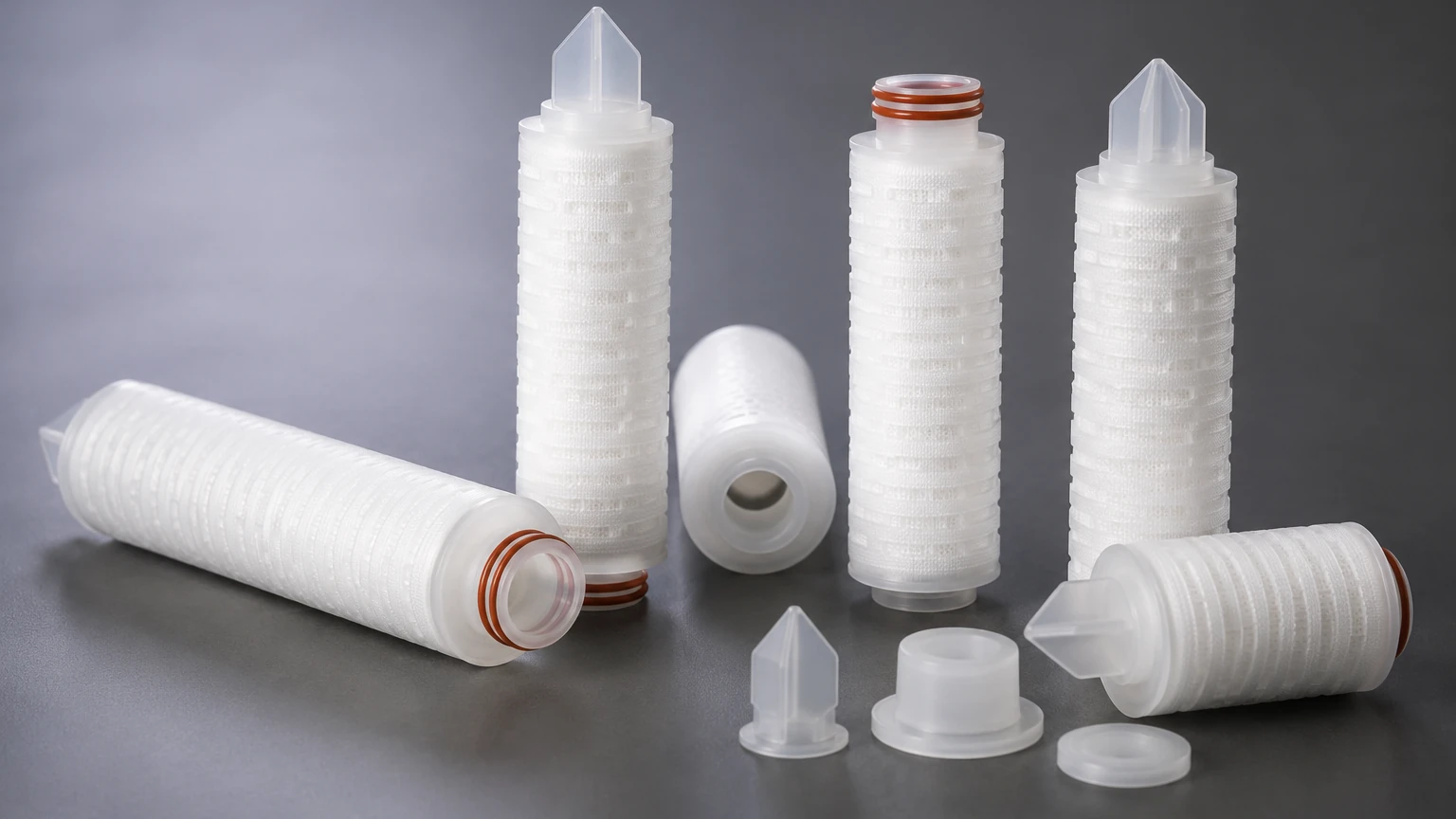
A capsule filter is a self-contained, disposable filtration unit. Unlike traditional filter cartridges that require a separate stainless steel or plastic housing, the capsule integrates the filter media and the housing into a single, pre-assembled component.
Structural Design
The internal structure of a capsule filter PVDF typically consists of a pleated PVDF membrane supported by polypropylene or polyester layers. The pleating increases the effective filtration area (EFA), allowing for higher flow rates and increased dirt-holding capacity within a compact footprint. The outer shell is usually thermally welded to the end caps, ensuring a leak-proof construction without the use of adhesives or resins that could introduce contaminants.
Operational Advantages
1. Reduced Contamination Risk: Since the filter is self-contained, operators are not exposed to the process fluid during replacement, and the fluid is protected from environmental contaminants.
2. Ease of Installation: Capsules often feature various connection options, such as NPT threads, hose barbs, or sanitary flanges, allowing for rapid integration into existing piping systems.
3. Scalability: Capsule filters are available in various sizes, from small laboratory-scale units to large-capacity industrial versions, facilitating a seamless transition from R&D to full-scale production.
Hydrophobic vs. Hydrophilic PVDF Membranes
One of the most important distinctions in selecting a capsule filter PVDF is the surface chemistry of the membrane. PVDF is naturally hydrophobic, but it can be chemically modified to be hydrophilic.
Hydrophobic PVDF
Natural PVDF repels water. This property is utilized in gas filtration and venting applications. Hydrophobic PVDF capsule filters are used to:
* Filter compressed air and technical gases.
* Provide sterile venting for storage tanks and bioreactors.
* Protect vacuum pumps from moisture and particulate matter.
Hydrophilic PVDF
Through surface modification, PVDF membranes can be made hydrophilic, meaning they can be wetted by water and other aqueous liquids without the need for pre-wetting with alcohols. Hydrophilic PVDF capsule filters are preferred for:
* Sterile filtration of aqueous buffers and media.
* Clarification of biological fluids.
* Final filtration of high-purity water.
Key Industrial Applications
The versatility of the capsule filter PVDF allows it to serve multiple high-stakes industries where precision and reliability are non-negotiable.
Pharmaceutical and Biotechnology
In the pharmaceutical sector, PVDF capsules are used for the sterile filtration of liquids and gases. Their low protein binding ensures that biological yields are maximized. They are frequently used in the production of vaccines, monoclonal antibodies, and small-molecule injectables. Compliance with USP Class VI plastics biological reactivity tests is a standard requirement for these applications.
Semiconductor and Microelectronics
The manufacture of microelectronics requires ultra-pure chemicals and deionized water. PVDF capsule filters are employed to remove sub-micron particulates from photoresists, developers, and etching chemicals. Their chemical robustness ensures that the membrane does not shed fibers or leach ions that could ruin sensitive silicon wafers.
Chemical Processing and Fine Chemicals
For the filtration of specialty chemicals, solvents, and aggressive acids, PVDF provides the necessary durability. Engineers often specify PVDF when the process fluid is too aggressive for standard polymers but does not require the extreme (and more expensive) resistance of PTFE.
Engineering Evaluation and Selection Criteria
When specifying a capsule filter PVDF for an industrial process, several technical parameters must be evaluated to ensure performance and cost-effectiveness.
Pore Size Rating
PVDF membranes are available in various pore sizes, typically ranging from 0.1 μm to 1.0 μm. For sterile filtration, a 0.22 μm absolute-rated membrane is standard, as it is validated for the removal of *Brevundimonas diminuta*, the benchmark organism for sterile filtration.
Flow Rate and Pressure Drop
The relationship between flow rate and differential pressure (ΔP) is critical. A higher EFA (Effective Filtration Area) generally results in a lower initial ΔP and a longer service life. Engineers must calculate the required flow rate and ensure the selected capsule size can handle it without exceeding the maximum allowable pressure drop.
Sterilization Compatibility
Depending on the application, the capsule may need to be sterilized. Most PVDF capsule filters are compatible with autoclaving or gamma irradiation. However, if In-Situ Steam (SIP) sterilization is required, the engineer must confirm that the capsule housing and internal supports are rated for the specific temperature and pressure of the steam cycle.
Integrity Testing
In critical applications, the integrity of the filter must be verified before and after use. Common methods include the Bubble Point test and the Diffusion Flow test. PVDF membranes are well-suited for these tests, providing clear and repeatable results that confirm the filter's ability to meet its rated retention efficiency.
Integration with Industrial Systems
While capsule filters are often plastic-based, they frequently operate within larger systems that utilize stainless steel components. For instance, a high-performance filtration skid might use Kaifil’s custom stainless steel housings for pre-filtration stages, followed by a PVDF capsule filter for final polishing or sterile venting.
For more information on high-performance filtration components and custom manufacturing capabilities, professionals can Review product options and application support on the Kaifil Main Page. Integrating specialized metal filtration components with high-performance polymer capsules allows for a robust, hybrid approach to complex industrial challenges.
Common Risks and Mitigation in Filter Selection
Failure to properly vet a capsule filter PVDF can lead to process downtime or product contamination. Common risks include:
* Chemical Incompatibility: Using a PVDF filter with a solvent that causes the membrane to swell or the housing to crack. Always consult a chemical compatibility chart.
* Inadequate Venting: If air is trapped within the capsule during liquid filtration, it reduces the effective filtration area and can lead to premature clogging or erratic flow. Most industrial capsules include a vent valve to mitigate this.
* Excessive Differential Pressure: Operating a filter beyond its rated ΔP can cause "breakthrough," where contaminants are forced through the membrane, or structural failure of the pleat pack.
Total Cost of Ownership (TCO)
While the unit price of a capsule filter PVDF is a factor, the Total Cost of Ownership includes the frequency of replacement, the cost of labor for change-outs, and the potential cost of product loss due to filtration failure. A high-quality PVDF membrane that offers a longer service life and higher reliability often results in a lower TCO than a cheaper alternative that requires frequent replacement or risks process integrity.
Conclusion
The capsule filter PVDF is a sophisticated tool designed for the most demanding industrial filtration environments. By combining the chemical and thermal advantages of PVDF membranes with the convenience and safety of a self-contained capsule, these filters provide a reliable solution for maintaining process purity. Whether used in the sterile filtration of pharmaceuticals or the purification of microelectronic chemicals, the PVDF capsule remains a cornerstone of modern process engineering.
When selecting a filtration solution, engineers should balance the technical requirements of the fluid with the operational goals of the facility, ensuring that every component—from the primary membrane to the secondary stainless steel supports—is optimized for the task at hand.
