


Titanium Heat Exchangers
In the landscape of industrial thermal management, titanium heat exchangers represent a pinnacle of engineering for environments where standard materials fail. These components are essential in industries ranging from chemical processing and marine engineering to power generation and pharmaceuticals. Because titanium offers an exceptional strength-to-weight ratio and unparalleled resistance to corrosion, it is often the material of choice for handling aggressive media such as seawater, chlorides, and various organic acids.
For engineers and procurement teams, selecting the right heat exchanger involves more than just calculating thermal loads. It requires a comprehensive understanding of material compatibility, fluid dynamics, and the protective measures—such as high-precision filtration—necessary to maintain system integrity over a long service life. This guide examines the technical specifications, application benefits, and critical maintenance considerations of titanium heat exchangers.
Material Advantages: Why Titanium is Specified for Harsh Environments
The primary driver behind the selection of titanium for heat transfer equipment is its chemical stability. Unlike stainless steel or copper-nickel alloys, titanium forms a tenacious, protective oxide film (TiO2) almost instantaneously when exposed to oxygen. This film is highly stable and self-healing, providing a barrier against localized corrosion, pitting, and stress corrosion cracking.
Corrosion Resistance in Saline and Acidic Media
Titanium heat exchangers are most frequently deployed in applications involving seawater. While stainless steels like 316L are susceptible to pitting and crevice corrosion in high-chloride environments, titanium remains virtually immune at temperatures up to 130°C (266°F). This makes it the standard for offshore oil and gas platforms, coastal power plants, and desalination facilities. Furthermore, titanium exhibits excellent resistance to nitric acid, chromic acid, and organic acids, provided that oxidizing conditions are maintained.
High Strength-to-Weight Ratio
From an engineering perspective, titanium's mechanical properties allow for thinner wall thicknesses in tubing and plates compared to other metals. This high strength-to-weight ratio not only reduces the overall footprint of the heat exchanger but also compensates for titanium’s lower thermal conductivity relative to copper or aluminum. By utilizing thinner materials, engineers can achieve efficient heat transfer rates without compromising the structural integrity of the pressure vessel.
Common Configurations: Shell and Tube vs. Plate Heat Exchangers
Titanium heat exchangers are typically manufactured in two primary configurations: shell and tube or plate-and-frame. The choice between these depends on the operating pressure, temperature, and the nature of the fluids being processed.
Titanium Shell and Tube Heat Exchangers
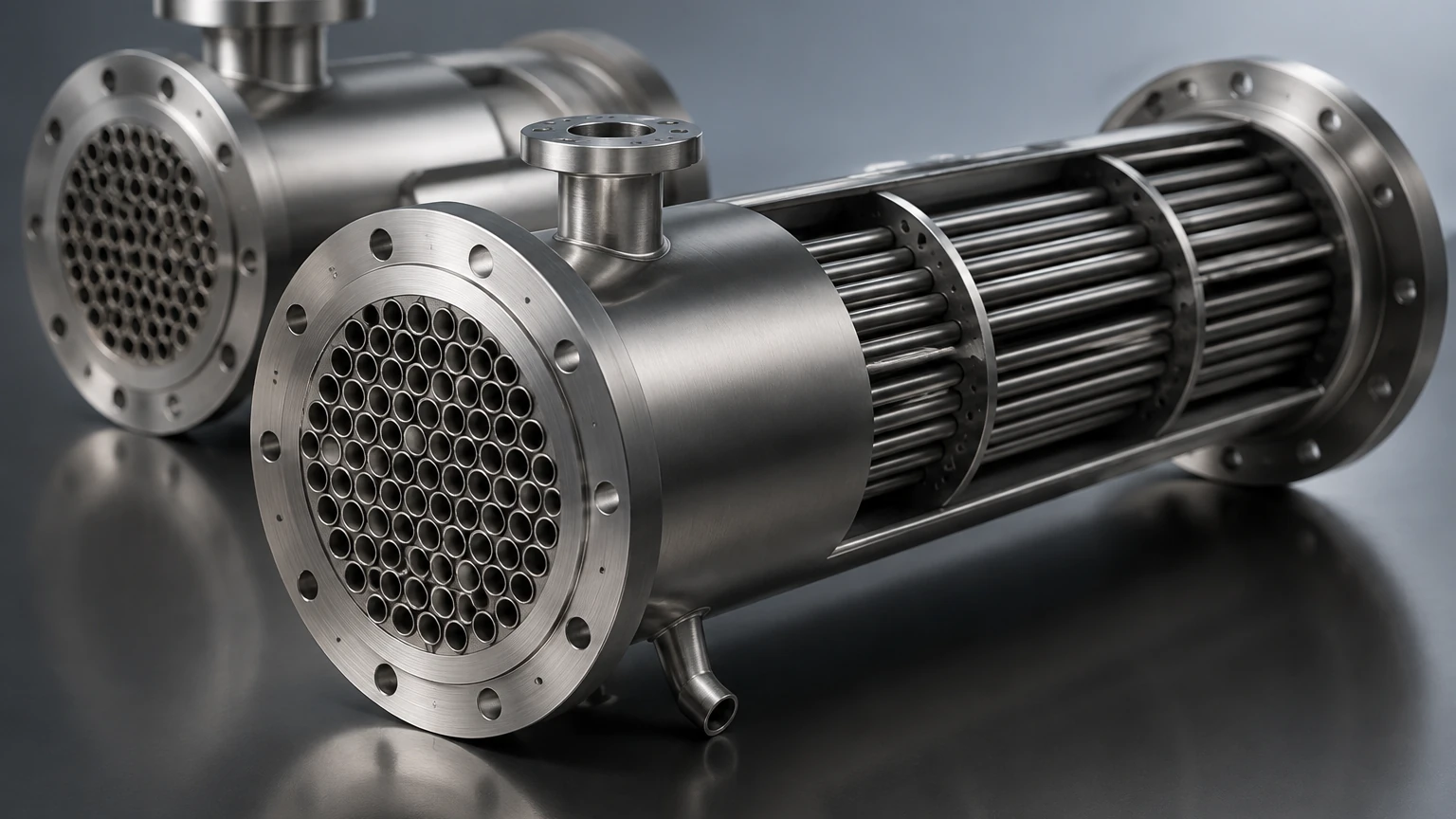
This is the most traditional design, consisting of a series of titanium tubes housed within a cylindrical shell. They are preferred for high-pressure applications (exceeding 30 bar) and processes where there is a significant temperature difference between the two fluids. Shell and tube designs are also easier to mechanically clean, making them suitable for fluids with a higher risk of macro-fouling. Engineers often specify titanium tubes with titanium-clad carbon steel tube sheets to balance cost and performance.
Titanium Plate Heat Exchangers (PHE)
Plate heat exchangers utilize corrugated titanium plates to create a large surface area for heat transfer in a compact space. The corrugations induce turbulence at low fluid velocities, which significantly enhances the heat transfer coefficient and helps reduce the rate of fouling. PHEs are ideal for applications with tight temperature approaches (where the temperature difference between the hot and cold fluid is minimal). However, they are generally limited to lower operating pressures compared to shell and tube designs.
Critical Engineering Considerations for Thermal Performance
Designing a system around titanium heat exchangers requires careful attention to fluid velocity and fouling factors. While titanium is highly resistant to erosion-corrosion, the efficiency of the heat transfer is heavily dependent on maintaining clean surfaces.
Heat Transfer Coefficients and Fouling
Fouling—the accumulation of unwanted material on heat transfer surfaces—is the primary enemy of efficiency. In titanium systems, fouling can take the form of scale, biological growth, or particulate deposition. Because titanium is more expensive than traditional alloys, engineers often design for higher fluid velocities (typically 2 to 4 meters per second) to create a "self-cleaning" effect through shear stress. However, high velocities increase the risk of particulate-induced erosion if the fluid is not properly filtered.
Thermal Conductivity and Design Optimization
Titanium has a lower thermal conductivity (approximately 15.6 W/m·K) than many other metals used in heat exchangers. To overcome this, designers use "enhanced surface" tubes or specific plate patterns to increase the surface area and promote turbulence. By optimizing the geometry, the overall heat transfer coefficient (U-value) can be kept competitive with more conductive materials while providing much greater longevity.
Protecting Heat Exchangers with Precision Filtration Systems
One of the most overlooked aspects of heat exchanger performance is the quality of the influent fluid. Even the most robust titanium heat exchangers can suffer from reduced efficiency or mechanical damage if particulates are allowed to enter the system. This is where high-quality filtration components become essential.
To ensure the longevity of titanium surfaces, industrial processes often integrate stainless steel wire mesh filters or custom filter cartridges. These components serve as the first line of defense, removing suspended solids, sand, and biological debris that could settle in the low-velocity zones of the heat exchanger or cause abrasive wear on the titanium plates. For organizations looking to optimize their filtration stages, it is advisable to Review product options and application support to find the correct micron rating and material compatibility for their specific industrial environment.
Using a precision-engineered stainless steel filter from a manufacturer like Kaifil ensures that the delicate titanium surfaces remain free from debris. This is particularly critical in plate heat exchangers, where the narrow channels between plates can easily become clogged, leading to localized hotspots and decreased thermal efficiency.
Maintenance Protocols and Lifecycle Management
While titanium heat exchangers are designed for durability, they are not "set and forget" components. A structured maintenance program is necessary to ensure they meet their expected 20- to 30-year service life.
Cleaning-In-Place (CIP)
For plate heat exchangers, CIP is the preferred method for removing scale and organic buildup. Because titanium is resistant to a wide range of chemicals, stronger acid or alkaline cleaners can often be used compared to those safe for copper-based exchangers. However, it is vital to ensure that the gaskets and other seals within the system are also compatible with the cleaning agents.
Mechanical Cleaning and Inspection
In shell and tube designs, mechanical cleaning using brushes or high-pressure water jets is common. During these maintenance intervals, engineers should perform eddy current testing or ultrasonic thickness gauging to check for any signs of mechanical wear or vibration-induced damage. While titanium does not corrode easily, it can be susceptible to mechanical fatigue if the support structures or baffles are not correctly maintained.
Monitoring Pressure Drop
An increase in pressure drop across the heat exchanger is the most reliable indicator of fouling. By installing differential pressure sensors, operators can schedule maintenance based on actual performance degradation rather than arbitrary time intervals. This proactive approach reduces downtime and prevents the system from running at sub-optimal efficiency.
Procurement Checklist: What Engineers Must Confirm
When sourcing titanium heat exchangers, the procurement process must be guided by technical data rather than price alone. Because of the material cost, errors in specification can be extremely expensive.
1. Material Grade: Confirm whether the application requires Grade 1 or Grade 2 titanium (unalloyed) or a palladium-stabilized grade (like Grade 7 or Grade 11) for enhanced resistance to crevice corrosion in reducing acid environments.
2. Design Codes: Ensure the unit is designed and stamped according to relevant codes, such as ASME Section VIII Division 1 or PED 2014/68/EU.
3. Filtration Requirements: Determine the maximum allowable particle size for the heat exchanger. If the system handles raw seawater or process fluids with high solids content, specify a stainless steel mesh filter or cartridge system upstream to protect the titanium components.
4. Gasket Compatibility: For plate heat exchangers, the gasket material (NBR, EPDM, Viton) must be as chemically resistant as the titanium plates themselves.
5. Total Cost of Ownership (TCO): Evaluate the higher initial capital expenditure (CAPEX) against the reduced maintenance costs and longer replacement cycles (OPEX). In many corrosive applications, titanium provides a lower TCO over a 10-year period compared to cheaper alloys that require frequent replacement.
Conclusion
Titanium heat exchangers are a critical investment for demanding industrial processes. Their ability to withstand aggressive chemical environments and high temperatures makes them indispensable for modern chemical and marine engineering. However, the performance of these systems is inextricably linked to the purity of the fluids passing through them. By pairing titanium's corrosion resistance with precision filtration solutions—such as the stainless steel wire mesh and filter cartridges provided by Kaifil—engineers can ensure maximum thermal efficiency and a significantly extended equipment lifespan. For more information on custom filtration components that protect high-value industrial equipment, visit the Kaifil Main Page.
