


Pneumatic Filter Food Grade
In the food and beverage industry, compressed air is often referred to as the "fourth utility." It is used extensively for powering pneumatic actuators, conveying raw ingredients, cleaning containers, and packaging finished products. However, because compressed air often comes into direct or indirect contact with food products, the integrity of the filtration system is paramount. Selecting a pneumatic filter food grade solution involves understanding complex regulatory standards, material compatibility, and engineering specifications to ensure both product safety and system efficiency.
Industrial filtration in food processing environments requires more than just basic particulate removal. It demands a specialized approach to hygiene, corrosion resistance, and the elimination of contaminants such as oil aerosols, moisture, and microorganisms. For engineers and procurement teams, the challenge lies in balancing high filtration efficiency with the durability required for rigorous cleaning cycles and continuous operation.
Regulatory Standards and Compressed Air Quality
When specifying a pneumatic filter food grade system, the first point of reference is the international standard for compressed air quality, ISO 8573-1. This standard categorizes air quality into classes based on the concentration of solid particles, water, and oil. In food-grade applications, the requirements are typically stringent:
1. Solid Particles: Filters must remove particles down to the sub-micron level to prevent physical contamination and the nesting of bacteria.
2. Water: Moisture must be controlled to prevent the growth of mold and fungi within the pneumatic lines.
3. Oil: Total oil (liquid, aerosol, and vapor) must be minimized, especially in oil-free environments or where "technically oil-free" air is required to prevent rancidity or flavor tainting in food products.
Beyond ISO standards, materials used in the construction of the filter housing and the filter media must comply with FDA (Food and Drug Administration) regulations or EC 1935/2004 in Europe. These regulations ensure that the components do not migrate harmful substances into the air stream and, subsequently, into the food product.
Material Selection: The Case for Stainless Steel
In food-grade pneumatic systems, material selection is not merely a matter of performance but a matter of compliance and longevity. While standard industrial filters may use aluminum or plastic housings, a pneumatic filter food grade unit typically utilizes high-grade stainless steel, such as 304 or 316L.
Corrosion Resistance
Stainless steel is inherently resistant to the corrosive environments found in food processing plants, where frequent washdowns with caustic chemicals and high-pressure steam are common. Unlike carbon steel or aluminum, stainless steel does not flake or oxidize, which could otherwise introduce metallic contaminants into the air stream.
Surface Finish and Cleanability
Engineering a food-grade filter requires attention to the surface finish. Smooth surfaces (often measured by Ra, or roughness average) prevent the accumulation of organic matter and simplify the sterilization process. For many food-grade applications, an electropolished finish is preferred to ensure that the internal surfaces of the filter housing are as smooth as possible, minimizing the risk of microbial growth.
Durability under Pressure
Pneumatic systems operate under significant pressure, often ranging from 7 to 10 bar (100–145 psi) or higher in specialized applications like PET bottle blowing. Stainless steel filter cartridges, particularly those using sintered metal or multi-layer wire mesh, provide the structural integrity needed to withstand these pressures and the potential for pressure spikes without collapsing or bypassing.
Types of Filtration in Food-Grade Pneumatic Systems
Achieving food-grade air quality usually requires a multi-stage filtration approach. Each stage addresses a specific type of contaminant to protect the downstream process and the final product.
1. Pre-Filtration (Particulate Removal)
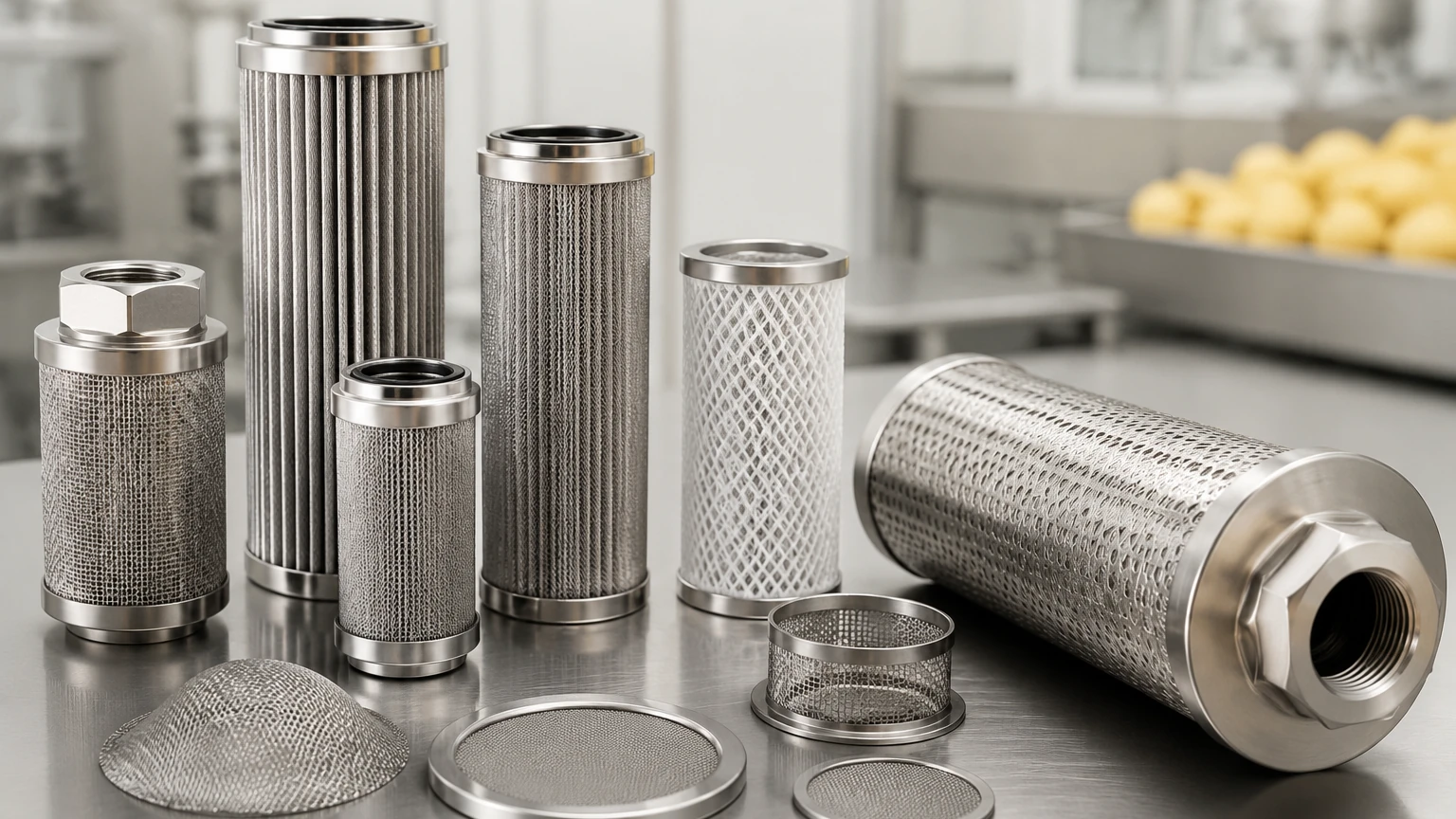
The first stage typically involves a high-capacity particulate filter. These filters are designed to remove larger debris, pipe scale, and bulk moisture. In a food-grade context, these are often made of pleated stainless steel wire mesh, which offers a high surface area and can be cleaned and reused, reducing the total cost of ownership.
2. Coalescing Filtration (Oil and Aerosol Removal)
Coalescing filters are critical for removing oil aerosols and fine water droplets. They work by forcing the air through a dense mat of fibers where small droplets collide and merge into larger drops that then drain away. For food-grade applications, it is essential that the binding agents and fibers used in these filters are inert and FDA-compliant.
3. Adsorption Filtration (Vapor Removal)
Even after coalescing, oil vapors and odors may remain in the air. Activated carbon filters are used to adsorb these gaseous contaminants. This is particularly important in applications where the air is used for "sparging" (bubbling air through a liquid) or where the air comes into direct contact with sensitive ingredients like dairy or chocolate, which easily absorb off-flavors.
4. Sterile Filtration
In the most sensitive applications—such as aseptic packaging—a sterile filter is the final line of defense. These filters are designed to remove 100% of bacteria and viruses. Sintered stainless steel fiber felt is a common choice here, as it can be sterilized in place (SIP) using steam, ensuring the filter remains a barrier rather than a source of contamination.
Engineering Selection Criteria for Purchasing Teams
When evaluating a pneumatic filter food grade solution, engineers must look beyond the micron rating. Several technical factors influence the performance and reliability of the system.
Flow Rate and Pressure Drop
Every filter introduces a restriction to the air flow, known as pressure drop (delta P). A high pressure drop forces the compressor to work harder, increasing energy costs. Engineers should select a filter sized correctly for the maximum flow rate of the application to keep the initial pressure drop low (typically under 0.1 to 0.2 bar for a clean filter).
Filtration Accuracy (Micron Rating)
It is important to distinguish between "nominal" and "absolute" micron ratings. A nominal rating indicates the filter can trap a percentage of particles of a certain size, while an absolute rating guarantees the capture of all particles above that size. For food safety, absolute ratings are generally required for final-stage filtration.
Sealing Materials
The gaskets and O-rings within the filter housing must also be food-grade. Common materials include EPDM, Silicone, or Viton (FKM), provided they are certified for food contact. These seals must remain resilient under temperature fluctuations and exposure to cleaning agents to prevent leaks.
Maintenance and Total Cost of Ownership
While the initial purchase price of a high-quality pneumatic filter food grade unit is an important factor, the long-term operational costs often carry more weight. Stainless steel filtration solutions from manufacturers like Kaifil offer distinct advantages in this regard.
* Cleanability: Unlike disposable plastic or paper elements, stainless steel mesh and sintered filters can often be cleaned using ultrasonic baths or back-flushing. This extends the service life of the element significantly.
* Replacement Cycles: Monitoring the pressure drop across the filter is the most effective way to determine when a filter needs cleaning or replacement. Many modern systems include differential pressure gauges to alert maintenance teams before the filter becomes a bottleneck.
* Integrity Testing: In high-risk food environments, the ability to perform integrity tests (such as the bubble point test) on the filter elements ensures that the filtration barrier has not been compromised by mechanical stress or improper installation.
Customization and OEM Integration
Many food processing machines have unique spatial constraints or specific connection requirements (such as Tri-Clamp or DIN sanitary fittings). Working with a manufacturer capable of providing custom stainless steel filtration solutions allows engineers to integrate the pneumatic filter food grade directly into the machine design, rather than relying on bulky off-the-shelf adapters.
Customization options often include:
* Specific housing dimensions to fit tight cabinets.
* Custom micron ratings tailored to unique ingredient particle sizes.
* Integrated drainage systems for automatic condensate removal.
* High-temperature versions for applications involving hot air or steam-jacketed lines.
For those seeking comprehensive technical specifications or customized engineering support for industrial filtration, visiting the Main Page provides access to a wide range of stainless steel filter cartridges and precision metal components designed for demanding industrial environments.
Conclusion
Implementing a pneumatic filter food grade strategy is a critical component of food safety management systems like HACCP (Hazard Analysis and Critical Control Points). By selecting filters constructed from high-grade stainless steel and designed to meet international air quality standards, food processors can protect their products from contamination, ensure regulatory compliance, and optimize the efficiency of their pneumatic systems.
Whether the application involves simple pneumatic actuation or direct contact with sensitive food ingredients, the choice of filtration media and housing design should be guided by engineering rigor. Investing in durable, cleanable, and high-performance filtration components not only safeguards the consumer but also protects the manufacturer's brand reputation and operational bottom line.
