


1 x 1 Woven Wire Mesh: Engineering Specifications and Industrial Applications
In the landscape of industrial filtration and material separation, the term "1 x 1" refers to one of the coarsest configurations available in the wire cloth industry. Specifically, a 1 x 1 woven wire mesh indicates one opening per linear inch in both the warp and shute directions. While finer meshes are often the focus of high-precision liquid filtration, coarse meshes like the 1 x 1 variety serve as the critical structural backbone for complex filtration systems, safety enclosures, and heavy-duty screening operations.
For engineers and procurement professionals, selecting the correct Plain, twill and dutch woven wire mesh in SS304/316L — rolls, cut mesh and framed panels. Send mesh count or micron target for a technical quote. requires a deep understanding of wire diameter, open area percentages, and material performance under mechanical stress. This guide examines the technical parameters of 1 x 1 woven wire mesh, its role in industrial environments, and the engineering considerations necessary for optimal integration.
Defining 1 x 1 Woven Wire Mesh in Industrial Contexts
To understand the 1 x 1 mesh, one must first distinguish between "mesh count" and "clear opening." In a 1 x 1 mesh, the count is exactly one wire per inch. However, the actual physical space through which a medium passes—the clear opening—is determined by subtracting the wire diameter from the center-to-center distance of the wires.
For example, if a 1 x 1 mesh utilizes a 0.063-inch wire diameter, the clear opening is 0.937 inches. If a heavier 0.120-inch wire is used, the opening narrows to 0.880 inches. This distinction is vital for engineers calculating flow rates or particle retention. Unlike finer weaves that may utilize twill or dutch weave patterns to achieve micron-rated filtration, 1 x 1 mesh is almost exclusively produced using a plain weave pattern. In a plain weave, each shute wire passes alternately over and under each warp wire, creating a stable, square opening that offers predictable performance across the entire surface area.
Material Selection: Balancing Durability and Corrosion Resistance
The performance of a 1 x 1 woven wire mesh is heavily dependent on the alloy selected. Because these meshes are often exposed to harsh industrial environments or used as the primary support for finer filter media, the material must withstand both chemical attack and mechanical wear.
Stainless Steel 304
As the industry standard, SS304 provides excellent durability and basic corrosion resistance. It is suitable for most general industrial applications, including safety guards, architectural panels, and non-corrosive fluid screening. It offers a cost-effective solution when the environment does not contain high concentrations of chlorides or acids.
Stainless Steel 316L
For applications involving chemical processing, marine environments, or pharmaceutical production, SS316L is the preferred choice. The addition of molybdenum enhances its resistance to pitting and crevice corrosion, particularly in chloride-rich environments. The "L" designation signifies low carbon content, which is essential if the mesh is to be welded into frames or support structures, as it prevents carbide precipitation that could lead to intergranular corrosion.
Specialty Alloys
In extreme cases involving high temperatures or highly aggressive chemicals, alloys such as Monel, Inconel, or Hastelloy may be required. These materials ensure that the 1 x 1 mesh maintains its structural integrity even when the filtration system is subjected to thermal cycling or acidic wash-downs.
Engineering Calculations: Open Area and Flow Capacity
One of the primary reasons engineers specify a 1 x 1 woven wire mesh is its high percentage of open area. This characteristic allows for maximum flow with minimal pressure drop (delta P). In filtration systems, this mesh often serves as the "trash screen" or the first stage of a multi-stage system, capturing large debris before it can damage downstream pumps or clog finer filter cartridges.
To calculate the percentage of open area in a 1 x 1 mesh, the following formula is used:
Open Area % = (Opening Size² / Center-to-Center Distance²) x 100
Given that the center-to-center distance for a 1 x 1 mesh is exactly 1 inch, the calculation simplifies to the square of the opening size multiplied by 100. A mesh with a 0.080-inch wire diameter results in a 0.920-inch opening, yielding an open area of approximately 84.6%. This high transparency to flow makes it an ideal candidate for intake screens and high-velocity air filtration assemblies.
When evaluating flow capacity, engineers must also consider the "tortuosity" of the path. In a plain weave 1 x 1 mesh, the path is relatively direct, which minimizes turbulence. This is a critical factor in hydraulic systems where maintaining laminar flow is essential for system efficiency.
Structural Integrity and Support Applications
Beyond simple screening, 1 x 1 woven wire mesh is frequently employed as a support structure for finer filtration media. In large-scale industrial filter cartridges, a fine stainless steel mesh (such as a 100 or 200 mesh) lacks the inherent rigidity to withstand high differential pressures. By layering the fine mesh against a 1 x 1 or similar coarse mesh, the assembly gains the necessary mechanical strength to prevent media migration or pleat collapse.
Support for Sintered Media
In sintered metal fiber or multi-layer mesh laminates, the 1 x 1 mesh acts as the drainage layer. It provides a gap between the active filtration layer and the perforated core of the filter housing, ensuring that the entire surface area of the fine media is utilized rather than just the areas directly over the perforations.
Mechanical Guards and Enclosures
In heavy machinery environments, 1 x 1 mesh is used for safety enclosures. The wire diameter is selected based on the required impact resistance. A 1 x 1 mesh with a 0.135-inch wire (10 gauge) provides significant protection against flying debris while maintaining visibility and airflow for cooling. This dual-purpose functionality—protection and ventilation—is a hallmark of coarse woven wire mesh applications.
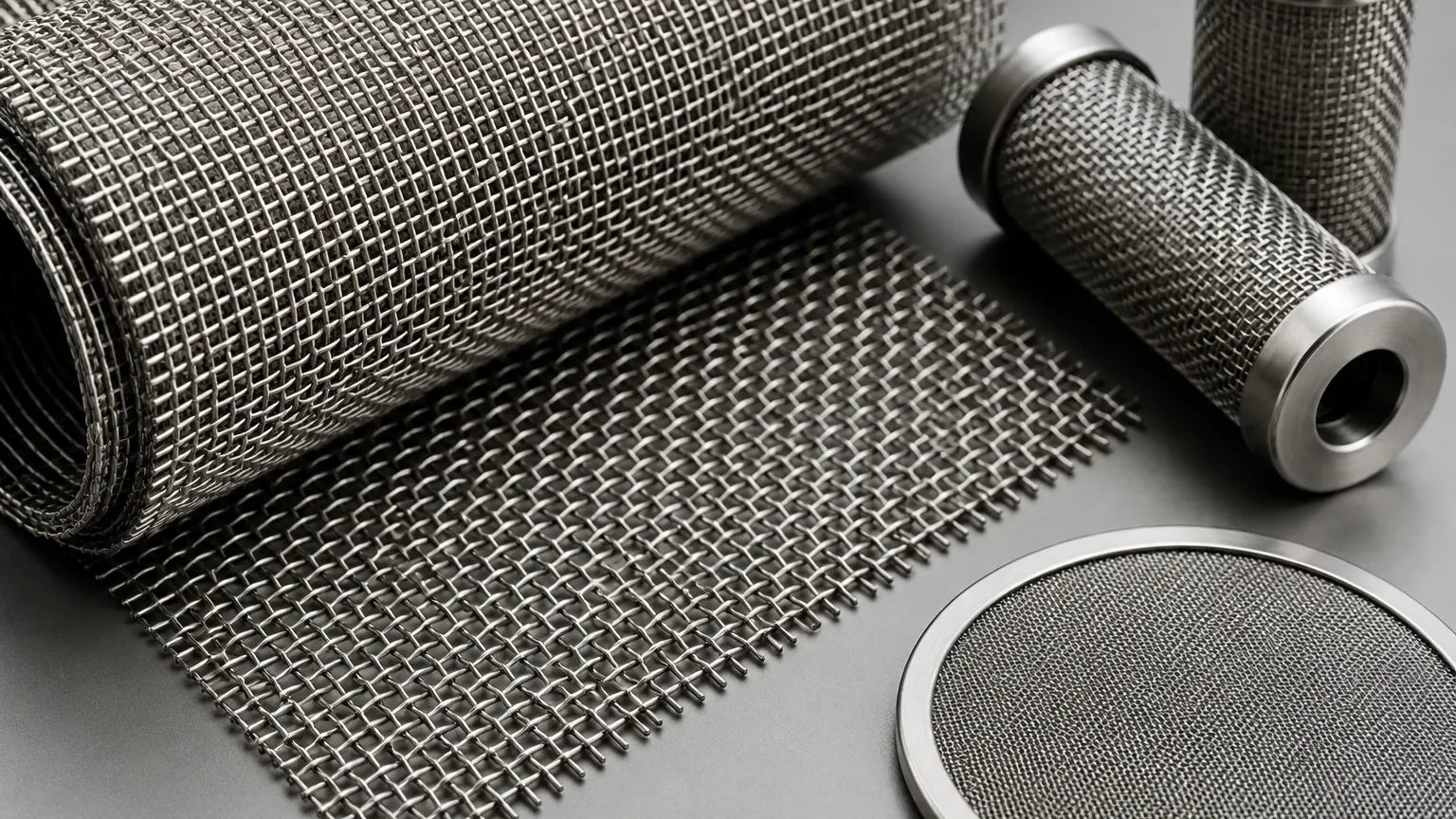
Customization and Secondary Processing for 1 x 1 Mesh
While 1 x 1 woven wire mesh is available in standard rolls, most industrial applications require secondary processing to meet specific engineering tolerances. Kaifil specializes in transforming raw mesh into functional components through several precision methods:
1. Precision Slitting and Cutting: For integration into filter housings, mesh must be cut to exact dimensions. This includes circular discs for plate filters or rectangular panels for shaker screens. Precision cutting ensures that the edges do not fray, which is critical for maintaining the integrity of the seal.
2. Framing and Edging: To facilitate installation and improve safety, 1 x 1 mesh panels can be equipped with U-binders or welded frames. This provides a rigid edge that can be bolted or clamped into place without risking wire displacement.
3. Forming and Welding: Coarse mesh can be rolled into cylinders to create pre-filter baskets or support cages. Resistance welding or TIG welding is used to join the mesh seams, ensuring that the joint is as strong as the base material.
4. Surface Treatments: Depending on the application, the mesh may undergo electropolishing to remove burrs and improve corrosion resistance, or ultrasonic cleaning to ensure it meets the stringent cleanliness standards of the food and beverage or pharmaceutical industries.
Procurement and Quality Assurance Checklist
When sourcing 1 x 1 woven wire mesh for a project, purchasing teams and engineers should confirm several key data points to ensure the product meets the intended performance specifications. Relying on a manufacturer with deep technical expertise, such as Kaifil, helps mitigate the risks associated with material non-compliance or structural failure.
* Wire Gauge Confirmation: Specify the wire diameter in decimals (e.g., 0.080") rather than just gauge numbers to avoid ambiguity between different gauge standards (AWG vs. SWG).
* Alloy Certification: Request Mill Test Reports (MTRs) to verify the chemical composition of the stainless steel, ensuring it meets the ASTM standards for SS304 or SS316L.
* Dimensional Tolerance: Define the allowable variance in the mesh opening and the overall panel dimensions. For support structures, flatness is often a critical tolerance.
* Edge Finish: Determine if the application requires a raw cut edge, a knuckled edge (where wires are bent back), or a framed edge.
* Quantity and Packaging: For large-scale projects, determine if the mesh should be supplied in bulk rolls or pre-cut pieces to reduce on-site labor costs.
Common Risks and Mitigation in Coarse Mesh Selection
The most common risk in specifying 1 x 1 mesh is underestimating the mechanical load. While the mesh appears robust, high-pressure surges in a fluid line can cause "wire stripping" if the mesh is not properly secured within its frame. Engineers should calculate the maximum expected pressure and ensure the wire diameter and welding method are sufficient to prevent the wires from shifting out of their 1-inch centers.
Another risk is galvanic corrosion. If a stainless steel 1 x 1 mesh is installed in a carbon steel frame in a moist environment, the mesh may accelerate the corrosion of the frame. Specifying compatible materials for the entire assembly is essential for long-term durability.
Conclusion
1 x 1 woven wire mesh is a foundational component in industrial filtration and structural design. Its high open area, combined with the strength of stainless steel alloys, makes it indispensable for applications ranging from heavy-duty pre-filtration to safety guarding. By focusing on precise wire diameters, material grades, and customization options, engineers can leverage this coarse mesh to enhance the reliability and efficiency of their systems. Whether used as a standalone screen or a support layer for sophisticated filter media, the 1 x 1 mesh remains a critical tool in the industrial engineering toolkit.
