


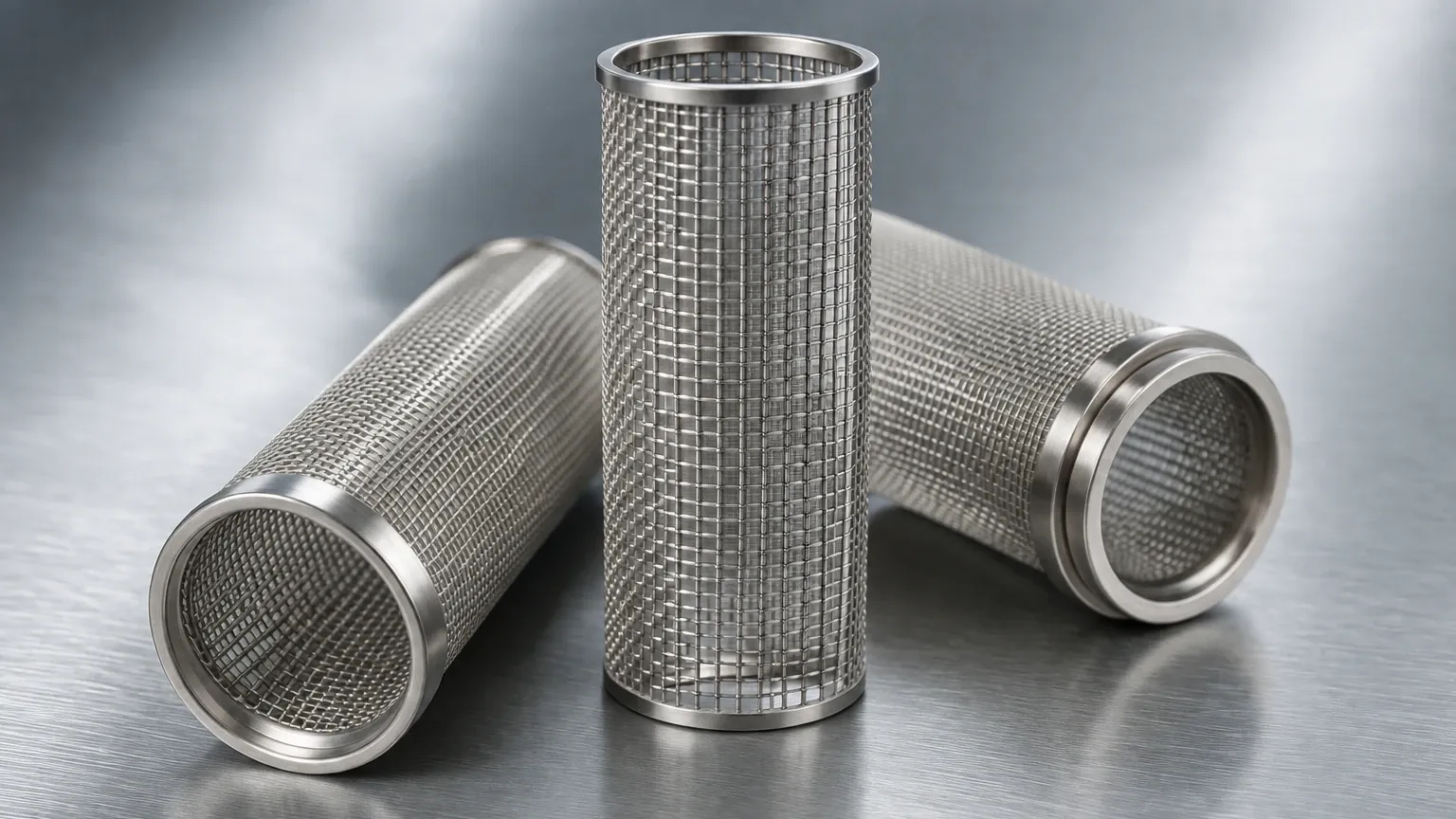
Wire Mesh Cylinder Strainer
In industrial processing, the integrity of a fluid system often depends on the efficiency of its primary filtration components. A wire mesh cylinder strainer serves as a critical line of defense, designed to remove solid particulates from liquids, gases, or steam. Unlike disposable filters, these cylindrical components are engineered for durability, precision, and reusability, making them a staple in chemical processing, hydraulic systems, and food production.
For engineers and procurement teams, selecting the right Wire Mesh Filter Cylinders & Tubes requires a deep understanding of material science, fluid dynamics, and mechanical design. This article explores the technical nuances of these components, providing the information necessary to optimize filtration performance and ensure long-term system reliability.
Engineering Fundamentals of Wire Mesh Strainers
The performance of a wire mesh cylinder strainer is dictated by the weave type and the material properties of the wire used. Stainless steel is the industry standard due to its mechanical strength and resistance to environmental degradation.
Material Selection: 304 vs. 316L
Material choice is the first decision point in the engineering process. Stainless steel 304 is suitable for general-purpose applications where basic corrosion resistance is required. However, in environments involving chlorides, high acidity, or pharmaceutical-grade requirements, 316L stainless steel is preferred. The lower carbon content in 316L minimizes carbide precipitation during welding, which is essential for maintaining the structural integrity of the cylinder's seams.
Weave Patterns and Filtration Characteristics
The geometry of the mesh determines the filtration accuracy (micron rating) and the flow resistance.
* Plain Weave: The most common and cost-effective, where each warp wire crosses over and under each weft wire. It provides high flow rates but is limited in its ability to capture very fine particles under high pressure.
* Twill Weave: Allows for thicker wires and a heavier mesh, making it suitable for high-load applications where the strainer must withstand significant differential pressure.
* Dutch Weave: This pattern uses a larger diameter for the warp wires and a smaller diameter for the weft wires, resulting in a dense, strong mesh with precise pore sizes. This is ideal for high-pressure filtration and fine particulate removal.
Structural Design and Mechanical Integrity
A wire mesh cylinder strainer is rarely just a piece of mesh rolled into a tube. To survive the rigors of industrial flow, it must be supported by a robust mechanical structure.
Reinforcement Layers
For applications involving high flow velocities or viscous fluids, a single layer of wire mesh may collapse. Engineers often specify a multi-layer construction. This typically involves a fine filtration mesh sandwiched between coarser support meshes or a perforated metal core. The perforated core provides the necessary hoop strength to prevent deformation, while the mesh layers handle the actual particulate capture.
Seam Welding and End Configurations
The method used to join the mesh edges is a critical failure point. High-quality Wire Mesh Filter Cylinders & Tubes utilize plasma or resistance welding to create a seamless-strength bond that does not introduce contaminants or significantly restrict flow.
Furthermore, the end caps or fittings must be designed to ensure a bypass-free seal. Common configurations include:
* Open Ends: Often used with gaskets in housing assemblies.
* Closed Ends: Featuring a solid metal cap to force all fluid through the mesh walls.
* Threaded or Flanged Fittings: For direct integration into piping systems without external housings.
Evaluating Filtration Efficiency and Performance Metrics
When specifying a wire mesh cylinder strainer, engineers must balance filtration fineness with the allowable pressure drop.
Micron Rating: Absolute vs. Nominal
It is vital to distinguish between nominal and absolute ratings. A nominal rating indicates the ability of the mesh to retain a majority of particulates of a certain size, while an absolute rating (often achieved through Dutch weaves) guarantees that no particle larger than the specified size will pass through. In critical hydraulic or pharmaceutical applications, absolute ratings are often mandatory to protect downstream equipment.
Effective Filtration Area (EFA)
The EFA is the total open area of the mesh through which fluid can pass. A higher EFA results in a lower initial pressure drop and a longer service life before the strainer becomes blinded by debris. When designing a system, maximizing the length or diameter of the cylinder can increase the EFA, thereby reducing the frequency of maintenance cycles.
Flow Velocity and Pressure Drop
As fluid passes through the wire mesh, a pressure differential ($ΔP$) is created. If the flow velocity is too high, the $ΔP$ can increase exponentially as the mesh begins to capture particles. Engineers must calculate the "clean pressure drop" to ensure the system pump can handle the resistance even when the strainer is partially loaded.
Customization for Demanding Industrial Applications
Standard off-the-shelf strainers often fail to meet the specific requirements of specialized industrial processes. Customization allows for the optimization of every variable, from the alloy used to the specific dimensions of the cylinder.
Chemical and Petrochemical Processing
In these sectors, strainers must withstand aggressive solvents and high temperatures. Custom-fabricated wire mesh cylinders can be produced from exotic alloys like Monel or Inconel if standard stainless steel is insufficient. Furthermore, the design may include specialized coatings to prevent chemical bonding of sticky resins to the mesh surface.
Food and Beverage Requirements
For food-grade applications, the wire mesh cylinder strainer must be free of crevices where bacteria can grow. This requires "sanitary" design principles, including smooth, continuous welds and high-polish finishes (often RA < 0.8 μm). The materials must also be FDA-compliant and capable of withstanding Clean-in-Place (CIP) procedures involving caustic chemicals and high-pressure steam.
Hydraulic and Lubrication Systems
In hydraulic circuits, the primary goal is protecting sensitive valves and pumps from metal shavings or environmental dust. These strainers often require high collapse pressure ratings, as the viscosity of cold hydraulic oil can create massive pressure spikes during system startup.
Maintenance and Longevity: Cleaning and Replacement Cycles
One of the primary advantages of a stainless steel wire mesh cylinder strainer is its cleanability. Unlike polymer-based cartridges, metal mesh can be restored to near-original performance through various cleaning methods.
Cleaning Techniques
1. Backwashing: Reversing the flow of fluid through the strainer to dislodge surface-level particulates. This is the most common method for automated systems.
2. Ultrasonic Cleaning: Using high-frequency sound waves in a solvent bath to create cavitation bubbles that scrub particulates from deep within the mesh pores. This is highly effective for Dutch weaves or multi-layer sintered mesh.
3. Chemical Cleaning: Using acids or bases to dissolve organic or mineral scaling. This requires careful material compatibility checks to ensure the cleaning agent does not pit the stainless steel.
Determining Replacement Cycles
While reusable, these components are not infinite. Fatigue from pressure cycling, erosion from abrasive particles, or damage during cleaning will eventually necessitate replacement. Engineers should monitor the "terminal pressure drop"—the point at which the pressure differential indicates the mesh is permanently blinded or structurally compromised. Regular visual inspections for broken wires or thinning mesh are also essential.
Total Cost of Ownership and Procurement Considerations
When evaluating the cost of a wire mesh cylinder strainer, the initial purchase price is only one component of the Total Cost of Ownership (TCO).
Initial Investment vs. Operational Savings
A high-quality, custom-engineered stainless steel strainer typically has a higher upfront cost than a standard or disposable alternative. However, the TCO is often much lower due to:
* Reduced Downtime: Durable construction leads to fewer unplanned failures.
* Lower Disposal Costs: Reusable filters eliminate the waste stream associated with disposable cartridges.
* Process Efficiency: Precisely engineered mesh ensures lower pressure drops, reducing the energy consumption of system pumps.
Technical Support and OEM Capabilities
Working with a manufacturer that offers OEM capabilities is crucial for complex projects. A manufacturer like Kaifil provides the technical expertise to assist in material selection and structural design, ensuring the final product meets the specific demands of the application. When sourcing Wire Mesh Filter Cylinders & Tubes, it is important to confirm the manufacturer's quality control processes, such as bubble point testing to verify micron ratings and hydrostatic testing to confirm structural integrity.
Conclusion
The wire mesh cylinder strainer is a deceptively simple component that requires sophisticated engineering to perform reliably in industrial environments. By focusing on material grade, weave geometry, and structural reinforcement, engineers can select a filtration solution that protects downstream equipment and optimizes process efficiency. Whether for high-pressure hydraulics or sanitary food processing, the transition from a standard filter to a precision-engineered wire mesh cylinder is a strategic investment in system longevity and operational excellence.
