


Expanded Metal Clips
In the realm of industrial filtration and structural engineering, the integrity of a system is often only as reliable as its fastening components. Expanded metal clips are specialized hardware designed to secure expanded metal panels to frames, supports, or other structural elements without compromising the material's physical properties. While the mesh itself provides the necessary filtration or protective barrier, the clips ensure that the assembly remains stable under mechanical stress, vibration, and environmental pressure. For engineers and procurement professionals, understanding the technical nuances of these clips is essential for optimizing the performance and lifespan of industrial installations.
The Functional Role of Expanded Metal Clips in Industrial Systems
Expanded metal clips serve as the critical interface between the mesh panel and the surrounding infrastructure. Unlike welding, which can create heat-affected zones that weaken the metal or alter its corrosion resistance, mechanical clips provide a secure attachment method that preserves the structural integrity of the base material. In applications such as industrial walkways, filtration housings, and machine guards, these clips distribute the load evenly across the mesh strands, preventing localized stress concentrations that could lead to premature failure.
There are several primary functions that expanded metal clips fulfill in a B2B context:
1. Structural Stability: They prevent the panels from shifting or rattling, which is particularly important in high-vibration environments like hydraulic systems or chemical processing plants.
2. Ease of Maintenance: Mechanical clips allow for the non-destructive removal of panels. This is a vital feature in filtration systems where filter cartridges or mesh screens must be periodically inspected or replaced.
3. Thermal Expansion Management: In high-temperature applications, metals expand and contract. Properly designed clips allow for a degree of movement, preventing the mesh from buckling or the fasteners from shearing.
4. Uniformity of Tension: For filtration applications, maintaining a flat and uniform surface is necessary for consistent flow rates. Clips ensure the mesh is held taut against its support frame.
Integrating Clips with Perforated & Expanded Metal Structures
The selection of fastening hardware is inextricably linked to the specifications of the mesh being used. Perforated & Expanded Metal products differ significantly in their geometry and load-bearing characteristics. Expanded metal is manufactured by slitting and stretching a solid metal sheet, creating a diamond-shaped pattern with interconnected strands and bonds. Because the material is not woven or welded, it possesses a unique three-dimensional profile that requires specific clip designs to ensure a flush fit.
When engineers specify expanded metal for filtration or guarding, they must consider the "opening size" (the dimensions of the diamond) and the "strand thickness." Standard expanded metal clips are often designed to hook over the bond—the point where the strands intersect—to provide maximum grip. In contrast, perforated metal, which consists of holes punched into a flat sheet, may utilize different fastening methods, such as flat washers and bolts. However, for the three-dimensional nature of expanded metal, specialized clips are necessary to bridge the gap between the raised strands and the flat mounting surface.
Mechanical Design and Selection Criteria for Fastening Components
Selecting the right expanded metal clips involves more than just matching the material; it requires a deep dive into the mechanical requirements of the application. Engineers typically evaluate clips based on several key criteria:
Clip Geometry and Type
There are various clip configurations available, each suited for different mounting scenarios:
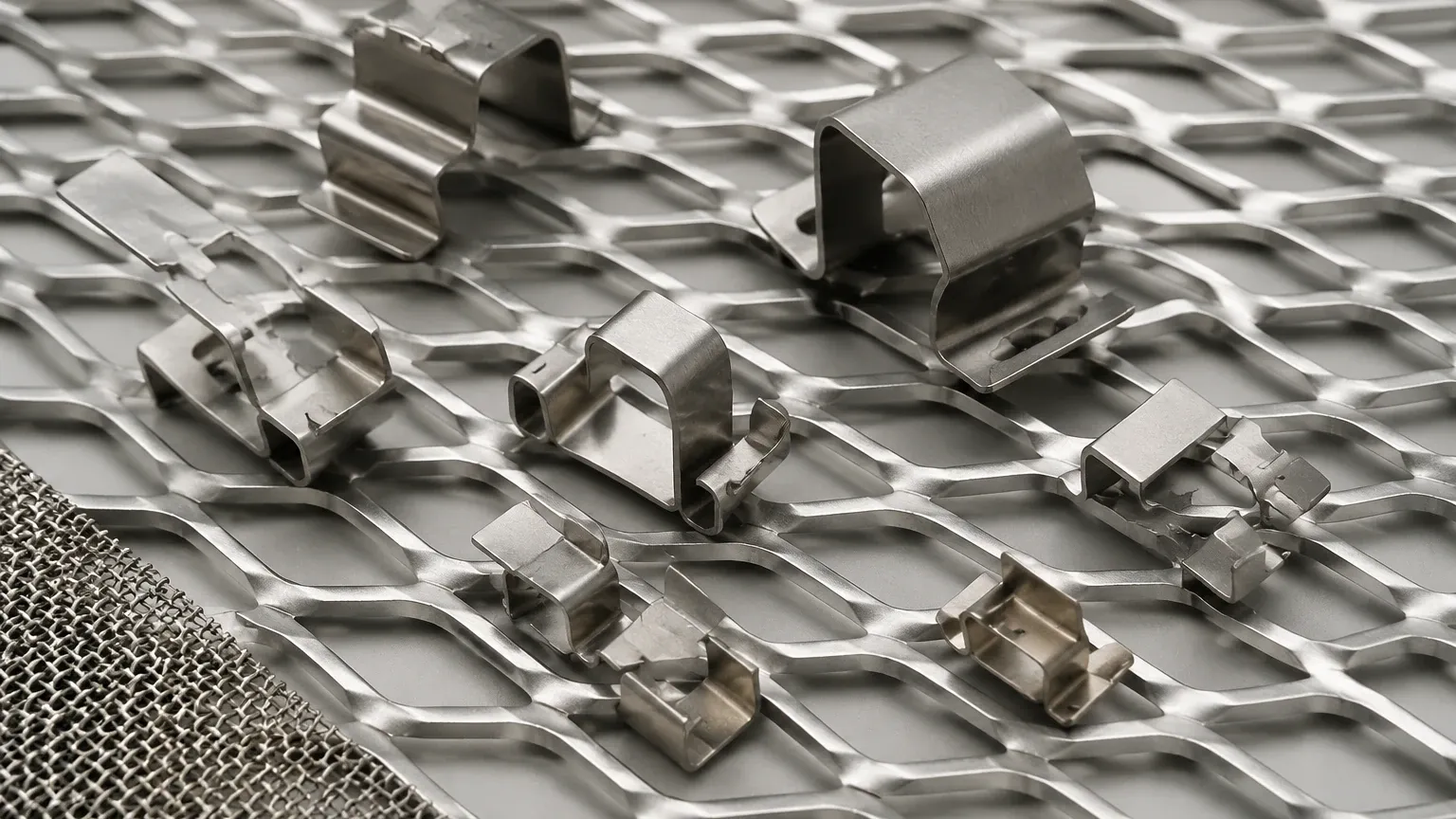
* U-Clips: These wrap around the edge of the mesh and the frame, providing a secure perimeter attachment. They are ideal for panels that are flush-mounted.
* G-Clips (Grating Clips): Often used for heavier expanded metal gratings, these clips use a friction-fit or bolt-through mechanism to secure the mesh to the top flange of a structural beam.
* L-Clips and J-Clips: These are used for offset mounting or when the mesh needs to be secured to an angle iron or tube frame.
Load-Bearing Capacity
In industrial flooring or heavy-duty filtration, the clips must withstand significant downward and upward forces. The shear strength of the bolt or screw used in conjunction with the clip must be calculated based on the maximum expected load. For filtration cartridges, the clips must resist the pressure drop (delta P) across the mesh to prevent the screen from dislodging.
Vibration Resistance
In hydraulic and pneumatic applications, constant vibration can cause standard fasteners to loosen. Engineers should look for expanded metal clips that can be used with lock washers, nylon-insert nuts, or those designed with a self-locking geometry to ensure long-term reliability.
Material Compatibility and Environmental Durability
One of the most common risks in industrial fastening is galvanic corrosion. This occurs when two dissimilar metals are in contact in the presence of an electrolyte (such as moisture or chemicals). To prevent this, it is a standard engineering requirement that expanded metal clips be manufactured from the same material as the mesh and the support frame, or a material that is cathodically compatible.
Kaifil specializes in stainless steel solutions, and for most industrial B2B applications, stainless steel clips are the preferred choice. The two most common grades are:
* Grade 304 Stainless Steel: Suitable for general industrial use, providing excellent strength and good corrosion resistance in most atmospheric conditions.
* Grade 316/316L Stainless Steel: Essential for marine environments, chemical processing, and food and beverage applications. The addition of molybdenum provides superior resistance to chlorides and pitting corrosion.
Beyond the base material, the finish of the clip also matters. For pharmaceutical or food-grade filtration, clips must be free of burrs and may require electropolishing to ensure a smooth, easy-to-clean surface that prevents bacterial growth.
Installation Best Practices for Long-Term Structural Integrity
The performance of expanded metal clips is heavily dependent on proper installation techniques. Even the highest quality stainless steel clip will fail if it is improperly tensioned or spaced. Engineers should provide clear installation protocols that include:
1. Spacing Intervals: Clips should generally be placed every 12 to 18 inches along the perimeter of the panel, with additional clips near corners or areas of high stress. Inadequate spacing can lead to "oil-canning" or sagging of the mesh.
2. Torque Specifications: Over-tightening can deform the expanded metal strands, while under-tightening leads to vibration and wear. Using calibrated torque wrenches during assembly ensures consistency across the entire installation.
3. Edge Treatment: When using expanded metal clips, it is important to ensure the mesh edges are properly deburred. Sharp edges can interfere with the seating of the clip and create safety hazards for maintenance personnel.
4. Alignment: The clips must be aligned with the bonds of the expanded metal. Fastening to a single strand is significantly weaker than fastening across a bond where multiple strands meet.
Custom OEM Solutions and Engineering Support
In many advanced industrial applications, off-the-shelf expanded metal clips may not meet the specific requirements of a unique filtration housing or a complex machine guard. This is where OEM (Original Equipment Manufacturer) customization becomes invaluable. Customization allows for the development of clips that match the exact strand width and thickness of a proprietary mesh design.
When working with a manufacturer like Kaifil, purchasing teams and engineers can collaborate on bespoke designs that integrate the fastening system directly into the filtration component. For example, a custom filter cartridge may feature integrated clips that snap into place, reducing assembly time on the production line and eliminating the need for separate hardware.
Key information to confirm with a manufacturer before proceeding with a custom clip order includes:
* Material Certification: Ensure the clips come with mill test reports (MTRs) to verify the stainless steel grade.
* Dimensional Tolerances: Confirm that the clip dimensions are compatible with the specific Perforated & Expanded Metal gauge being used.
* Testing Data: For critical applications, request data on pull-out strength or salt spray testing to validate environmental durability.
Conclusion: The Importance of Technical Precision
Expanded metal clips are often viewed as secondary components, but they are fundamental to the safety and efficiency of industrial filtration and structural systems. By selecting the correct material grade, understanding the mechanical loads, and adhering to strict installation standards, engineers can ensure that their expanded metal assemblies perform reliably in the most demanding environments. Whether the application involves chemical processing, water treatment, or industrial equipment manufacturing, the synergy between the mesh and its fastening system is the key to long-term operational success. Investing in high-quality, precision-engineered clips is a necessary step in minimizing maintenance costs and preventing system downtime.
