


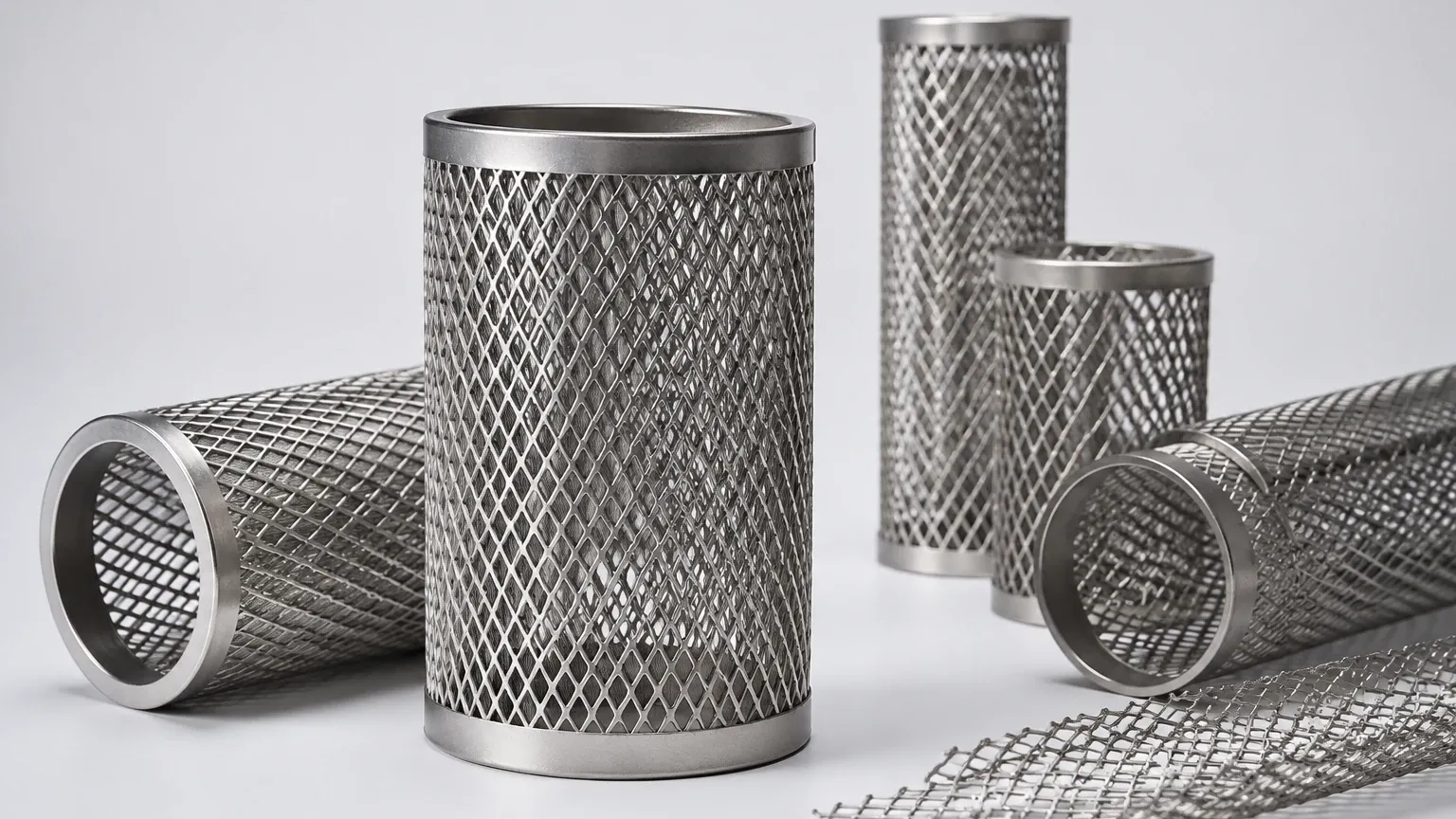
Expanded Metal Cylinder
In industrial filtration and structural engineering, the expanded metal cylinder serves as a critical component for fluid management, particulate separation, and mechanical support. Unlike traditional woven wire mesh or perforated sheets, expanded metal is produced through a unique process of slitting and stretching, resulting in a continuous, jointless piece of material. When rolled and welded into a cylindrical form, this material offers a high strength-to-weight ratio and specific flow characteristics that are essential for demanding B2B applications in chemical processing, hydraulics, and water treatment.
Selecting the right Perforated & Expanded Metal solution requires a deep understanding of the mechanical properties, manufacturing tolerances, and fluid dynamics associated with expanded geometries. For engineers and procurement teams, the decision often hinges on balancing filtration efficiency with structural durability and total cost of ownership.
Understanding the Geometry and Structure of Expanded Metal
The fundamental advantage of an expanded metal cylinder lies in its geometry. The expansion process creates a series of diamond-shaped openings. These openings are defined by several technical parameters that engineers must specify:
* LWD (Long Way of Design): The distance from the center of one joint to the center of the next joint across the long diamond axis.
* SWD (Short Way of Design): The distance across the short diamond axis.
* Strand Width: The amount of metal between the openings.
* Strand Thickness: The gauge of the original metal sheet.
* Bonds: The intersection points where the strands meet, which remain part of the solid metal sheet.
Because the material is stretched rather than punched, there is no scrap or metal loss during production. This makes expanded metal a cost-effective alternative to perforated metal, especially when using expensive alloys like 316L stainless steel. Furthermore, the strands of an expanded metal cylinder are set at an angle to the plane of the sheet. This creates a three-dimensional profile that can help deflect large debris or influence the turbulence of the fluid passing through the cylinder.
Manufacturing Processes for Expanded Metal Cylinders
Creating a high-performance expanded metal cylinder involves more than just expanding a sheet. The fabrication process must ensure dimensional stability and weld integrity to withstand industrial pressures.
Slitting and Stretching
The process begins with a solid metal plate or coil. A specialized machine slits and stretches the metal simultaneously. This cold-working process increases the hardness of the material, which can be beneficial for structural applications but may require annealing if further high-precision forming is needed.
Rolling and Seam Welding
Once the expanded sheet is produced, it is cut to size and rolled into a cylindrical shape. The longitudinal seam is then joined. In industrial filtration, TIG (Tungsten Inert Gas) or Plasma welding is preferred over spot welding. These methods provide a continuous, leak-proof seam that maintains the cylinder's "hoop strength." For applications involving high-pressure differentials, such as hydraulic return line filters, the integrity of this weld is the primary failure point that must be inspected.
Flattening vs. Standard Expanded Metal
Engineers can choose between "standard" (raised) and "flattened" expanded metal. Standard expanded metal has a textured surface with strands tilted at an angle. Flattened expanded metal is passed through a cold-roll reducing mill, which levels the strands into a single plane. While flattened metal is thinner and smoother, standard expanded metal provides superior rigidity and a larger surface area, which can be advantageous in certain chemical catalysts or heat exchange applications.
Comparing Expanded Metal and Perforated Metal in Filtration
When specifying components for a filtration system, engineers often compare the expanded metal cylinder against perforated metal cylinders. Both have distinct roles within the Perforated & Expanded Metal category.
Material Efficiency
Perforated metal is created by punching holes in a sheet, which can result in up to 40% material waste. Expanded metal involves zero waste, making it the more sustainable and economical choice for large-scale industrial projects.
Structural Rigidity
The "truss-like" structure of expanded metal provides inherent strength. Each diamond shape acts as a structural support for the next. In many filtration housings, an expanded metal cylinder is used as an outer cage or an inner core to support finer, more fragile filter media like pleated paper or fine wire mesh. The expanded metal prevents the primary filter media from collapsing under high pressure.
Flow Characteristics
Perforated metal offers very precise control over hole size and spacing, which is critical for exact particulate cut-off points. Expanded metal, however, typically offers a higher percentage of open area. This results in a lower pressure drop across the filter, allowing for higher flow rates in systems where energy efficiency and pump longevity are priorities.
Material Selection and Chemical Compatibility
Industrial environments often expose filtration components to corrosive fluids, extreme temperatures, and high mechanical stress. Selecting the appropriate alloy for an expanded metal cylinder is vital for ensuring a long service life.
1. Stainless Steel 304/304L: The standard choice for general industrial use. It offers good corrosion resistance and is suitable for food and beverage applications where sanitation is required.
2. Stainless Steel 316/316L: Contains molybdenum, which provides superior resistance to chlorides and acids. This is the preferred material for marine environments, pharmaceutical manufacturing, and aggressive chemical processing.
3. Carbon Steel: Often used in hydraulic oil systems where corrosion is not a primary concern, provided the oil contains rust inhibitors. It is frequently galvanized or coated to prevent oxidation during storage or transport.
4. Specialty Alloys: For high-temperature or highly acidic environments, materials like Monel, Inconel, or Titanium can be expanded, though these require specialized manufacturing expertise to ensure the expansion process does not introduce micro-cracks.
Engineering Considerations for Flow Rate and Pressure Drop
One of the most common questions engineers ask when integrating an expanded metal cylinder is how it will affect the system's pressure drop ($ΔP$). The open area of the cylinder is the primary factor here.
Unlike a flat sheet, a cylinder's effective open area can change based on the direction of the flow (inside-out vs. outside-in). Because the strands are angled in standard expanded metal, they can create a "louvers" effect. If the fluid hits the underside of the strand, it may experience more resistance than if it flows over the top.
In high-viscosity applications, such as heavy oil filtration, the "tortuous path" created by the expanded metal geometry can actually help in trapping fibrous contaminants that might otherwise pass through the straight holes of a perforated screen. However, for high-velocity gas filtration, this same geometry might induce unwanted turbulence. Engineers should request flow coefficient ($Cv$) data or perform CFD (Computational Fluid Dynamics) modeling when the cylinder is used as a primary flow-control element.
Customization and OEM Integration for Industrial Systems
Most industrial applications require a customized expanded metal cylinder rather than an off-the-shelf product. Customization options extend beyond just the diameter and length of the cylinder.
End Cap Configurations
Cylinders can be supplied with various end treatments to facilitate installation into existing housings. These include:
* Flanged Ends: For bolting the cylinder between pipe sections.
* Threaded Fittings: For easy removal and replacement in hydraulic systems.
* Reinforced Rings: To provide extra crush resistance at the sealing points.
* Open/Closed Ends: Depending on whether the cylinder is a flow-through strainer or a dead-end filter.
Multi-Layer Construction
In many cases, a single expanded metal cylinder is not enough to achieve the required filtration fineness. OEM manufacturers like Kaifil often produce multi-layer components where an expanded metal cylinder acts as the structural skeleton, supporting layers of sintered wire mesh or non-woven fibers. This combination provides the precision of fine filtration with the mechanical robustness of expanded metal.
Maintenance, Cleaning, and Replacement Cycles
The total cost of ownership for an expanded metal cylinder is heavily influenced by its cleanability. In B2B sectors like wastewater treatment or food processing, the ability to reuse components is a significant cost-saver.
Cleaning Methods
Because expanded metal is a single piece of material without the "nooks and crannies" found in woven wire mesh (where wires overlap), it is generally easier to clean.
* Backwashing: High-pressure fluid is sent in the reverse direction to dislodge particulates.
* Ultrasonic Cleaning: High-frequency sound waves in a solvent bath can remove fine particles trapped in the bonds of the diamonds.
* Chemical Cleaning: Stainless steel cylinders can be soaked in caustic or acidic solutions to dissolve organic or mineral scale, provided the material is compatible.
Determining Replacement Cycles
While expanded metal is durable, it is not infinite. Replacement should be considered if:
1. Permanent Deformation: If the cylinder has "bowed" or lost its circularity due to pressure spikes, its sealing integrity is compromised.
2. Erosion: In abrasive slurry applications, the strands of the expanded metal may thin over time, leading to a loss of structural strength.
3. Stress Corrosion Cracking: In certain chemical environments, the cold-worked areas of the expanded metal (the bonds) may develop microscopic cracks.
Regular inspection of the weld seams and the diamond intersections is recommended during scheduled maintenance shutdowns.
Conclusion
The expanded metal cylinder is a versatile and efficient solution for modern industrial filtration and structural needs. By offering a high open area, exceptional strength, and cost-effective production, it remains a staple in the engineer's toolkit. Whether used as a standalone strainer or as a support core for complex filter assemblies, understanding the nuances of its geometry and material properties is key to optimizing system performance. When sourcing these components, partnering with a manufacturer that understands the technical demands of Perforated & Expanded Metal ensures that the final product meets the rigorous standards required for industrial service.
