


Expanded Metal Grill Grate
In industrial manufacturing and filtration, the expanded metal grill grate serves as a critical component for structural support, heat dissipation, and material separation. Unlike traditional woven wire or welded mesh, expanded metal is produced through a unique process of slitting and stretching a single solid sheet of metal. This results in a continuous, jointless structure that offers exceptional strength-to-weight ratios and structural integrity. For engineers and procurement specialists, understanding the technical nuances of Perforated & Expanded Metal is essential for selecting the right components for demanding industrial environments.
The Manufacturing Process and Structural Advantages
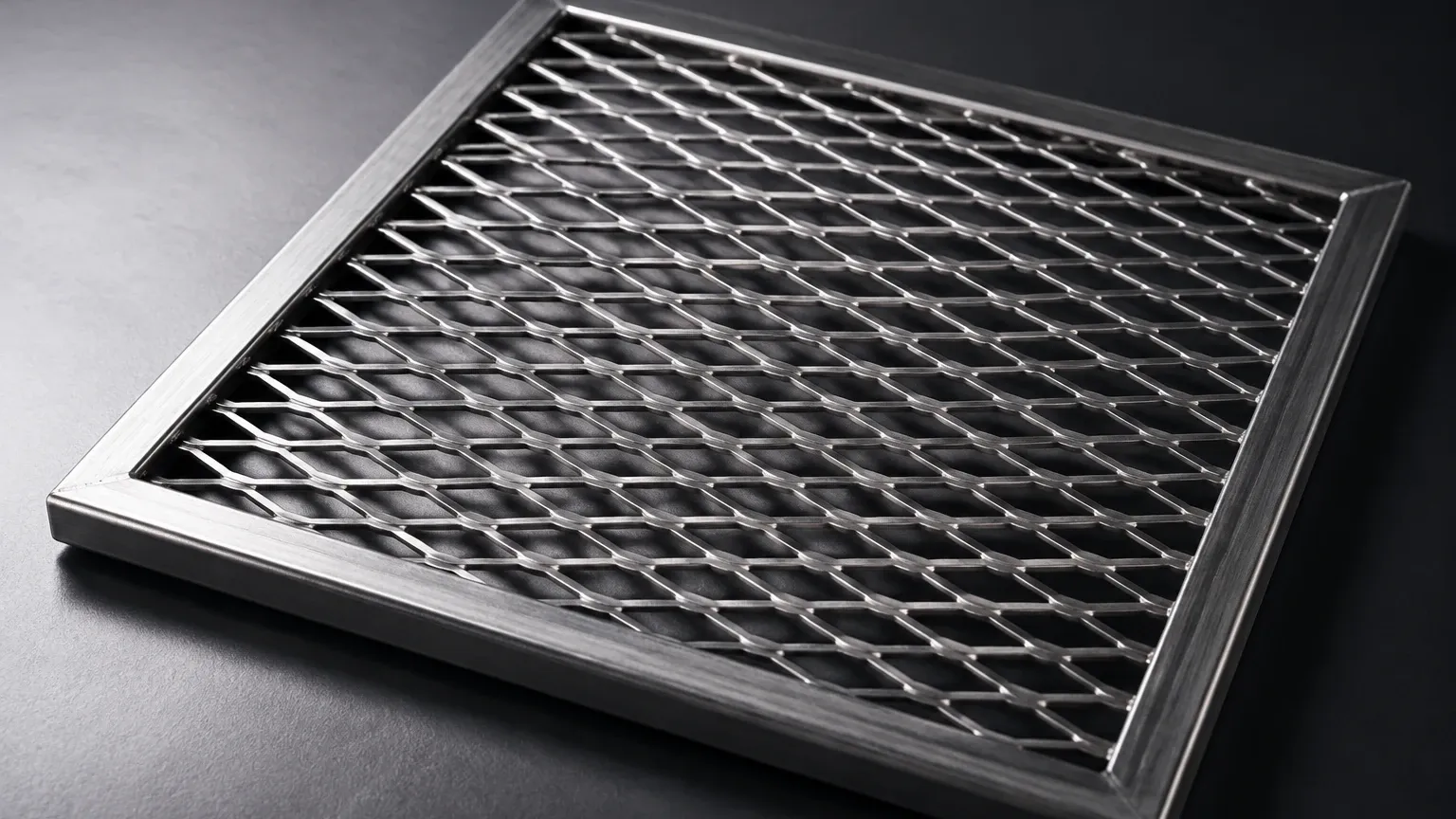
The production of an expanded metal grill grate is a cold-forming process. A metal sheet is fed through a machine equipped with a reciprocating knife that slits the metal while simultaneously stretching it. This creates the characteristic diamond-shaped openings. Because the material is stretched rather than punched, there is zero scrap or waste during production, making it a highly cost-effective alternative to perforated metal in many applications.
From an engineering perspective, the lack of welds or joins is a primary advantage. In a welded grate, the joints are often the first points of failure due to thermal expansion, mechanical stress, or localized corrosion. An expanded metal grate, being a single piece of material, distributes loads evenly across the entire structure. This inherent rigidity makes it ideal for high-vibration environments or applications where the grate must support significant weight without sagging.
Material Selection for Industrial Environments
When specifying an expanded metal grill grate, the choice of material is the most significant factor affecting longevity and performance. While carbon steel and aluminum are used in lighter applications, industrial filtration and food processing typically require stainless steel.
Stainless Steel 304
Standard 304 stainless steel is the most common choice for general industrial use. It provides excellent corrosion resistance and can withstand temperatures up to approximately 870°C (1600°F). It is widely used in food processing and industrial drying where moisture is present but chemical exposure is moderate.
Stainless Steel 316 and 316L
For environments involving high salinity, chlorides, or aggressive chemical cleaners, SS316 is the preferred material. The addition of molybdenum enhances its resistance to pitting and crevice corrosion. In applications requiring extensive welding or exposure to high-heat cycles, 316L (low carbon) is often specified to prevent carbide precipitation and maintain structural integrity at the heat-affected zones.
Specialty Alloys
In extreme cases, such as chemical reactors or aerospace filtration, nickel alloys or titanium may be used. These materials offer specialized resistance to high-temperature oxidation or specific acidic environments, though they come at a higher cost point.
Engineering Specifications: SWD, LWD, and Open Area
To accurately specify an expanded metal grill grate, engineers must define several geometric parameters. These measurements determine the grate's filtration capability, airflow, and mechanical strength.
* SWD (Short Way of Design): The distance from the center of one bond to the center of the next bond measured across the short diamond diagonal.
* LWD (Long Way of Design): The distance across the long diamond diagonal.
* Strand Width: The amount of metal between the openings.
* Strand Thickness: The thickness of the original base metal sheet.
* Open Area Percentage: This is perhaps the most critical metric for filtration and airflow. It is calculated based on the relationship between the strand width and the diamond dimensions. A higher open area allows for better drainage and airflow but may reduce the overall load-bearing capacity of the grate.
For an expanded metal grill grate used in industrial drying or food processing, the open area must be balanced to ensure that the product is supported adequately while allowing for uniform heat distribution or liquid drainage.
Comparing Raised vs. Flattened Expanded Metal
Expanded metal is available in two primary finishes: raised (standard) and flattened. Choosing between these depends on the specific application requirements.
Raised Expanded Metal
In its standard form, the strands and bonds are set at a sharp angle to the plane of the sheet. This creates a 3D surface that offers maximum rigidity and excellent slip resistance. In industrial walkways or as a support grate for heavy filter media, raised metal is often preferred because it provides additional mechanical interlocking with the materials it supports.
Flattened Expanded Metal
Flattened metal is produced by passing the standard expanded sheet through a cold-roll reducing mill. This process flattens the strands and bonds into the same plane, resulting in a smooth, level surface. Flattened grates are easier to clean and are often used in applications where the material being processed must sit perfectly flat, or where a smooth surface is required to prevent damage to delicate filter membranes or food products.
Industrial Applications: Beyond the Grill
While the term "grill grate" often evokes images of food preparation, the industrial utility of these components is far broader. Their design makes them indispensable in several sectors:
1. Food Processing and Industrial Drying
In commercial dehydrators and ovens, expanded metal grates provide the necessary airflow to ensure even drying. The diamond pattern encourages turbulent air movement, which prevents "dead spots" where moisture might accumulate. Stainless steel options ensure compliance with FDA and hygiene standards.
2. Filtration Support Structures
In many liquid and gas filtration systems, a fine wire mesh is used as the primary filtration medium. However, fine mesh lacks the structural strength to withstand high pressure. An expanded metal grill grate is often used as a "backup" or support layer, providing the necessary rigidity to prevent the mesh from bursting or deforming under flow pressure.
3. Chemical and Petrochemical Processing
Grates are used in catalyst baskets and separator vessels. The ability to customize the diamond size and strand width allows engineers to fine-tune the retention of catalyst particles while maintaining high flow rates for the process fluids.
4. Safety and Security
Due to its high strength and the difficulty of cutting through the interconnected diamond structure, expanded metal is frequently used for machine guards, safety partitions, and anti-slip flooring in industrial plants.
Key Considerations for Procurement and OEM Customization
When sourcing an expanded metal grill grate for a specific project, several factors must be confirmed with the manufacturer to ensure performance and cost-efficiency.
* Load Requirements: Will the grate be subjected to static loads, dynamic loads, or impact? This determines the required gauge and strand width.
* Environmental Exposure: Is the grate exposed to corrosive chemicals, high humidity, or extreme temperatures? This dictates the material grade (e.g., SS304 vs. SS316).
* Dimensional Tolerances: Industrial applications often require precise fitment into existing frames or housings. Confirming tolerances for camber, out-of-squareness, and overall dimensions is vital.
* Edge Finishing: Expanded metal has sharp edges by nature. Depending on the application, you may require the edges to be framed with U-edging or ground smooth to ensure safety and ease of installation.
Kaifil specializes in providing customized Perforated & Expanded Metal solutions. By working closely with an OEM manufacturer, engineers can specify exact LWD/SWD ratios that optimize the balance between filtration accuracy and structural durability.
Maintenance and Longevity in Demanding Environments
The total cost of ownership for an expanded metal grill grate is largely determined by its maintenance requirements and replacement cycle. In food-grade environments, the primary concern is "cleanability." Stainless steel grates are resistant to the caustic cleaning agents used in CIP (Clean-In-Place) systems. However, the diamond intersections can sometimes trap particles. For these applications, electropolishing is often recommended to create a microscopically smooth surface that discourages bacterial growth and simplifies cleaning.
In high-temperature applications, such as heat treatment furnaces, the grate will undergo thermal expansion and contraction. Because expanded metal is flexible in its design, it can often handle these cycles better than rigid welded plates, which may crack at the weld points. Regular inspections should focus on checking for signs of thinning (erosion) or significant warping that could compromise the support of the filter media.
Conclusion
The expanded metal grill grate is a versatile and robust component essential for modern industrial filtration and material processing. By selecting the appropriate material grade, diamond geometry, and surface finish, engineers can achieve a solution that balances airflow, strength, and corrosion resistance. Whether used as a standalone support grate or as part of a complex multi-layer filtration system, the technical advantages of expanded metal—namely its jointless construction and material efficiency—make it a superior choice for demanding B2B applications. When evaluating options, focusing on the specific engineering parameters and environmental factors will ensure the long-term reliability of the filtration system.
