


Expanded Metal Sizes
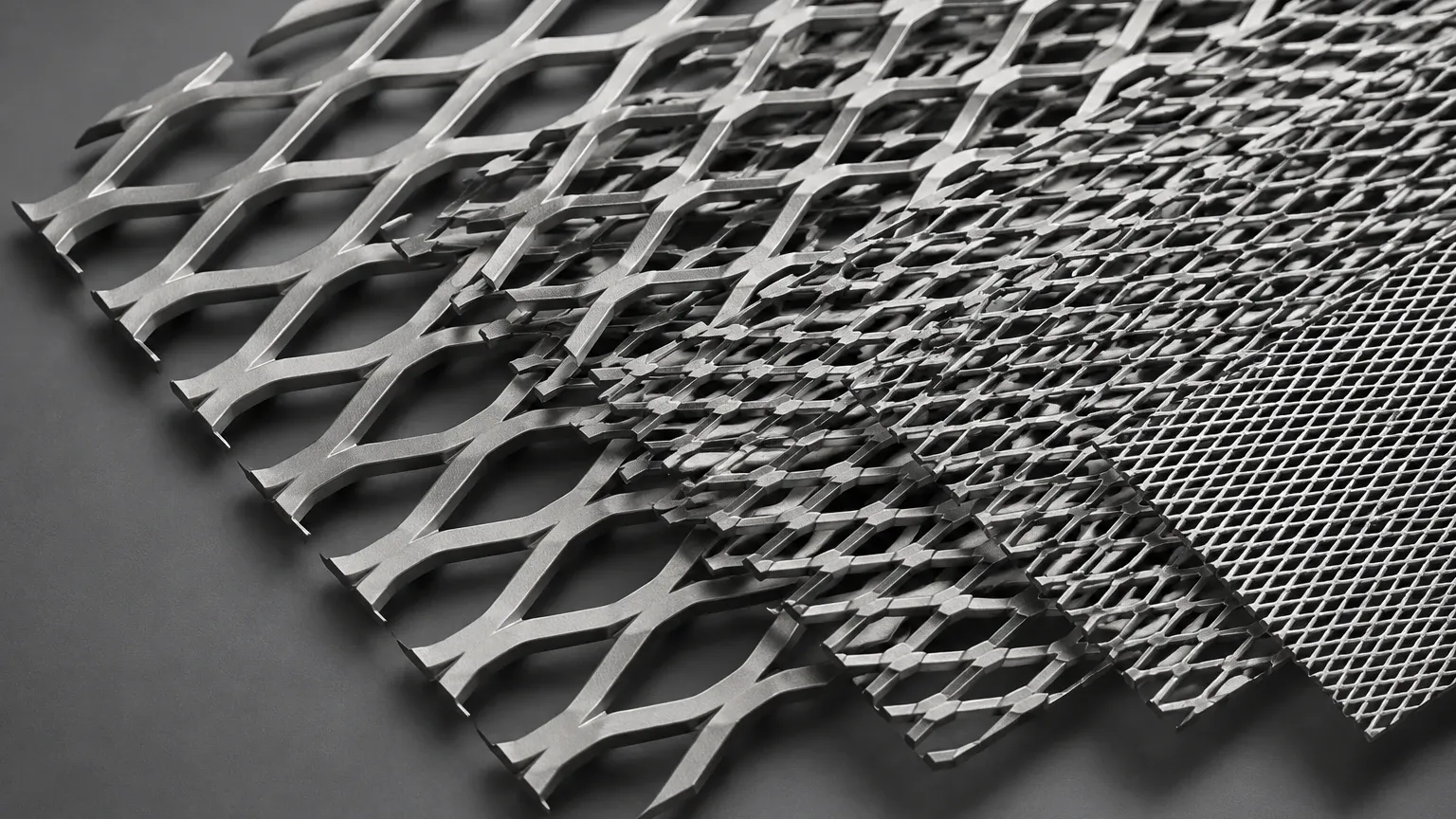
In industrial filtration and structural engineering, selecting the correct expanded metal sizes is a critical factor that determines the efficiency, durability, and pressure management of a system. Expanded metal is manufactured by simultaneously slitting and stretching a solid sheet of metal, typically stainless steel, to create a uniform diamond-patterned mesh. Unlike perforated metal, which involves punching out material, expanded metal is produced without waste, maintaining the structural integrity of the original sheet while providing a high strength-to-weight ratio.
For engineers and procurement teams, understanding the nuances of expanded metal dimensions is essential for ensuring compatibility with filter housings, meeting flow rate requirements, and providing adequate mechanical support for finer filter media. This guide examines the technical specifications, measurement standards, and selection criteria for expanded metal used in demanding industrial environments.
Understanding Expanded Metal Terminology and Measurement
To accurately specify expanded metal sizes, one must master the industry-standard terminology used to describe the diamond-shaped openings. These measurements are not merely dimensions; they dictate the mechanical properties of the mesh.
SWD and LWD (Short Way of Design and Long Way of Design)
The diamond pattern is defined by two primary axes:
* SWD (Short Way of Design): This is the distance from a point on a bond to a corresponding point on the next bond across the short axis of the diamond. It is essentially the width of the diamond opening plus one bond.
* LWD (Long Way of Design): This is the distance measured across the long axis of the diamond, from bond center to bond center.
It is important to note that the SWO (Short Way of Opening) and LWO (Long Way of Opening) refer to the clear space inside the diamond, excluding the width of the metal strands. Engineers must distinguish between these to ensure the mesh provides the necessary clearance or particle retention.
Strand Width and Thickness
The "strand" is the single metal strip that forms the side of the diamond.
* Strand Width: The amount of metal fed into the expanding machine between slits.
* Strand Thickness: The gauge or decimal thickness of the original base metal sheet.
By adjusting the strand width and the degree of stretching, manufacturers can produce a wide variety of Perforated & Expanded Metal configurations from the same base material, allowing for precise control over the weight and open area of the finished product.
Standard vs. Flattened Expanded Metal
When evaluating expanded metal sizes, engineers must choose between "Raised" (standard) and "Flattened" varieties. This choice significantly impacts the final thickness and surface characteristics of the component.
Raised Expanded Metal
In its standard form, expanded metal emerges from the machine with the strands set at a sharp angle to the plane of the sheet. This creates a three-dimensional texture that offers high rigidity and excellent grip. In filtration, raised expanded metal is often used as a robust outer support cage for filter cartridges, where its structural strength prevents the collapse of the internal media under high-pressure differentials.
Flattened Expanded Metal
Flattened expanded metal is produced by passing the standard raised sheet through a cold-roll reducing mill. This process flattens the strands and bonds into a single plane, reducing the overall thickness and creating a smooth surface.
For filtration applications, flattened expanded metal is preferred when the mesh serves as a support layer for delicate wire mesh or synthetic membranes. The smooth surface prevents the finer media from being abraded or punctured by the sharp edges of raised strands. However, flattening slightly increases the LWD and decreases the SWD, which must be accounted for during the design phase to maintain precise fitment.
Material Specifications and Gauge Considerations
Material selection is inseparable from size selection. In the chemical processing, pharmaceutical, and food and beverage industries, stainless steel (primarily grades 304 and 316L) is the standard due to its corrosion resistance and ability to withstand high temperatures.
Gauge and Decimal Thickness
Expanded metal sizes are often categorized by the gauge of the starting material. However, for precision engineering, relying on gauge numbers can be risky due to variations between standards (e.g., Manufacturers' Standard Gauge vs. Birmingham Gauge). It is best practice to specify the decimal thickness in inches or millimeters. Common thicknesses for industrial filtration components range from 0.020" (0.5mm) for light support to 0.125" (3.175mm) or thicker for heavy-duty industrial strainers.
Weight and Density
The weight per square foot is a critical metric for logistics and structural load calculations. Because the expanding process stretches the metal, the final weight of the expanded sheet is significantly lower than a solid sheet of the same outer dimensions. For example, a 1/2" #18 expanded metal sheet will weigh considerably less than a solid 18-gauge sheet, while providing sufficient structural reinforcement for most hydraulic filtration applications.
Engineering Calculations: Open Area and Flow Rates
One of the primary reasons for specifying particular expanded metal sizes is to achieve a targeted percentage of open area. This percentage determines the flow capacity and the pressure drop (delta P) across the filter element.
Calculating Open Area
The open area of expanded metal is calculated based on the relationship between the strand width and the SWD. The formula generally follows:
Percentage of Open Area = (1 – (2 × Strand Width / SWD)) × 100
In high-flow applications, such as water treatment or large-scale chemical processing, a higher open area (often exceeding 60-70%) is desired to minimize energy consumption and pump wear. Conversely, if the expanded metal is acting as a primary strainer, a smaller opening size with a lower open area may be necessary to capture specific particle sizes.
Impact on Filtration Performance
If the expanded metal openings are too small, the filter may clog prematurely, leading to frequent maintenance cycles and increased total cost of ownership. If the openings are too large, the mesh may fail to provide adequate support for the primary filter media, leading to pleat deformation or media migration. Engineers must balance the mechanical strength provided by wider strands against the flow efficiency provided by larger openings.
Selecting Expanded Metal Sizes for Industrial Applications
Different industries have distinct requirements for expanded metal configurations. At Kaifil, we observe that application-specific environmental factors often dictate the ideal size and material.
Chemical and Petrochemical Processing
In these environments, resistance to aggressive chemicals and high pressures is paramount. Heavier gauges (10 to 14 gauge) with relatively small SWD/LWD dimensions are often used to create rigid support cores for pleated stainless steel filter cartridges. The small diamond size ensures that the pleats remain uniform even under fluctuating flow conditions.
Food, Beverage, and Pharmaceutical
Hygiene and cleanability are the priorities here. Flattened expanded metal is almost universally preferred to eliminate crevices where bacteria or product residue could accumulate. Sizes are selected to ensure that the mesh can be easily sanitized via CIP (Clean-In-Place) systems. Stainless steel 316L is typically specified to prevent metallic contamination and withstand acidic or alkaline cleaning agents.
Hydraulic and Lubrication Systems
For hydraulic oil filtration, expanded metal is frequently used as an outer wrap. The sizes are chosen to protect the internal glass fiber or paper media from large debris while maintaining a low profile to fit within compact housing units. Thin-gauge, high-open-area expanded metal is ideal for these space-constrained applications.
Customization and Manufacturing Precision
While standard size charts exist, many industrial filtration challenges require customized expanded metal sizes. Customization allows for the optimization of the mesh to the specific geometry of the filter housing or the unique characteristics of the fluid being processed.
Custom Tooling and Dimensions
Advanced manufacturing capabilities allow for the adjustment of the expansion ratio to create non-standard SWD and LWD dimensions. This is particularly useful when an engineer needs a specific open area that falls between standard catalog items. Additionally, custom sheet sizes or pre-cut circular discs and cylinders can be produced to reduce assembly time and material waste at the client's facility.
Edge Configurations
When ordering custom expanded metal, engineers should consider the edge finish. "Random sheared" edges result from cutting through the diamonds, leaving sharp points. "Bond sheared" edges are cut along the bonds, providing a safer, more stable edge. For components that will be handled frequently by maintenance staff, bond shearing or a U-channel border is recommended.
Procurement Checklist: What to Confirm Before Ordering
To avoid costly errors and ensure the performance of the filtration system, purchasing teams and engineers should confirm the following details before finalizing an order for expanded metal:
1. Material Grade: Is 304 sufficient, or does the environment require 316L for superior corrosion resistance?
2. Style: Is the application better suited for Raised or Flattened expanded metal?
3. Opening Dimensions: Specify the required SWD and LWD. If particle retention is the goal, specify the SWO and LWO.
4. Strand Dimensions: Confirm both strand width and strand thickness (preferably in decimal units).
5. Overall Sheet Size: Define the length and width of the sheets, noting the direction of the diamonds (LWD usually runs parallel to the length of the sheet).
6. Tolerances: What are the allowable deviations in dimensions and flatness? This is critical for automated assembly processes.
7. Quantity and Lead Time: For OEM applications, ensure the manufacturer can scale production to meet your assembly schedule.
By focusing on these technical parameters, industrial professionals can select expanded metal sizes that provide the optimal balance of filtration efficiency, structural integrity, and cost-effectiveness. As a specialist in custom stainless steel filtration solutions, Kaifil provides the engineering expertise and manufacturing precision necessary to deliver high-performance metal mesh components tailored to the most demanding industrial environments.
