


Making Expanded Metal Video
In industrial manufacturing and filtration engineering, visual documentation such as a making expanded metal video serves as a critical technical resource. For procurement managers and design engineers, seeing the transformation of a solid metal sheet into a precise mesh structure provides essential insights into material integrity, structural strength, and the tolerances achievable during production. Understanding the mechanics behind this process is fundamental when selecting components for demanding environments, such as chemical processing or high-pressure hydraulic systems.
Expanded metal is a versatile material created by simultaneously slitting and stretching a metal sheet. Unlike perforated metal, which involves punching holes and generating scrap material, the expansion process is nearly waste-free. This efficiency, combined with the resulting three-dimensional structure, makes it a preferred choice for filtration support, architectural cladding, and industrial safety components.
Understanding the Manufacturing Process of Expanded Metal
The production of expanded metal is a specialized cold-working process that requires high-precision machinery. When viewing a making expanded metal video, technical professionals should observe the synchronization between the feeding mechanism and the reciprocating knives. The process begins with a solid sheet or coil of metal, typically stainless steel, carbon steel, or aluminum.
1. The Slitting Phase: A set of upper and lower blades, often referred to as knives, are configured in a specific pattern. As the metal sheet passes through the machine, the upper blade descends to create a series of slits.
2. The Stretching Phase: Simultaneously with the slitting, the machine exerts pressure to stretch the metal. Because the slits are offset, the stretching force opens the metal into a diamond-shaped or hexagonal pattern.
3. The Reciprocating Motion: The upper blade moves laterally after each stroke. This alternating movement creates the characteristic "bridges" or bonds where the metal remains solid, ensuring the structural continuity of the mesh.
This process does not involve welding or weaving. The resulting product is a single piece of metal with interconnected strands. For engineers, this lack of joints is a significant advantage, as it eliminates the risk of weld failure or unraveling under mechanical stress.
Key Technical Parameters in Expanded Metal Production
When evaluating a making expanded metal video for quality assurance, it is important to understand the terminology used to define the mesh geometry. These parameters directly influence the filtration efficiency and the mechanical load capacity of the final component.
* SWD (Short Way of Diamond): The distance from the center of one bond to the center of the next bond measured across the short diamond diagonal.
* LWD (Long Way of Diamond): The distance measured across the long diamond diagonal.
* Strand Width: The amount of metal fed under the knives before the next stroke occurs.
* Strand Thickness: The thickness of the original base metal sheet.
* Open Area Percentage: This is a critical calculation for filtration applications. It represents the ratio of the area of the openings to the total area of the sheet, determining the flow rate and pressure drop characteristics.
In a professional manufacturing environment, these dimensions are controlled with high precision. Variations in the feed rate or blade alignment can result in uneven mesh patterns, which may compromise the performance of a filter cartridge or a support core.
Flattened vs. Raised Expanded Metal: Engineering Distinctions
One of the most important distinctions shown in a making expanded metal video is the difference between "raised" (or standard) and "flattened" expanded metal. The choice between these two forms depends on the specific requirements of the application.
Raised Expanded Metal
Immediately after the expansion process, the strands are set at an angle to the plane of the sheet. This creates a three-dimensional, textured surface. Raised expanded metal provides excellent grip and high rigidity-to-weight ratios. In filtration, the raised structure can create turbulence, which may be beneficial in certain fluid dynamics scenarios to prevent the rapid buildup of a filter cake.
Flattened Expanded Metal
To produce flattened expanded metal, the raised mesh is passed through a cold-rolling reducing mill. This process flattens the strands and bonds into the same plane as the original sheet. Flattening increases the length of the sheet (often by about 5%) but results in a smooth, level surface. For engineers designing precision filter assemblies, flattened expanded metal is often preferred because it provides a consistent interface for delicate wire mesh layers or synthetic filter media, reducing the risk of abrasion or puncture.
Material Considerations for Industrial Filtration
Kaifil specializes in providing filtration solutions that must withstand corrosive environments and high temperatures. Therefore, the material used in the expansion process is as important as the manufacturing technique itself. While a making expanded metal video might show the process using various alloys, stainless steel is the standard for B2B industrial applications.
* Grade 304/304L: The most common stainless steel used for general industrial applications. It offers good corrosion resistance and is suitable for food and beverage processing.
* Grade 316/316L: Contains molybdenum, which provides superior resistance to chlorides and pitting. This is the preferred choice for marine environments, pharmaceutical manufacturing, and aggressive chemical processing.
* Specialty Alloys: For extreme conditions, materials like Monel, Inconel, or Titanium can be expanded, though these require specialized tooling and slower production speeds due to their work-hardening properties.
Selecting the correct material ensures that the Perforated & Expanded Metal components maintain their structural integrity throughout their intended service life, minimizing the total cost of ownership by reducing replacement frequency.
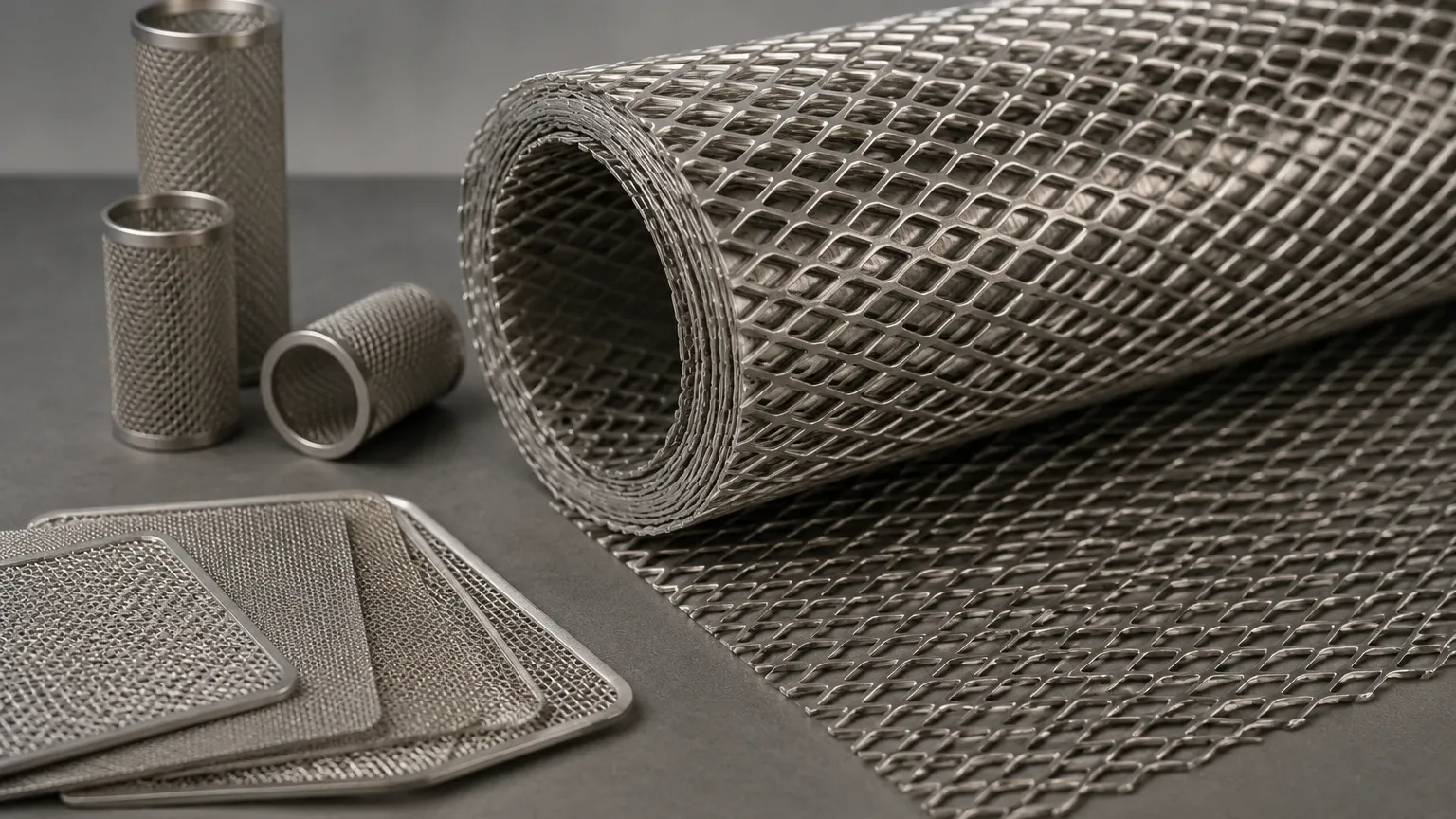
Comparing Perforated & Expanded Metal for Filtration Support
Engineers often face the decision of whether to use perforated or expanded metal for filter cores and outer guards. Both materials fall under the category of Perforated & Expanded Metal, but they offer different performance profiles.
Perforated Metal is created by punching holes in a sheet. It offers extremely high precision in hole size and placement. It is ideal for applications requiring specific hole shapes (like round or square) and where a very high degree of flatness is required without the need for additional rolling. However, it generates significant material waste.
Expanded Metal, as seen in a making expanded metal video, is more cost-effective because it utilizes the entire base sheet. It generally offers a higher strength-to-weight ratio than perforated metal. In hydraulic and high-pressure filtration, the interconnected strands of expanded metal provide exceptional resistance to collapsing under pressure. Furthermore, the angled strands of raised expanded metal can provide a larger surface area for bonding in composite filter structures.
Quality Control and Verification in Metal Expansion
A high-quality making expanded metal video should highlight the quality control measures implemented during production. For industrial B2B buyers, verifying these steps is essential to ensure the reliability of the supplied components.
1. Material Traceability: Manufacturers should provide Mill Test Reports (MTRs) to confirm the chemical composition and mechanical properties of the raw material.
2. Dimensional Inspection: Using calibrated calipers and optical comparators to verify SWD, LWD, and strand dimensions against the technical drawing specifications.
3. Flatness and Camber Checks: Ensuring the sheet or coil does not have excessive bowing or twisting, which could interfere with subsequent fabrication steps like welding or forming into cylinders.
4. Surface Finish: Checking for burrs, sharp edges (unless required), or oil residues that could contaminate the filtration system.
For custom filtration solutions, Kaifil emphasizes precise filtration performance. This means the expansion process must be tightly controlled to ensure that the open area remains consistent across the entire batch, preventing bypass or localized pressure spikes in the final filter assembly.
Customization and Industrial Applications
The flexibility of the expansion process allows for significant customization. Beyond standard diamond patterns, manufacturers can produce micro-mesh for fine filtration or heavy-duty grating for industrial walkways.
In the context of industrial filtration, expanded metal is frequently used as:
* Support Cores: Providing the internal structure for pleated filter cartridges to prevent the media from collapsing under flow pressure.
* Outer Protectors: Guarding delicate filter media from mechanical damage during handling or installation.
* Pre-filters: Acting as a coarse filter to remove large debris before the fluid reaches the primary, finer filtration stages.
* Diffusers: Helping to distribute flow evenly across the surface of a filter bed.
By working closely with a manufacturer that understands both the expansion process and the nuances of filtration engineering, B2B customers can develop customized components that meet specific flow rates, pressure requirements, and chemical compatibility standards.
Procurement and Technical Specification Checklist
Before finalizing a purchase order based on a making expanded metal video or a technical catalog, engineering and purchasing teams should confirm the following details to ensure the product is fit for purpose:
* Exact Material Grade: Specify 304, 316L, or other alloys based on the chemical environment.
* Mesh Orientation: Define whether the LWD should run parallel or perpendicular to the length of the sheet (important for structural bending).
* Style Designation: Use standard industry codes (e.g., 1/2" #18) but always supplement with specific SWD and LWD requirements.
* Surface Treatment: Determine if the product requires degreasing, pickling, passivating, or electropolishing, especially for pharmaceutical or food-grade applications.
* Tolerances: Clearly state the allowable variance in dimensions and flatness.
By focusing on these technical details, engineers can leverage the benefits of Perforated & Expanded Metal to achieve durable and cost-effective filtration performance. Understanding the manufacturing reality behind the video ensures that the transition from design to physical component is seamless and reliable.
