


0 Expanded
In the realm of industrial filtration and structural metal components, the term "0 expanded" refers to a critical manufacturing philosophy and technical specification: the zero-waste expansion process. Unlike traditional perforation methods that remove material to create openings, the expansion process slits and stretches a solid metal sheet to its desired dimensions. This results in a product where the weight of the finished mesh is equal to the weight of the original raw material sheet. For engineers and procurement specialists in the chemical, pharmaceutical, and food processing industries, understanding the nuances of zero-waste expanded metal is essential for optimizing both material costs and filtration performance.
Industrial filtration requires a balance between structural integrity and open area. The 0 expanded process provides a unique solution by creating a continuous, one-piece structure that lacks the welds or joints found in woven wire mesh. This article explores the technical foundations of expanded metal, its application in precision filtration, and the engineering considerations necessary when selecting these components for demanding industrial environments.
The Engineering Principles of Expanded Metal Manufacturing
The production of expanded metal is a precision engineering feat that involves a simultaneous slitting and stretching process. A solid sheet of metal—typically stainless steel for industrial filtration—is fed through a machine equipped with specialized knives. These knives create a series of staggered slits while the machine pulls the metal, stretching the slits into diamond-shaped openings.
Because no material is punched out during this process, it is fundamentally a "0 waste" or 0 expanded manufacturing method. This efficiency is a primary driver for its selection in large-scale industrial projects where material costs for high-grade alloys, such as 316L stainless steel, can be significant.
Standard vs. Flattened Expanded Metal
There are two primary forms of expanded metal used in filtration:
1. Standard (Raised) Expanded Metal: In this form, the strands and bonds are set at a uniform angle to the plane of the sheet. This creates a three-dimensional surface that provides excellent mechanical grip and creates turbulence in fluid flow, which can be advantageous in certain depth filtration applications.
2. Flattened Expanded Metal: This is standard expanded metal that has been passed through a cold-rolling reducing mill. The process flattens the strands and bonds into a single plane, resulting in a smooth, flat surface. Flattened 0 expanded metal is often used as a support layer for finer filter media, such as wire mesh or membranes, as it provides a consistent contact surface without sharp edges that could damage delicate materials.
Technical Specifications and Material Selection
When specifying 0 expanded components, engineers must navigate several key metrics that define the mesh's performance. The geometry of the diamond opening is characterized by two dimensions: the Long Way of the Diamond (LWD) and the Short Way of the Diamond (SWD). These measurements, combined with the strand width and thickness, determine the open area and the overall strength of the filter component.
Material Compatibility
For B2B applications in corrosive or high-temperature environments, material selection is the most critical factor.
* Stainless Steel 304: Suitable for general industrial use, providing good corrosion resistance and mechanical strength.
* Stainless Steel 316/316L: The industry standard for chemical processing and marine environments. The addition of molybdenum enhances resistance to pitting and crevice corrosion, particularly in chloride-rich environments.
* Specialty Alloys: In extreme cases, such as highly acidic pharmaceutical processing, alloys like Titanium or Hastelloy may be used in the expansion process.
Precision and Tolerances
In high-end filtration, "0 expanded" can also refer to micro-expanded metal. This involves extremely thin foils (often less than 0.1mm) expanded into tiny openings. These precision components require tight tolerances to ensure uniform flow distribution. Engineers must confirm the "percent open area" to calculate the pressure drop across the filter, ensuring the system operates within its designed hydraulic parameters.
Performance Advantages in Industrial Filtration
The structural nature of expanded metal offers several performance advantages over other media types. Because the mesh is made from a single piece of metal, there are no strands to unravel or welds to fail under high pressure. This makes it an ideal choice for high-viscosity fluids or high-pressure hydraulic systems.
Structural Integrity and Support
In many filtration systems, expanded metal serves as the "skeleton." For example, in a multi-layered filter cartridge, a layer of 0 expanded stainless steel provides the necessary rigidity to prevent the finer filter mesh from collapsing under the force of the fluid flow. Its high strength-to-weight ratio allows for the design of lighter filter housings without sacrificing safety or durability.
Flow Dynamics
The angled strands of raised expanded metal can be used to manipulate fluid dynamics. In air filtration or gas-liquid separation, the 3D structure helps to break up laminar flow, encouraging particulates to collide with the filter surface. This can increase the "dirt-holding capacity" of the filter compared to a flat perforated sheet.
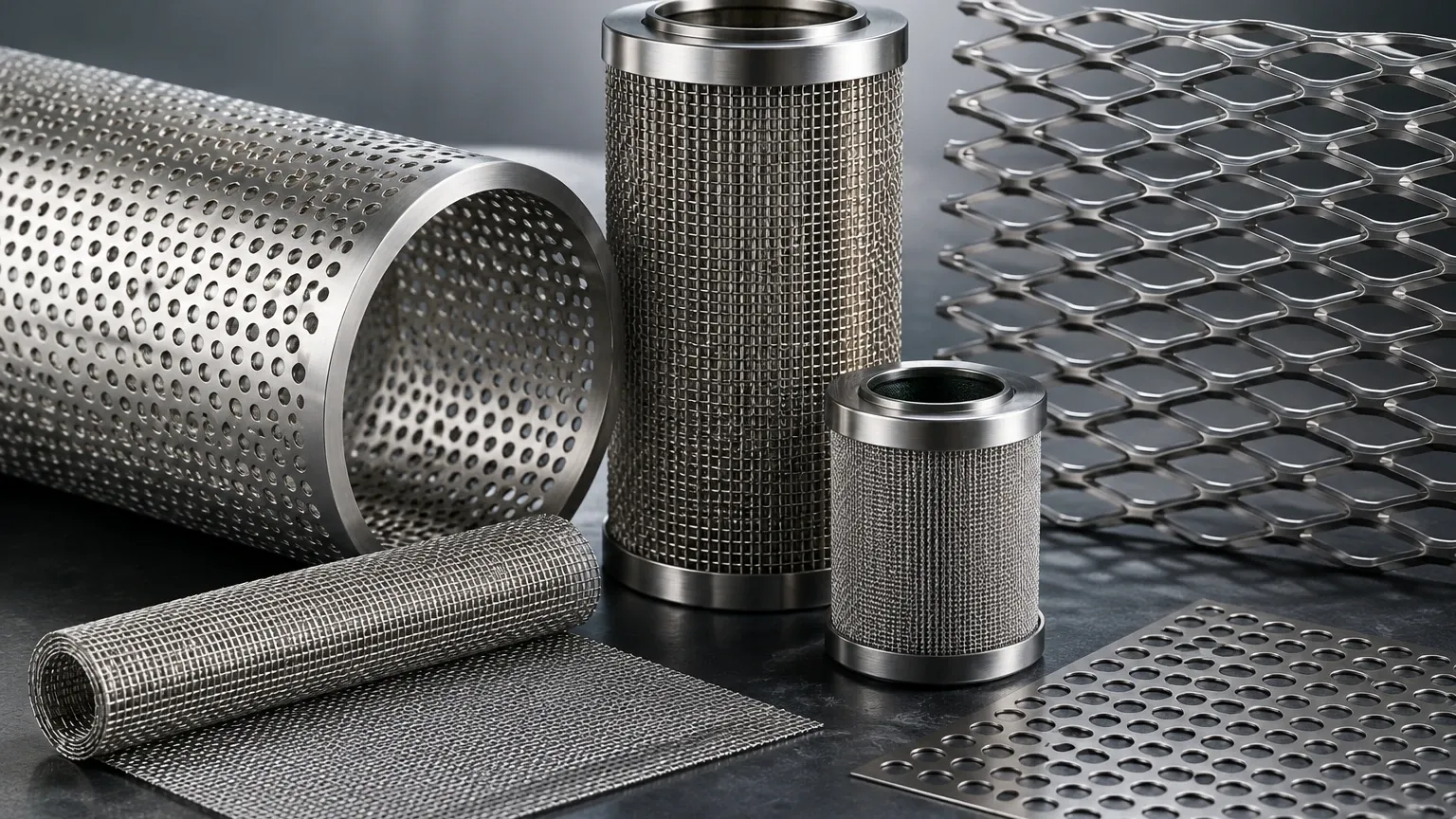
Comparing Perforated & Expanded Metal for Specific Applications
Choosing between Perforated & Expanded Metal is a common challenge for design engineers. While both products serve similar functions in separation and protection, their physical properties and cost structures differ significantly.
| Feature | Expanded Metal (0 Waste) | Perforated Metal |
| :— | :— | :— |
| Material Utilization | 100% (Zero Waste) | 60% – 80% (Waste from slugs) |
| Structural Type | One-piece, continuous | One-piece, with holes removed |
| Surface Profile | 3D (Standard) or Flat | Always Flat |
| Cost (High-grade alloys) | Lower (due to zero waste) | Higher (due to material loss) |
| Filtration Precision | Moderate to High | High (precision hole sizing) |
Perforated metal is often preferred when exact circular hole sizes are required for specific particle sizing. However, expanded metal is superior when the priority is a high open-area-to-weight ratio and cost-efficiency. In many industrial pre-filtration stages, expanded metal provides a more durable and economical solution than perforated sheets.
Critical Selection Criteria for Engineers
Before finalizing a purchase order for 0 expanded components, several technical questions must be addressed to ensure the product is fit for purpose.
1. What is the required filtration accuracy? Expanded metal is generally used for coarse filtration or as a support layer. If sub-micron filtration is required, the expanded metal will likely serve as a substrate for a finer mesh.
2. What are the pressure conditions? Engineers must calculate the maximum differential pressure (ΔP) the filter will encounter. The thickness of the expanded metal strands must be sufficient to withstand these forces without deforming.
3. Are there specific chemical exposures? Beyond just the primary fluid, consider cleaning agents. A filter used in the food and beverage industry must withstand caustic Clean-in-Place (CIP) chemicals.
4. Is customization required? OEM manufacturers can often provide custom LWD/SWD ratios to tune the filtration performance to a specific flow rate or particle size. This level of customization is crucial for optimizing the total cost of ownership.
Maintenance and Longevity in Demanding Environments
The durability of 0 expanded stainless steel makes it a long-term investment. However, its longevity depends on proper maintenance and cleaning protocols. Unlike disposable synthetic filters, stainless steel expanded metal can be cleaned and reused multiple times, significantly reducing the environmental impact and operating costs.
Cleaning Methods
* Backwashing: High-velocity reverse flow can dislodge particles trapped in the diamond mesh. The smooth transitions of the expanded strands (especially in flattened versions) facilitate easier release of contaminants.
* Ultrasonic Cleaning: For precision micro-expanded filters, ultrasonic baths are highly effective at removing microscopic debris from the bonds and strands.
* Chemical Cleaning: Stainless steel's resistance to a wide range of pH levels allows for aggressive chemical cleaning to remove organic fouling or scale.
Replacement Cycles
While the physical structure of expanded metal is robust, it is not indestructible. Engineers should monitor for signs of "blinding" (permanent clogging) or mechanical fatigue. In high-vibration environments, the bonds of the expanded metal should be inspected for stress fractures. However, compared to woven wire mesh, expanded metal typically offers a longer service life in high-stress applications due to its rigid, jointless construction.
Conclusion: Making the Informed Choice
The selection of 0 expanded metal components represents a strategic decision to prioritize material efficiency, structural strength, and long-term reliability. By eliminating material waste and providing a robust, one-piece filtration medium, expanded metal addresses the core needs of modern industrial processing.
Whether used as a primary filter for coarse particles or as a critical support structure in a complex multi-stage filtration system, expanded metal offers versatility that few other materials can match. For technical teams, the key to success lies in understanding the interplay between mesh geometry, material science, and fluid dynamics. By consulting with specialized manufacturers and reviewing the available Perforated & Expanded Metal options, engineers can ensure they select a solution that meets the rigorous demands of their specific industrial application.
