


Perforated Metal Grilles
In industrial engineering and facility management, perforated metal grilles serve as essential components that balance structural integrity with functional permeability. These components are not merely decorative covers; they are precision-engineered interfaces used for ventilation, acoustic dampening, debris filtration, and safety guarding. When selecting Perforated & Expanded Metal for industrial grilles, engineers must account for mechanical loads, airflow requirements, and environmental stressors to ensure long-term reliability.
As a specialized manufacturer, Kaifil provides custom stainless steel filtration and metal solutions that address the rigorous demands of the chemical, pharmaceutical, and food processing industries. Understanding the technical nuances of perforated metal grilles is critical for procurement teams and design engineers who require components that meet exact performance specifications.
The Role of Perforated & Expanded Metal in Grille Design
While both perforated and expanded metals are used to create grilles, they are manufactured through different processes that yield distinct mechanical properties. Perforated metal is produced by punching a series of holes into a solid sheet of metal, typically using a CNC press or a rotary pinned perforation roller. This process allows for high precision in hole placement and the ability to maintain wide margins (unperforated areas) around the edges, which is vital for mounting and structural stability.
In contrast, expanded metal is created by simultaneously slitting and stretching the material. This results in a diamond-shaped pattern that is integral to the sheet, with no material waste. For industrial grilles, perforated metal is often preferred when specific airflow percentages or precise filtration levels are required, whereas expanded metal is frequently chosen for heavy-duty walkways or high-strength security screens where a high strength-to-weight ratio is the primary concern.
Technical Specifications for Perforated Metal Grilles
Selecting the right perforated metal grilles requires a deep dive into geometric specifications. The performance of a grille is dictated by three primary factors: hole shape, hole arrangement, and the open area percentage.
Hole Shapes and Patterns
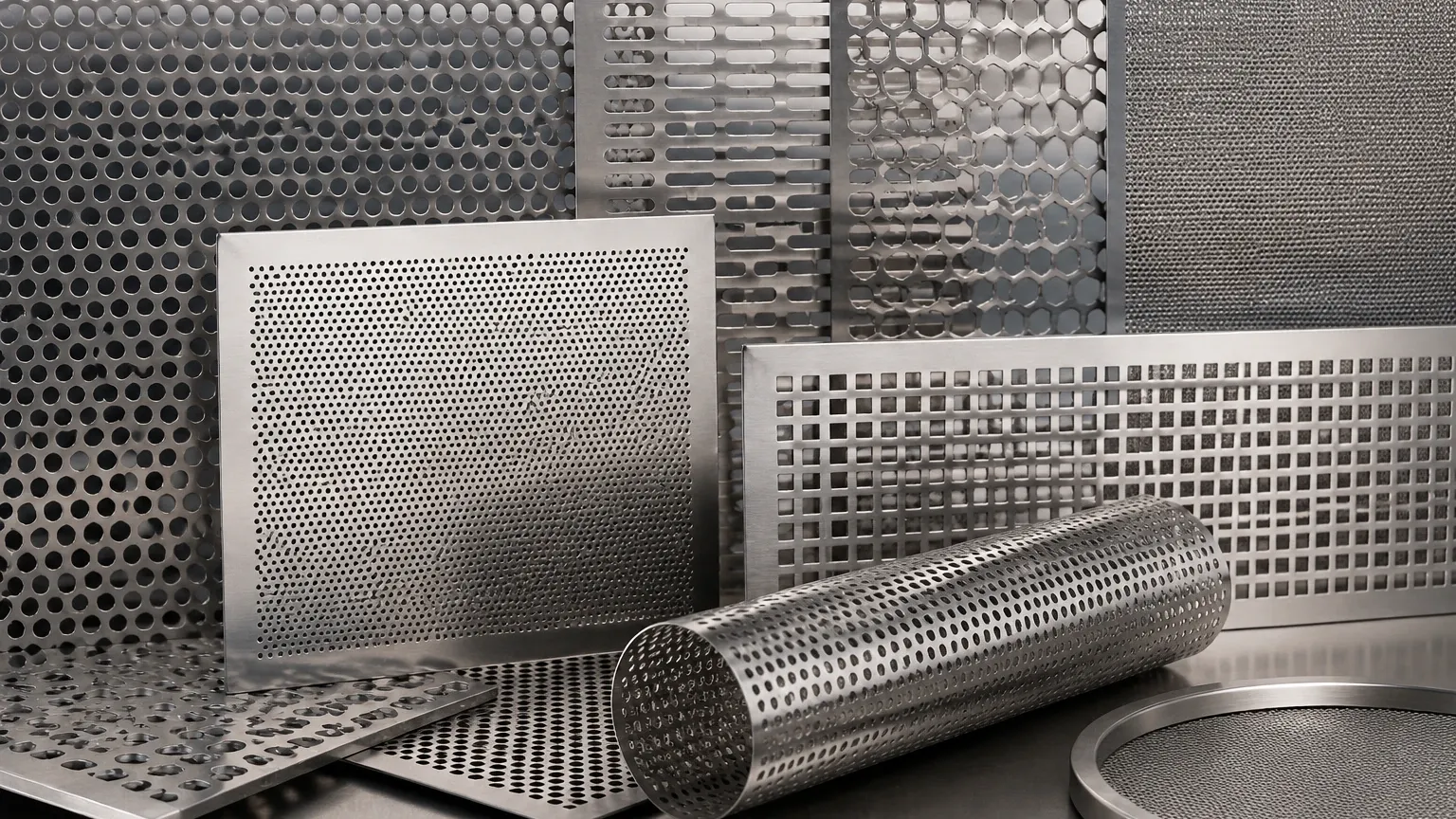
1. Round Holes: The most common and versatile shape. Round holes offer the greatest structural strength and are the easiest to manufacture efficiently. They are typically arranged in a 60-degree staggered pattern, which provides the highest open area and uniform strength in all directions.
2. Square Holes: Often used when a higher open area is required for maximum airflow or visibility. However, square holes can create stress concentrations at the corners, making them less ideal for high-pressure environments compared to round holes.
3. Slotted Holes: Frequently used in filtration or sorting applications where the direction of flow or the shape of the particles matters. Slotted grilles are often employed in drainage systems or as guards for machinery with specific cooling requirements.
Open Area Calculation
The "open area" refers to the percentage of the sheet that is comprised of holes. This is the most critical metric for HVAC and filtration engineers. A grille with too little open area will cause excessive backpressure, potentially damaging pumps or fans, while too much open area may compromise the structural integrity of the grille or allow unwanted debris to pass through.
For a standard 60-degree staggered round hole pattern, the open area (OA%) is calculated using the formula:
*OA% = (d² × 90.69) / p²*
*(Where 'd' is the hole diameter and 'p' is the center-to-center pitch).*
Material Selection and Environmental Compatibility
In industrial B2B applications, the material of the grille is often dictated by the chemical environment and the cleaning protocols of the facility. Kaifil specializes in stainless steel solutions, which are the industry standard for demanding environments.
Stainless Steel (304 and 316)
* Grade 304: Suitable for most general industrial applications. It provides excellent corrosion resistance and is cost-effective for indoor use or environments with minimal chemical exposure.
* Grade 316: Essential for marine environments, chemical processing plants, and pharmaceutical facilities. The addition of molybdenum provides superior resistance to chlorides and pitting corrosion, which is critical for grilles exposed to harsh cleaning agents or saline air.
Carbon Steel and Aluminum
While carbon steel is used for heavy-duty structural grilles, it requires secondary finishing like galvanizing or powder coating to prevent oxidation. Aluminum grilles are valued for their lightweight properties and natural resistance to atmospheric corrosion, making them suitable for lightweight HVAC components, though they lack the high-temperature resistance of stainless steel.
Engineering Considerations for Industrial Applications
When integrating perforated metal grilles into a system, engineers must look beyond the basic dimensions. Several secondary factors influence the total cost of ownership and the effectiveness of the component.
Margins and Blank Areas
Unlike standard stock sheets, custom-manufactured grilles can be designed with specific "margins." These are the solid areas around the perimeter of the perforated pattern. Specifying exact margins is necessary for bolt-hole alignment and welding. Without properly defined margins, the integrity of the mounting points may be compromised by holes that are too close to the edge.
Flatness and Tolerances
The perforation process introduces internal stresses into the metal sheet, which can cause bowing or warping. For high-precision grilles used in machinery guards or recessed floor vents, leveling is a necessary post-production step. Engineers should confirm the required flatness tolerances, especially if the grille must sit flush within a frame.
Surface Finishing
For the food and beverage and pharmaceutical sectors, the surface finish of the grille is a matter of hygiene. Electropolishing or pickling can be applied to stainless steel grilles to remove surface impurities and create a smooth, easy-to-clean finish that prevents bacterial growth. In industrial safety applications, a serrated or slip-resistant coating may be applied to expanded metal grilles used as foot-traffic surfaces.
Common Risks in Grille Procurement
One of the most frequent mistakes in specifying perforated metal grilles is overlooking the relationship between hole size and material thickness. As a general rule of thumb in metal punching, the hole diameter should not be smaller than the material thickness (1:1 ratio). Attempting to punch holes smaller than the thickness of the plate leads to high tool breakage rates and increased production costs.
Another risk is neglecting the "flow direction" in expanded metal grilles. Because the strands are angled, airflow or visibility may be restricted from certain angles. For perforated sheets, the direction of the stagger (long-way or short-way of the sheet) can affect how the material bends during fabrication, which is a vital consideration for curved grille designs.
Maintenance and Lifecycle Management
Industrial grilles are often "set and forget" components, but their maintenance is vital for system efficiency. In filtration and HVAC applications, the accumulation of particulate matter on the grille surface increases resistance and energy consumption.
* Cleaning Cycles: In food processing, grilles must be able to withstand high-pressure wash-downs. Stainless steel is preferred here because it does not degrade under frequent exposure to hot water and sanitizers.
* Inspection for Fatigue: In environments with high vibration (such as near large compressors), grilles should be inspected for stress cracks, particularly around the mounting holes and at the corners of square perforations.
* Replacement: When the structural integrity of the strands or the margins is compromised by corrosion or mechanical impact, immediate replacement is necessary to prevent downstream damage to sensitive equipment.
Conclusion: Confirming Requirements Before Production
To ensure the successful procurement of industrial grilles, purchasing teams and engineers should provide the manufacturer with a comprehensive data set. Before moving to the production phase for Perforated & Expanded Metal components, confirm the following:
* Material Grade: Is 304 sufficient, or does the environment require 316 stainless steel?
* Exact Dimensions: Including thickness (gauge), overall width/length, and required margins.
* Hole Pattern: Diameter, pitch, and orientation (staggered vs. straight).
* Open Area: Does the calculated percentage meet the airflow or filtration requirements?
* Post-Processing: Are there requirements for leveling, deburring, or specialized surface finishes?
By focusing on these technical boundaries, industrial professionals can secure grilles that provide the necessary protection and performance for their specific application. Kaifil’s expertise in custom metal fabrication ensures that every component, from simple ventilation grilles to complex filtration interfaces, is manufactured to the highest industrial standards, supporting the efficiency and safety of global industrial operations.
