


Perforated Metal Louvers
In industrial engineering and facility management, the requirement for controlled airflow often conflicts with the need for physical protection and debris exclusion. Perforated metal louvers serve as a critical technical solution to this challenge, bridging the gap between open ventilation and structural shielding. Unlike traditional slatted louvers, which are often assembled from multiple components, louvers fabricated from Perforated & Expanded Metal offer a unique combination of uniform airflow, high strength-to-weight ratios, and precise filtration capabilities.
For engineers and procurement teams, selecting the right perforated metal louvers requires an understanding of fluid dynamics, material science, and manufacturing tolerances. This guide examines the technical specifications, application logic, and selection criteria necessary to integrate these components into industrial systems effectively.
Understanding the Technical Role of Perforated Metal Louvers
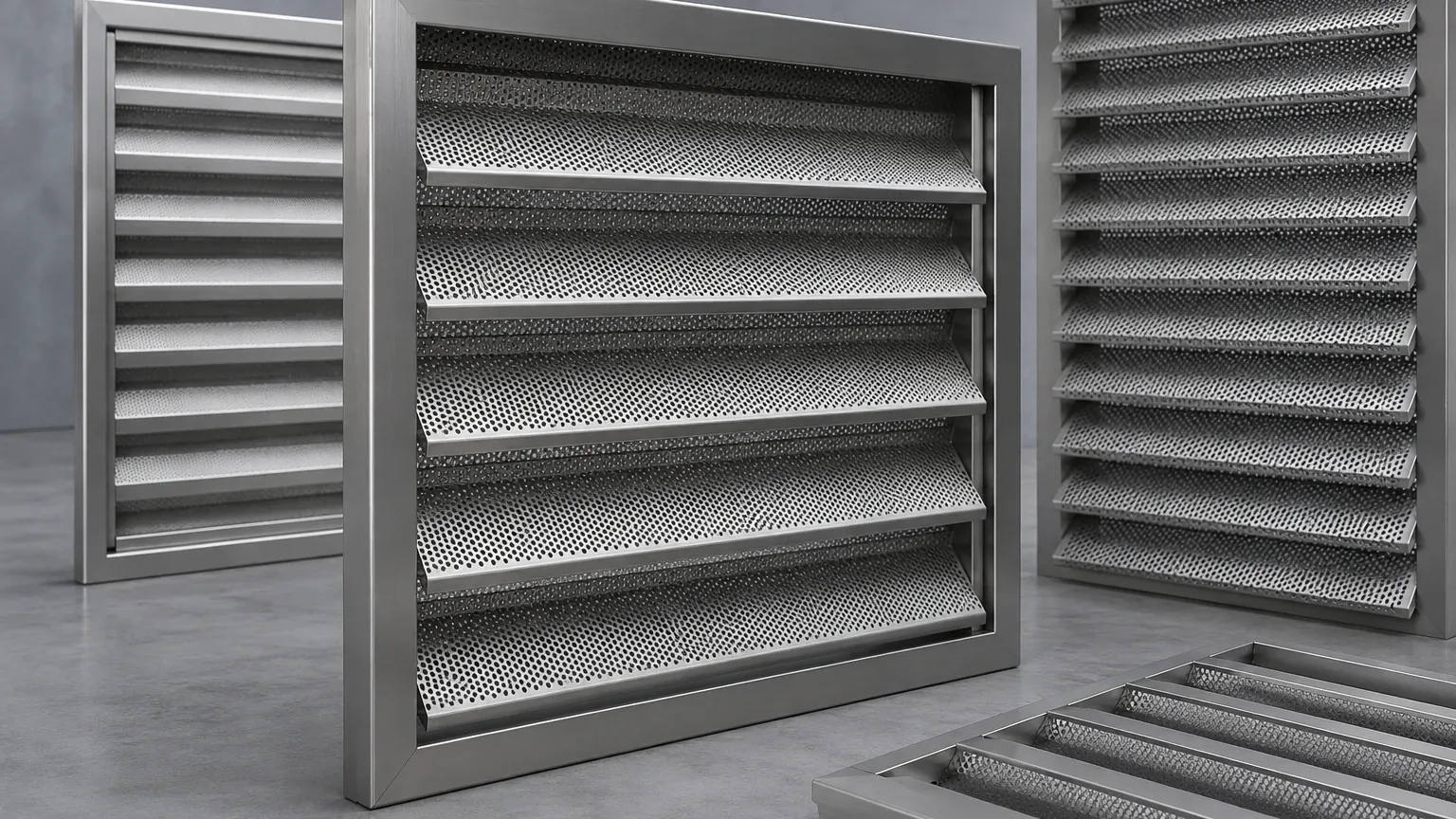
Perforated metal louvers are specialized components where the base material—typically a metal sheet—is punched with a specific pattern of holes and then formed or angled to provide directional flow or visual screening. In an industrial context, their primary function is to allow the passage of air or gases while preventing the ingress of rain, dust, or contaminants.
Because they are derived from perforated sheets, these louvers provide a more consistent barrier than traditional wide-slat designs. The "perforation" aspect allows for micro-level control over the open area, which is essential for maintaining specific pressure differentials in HVAC systems, machinery enclosures, and filtration housings. When high-precision manufacturing is applied, these components can also serve as secondary filtration stages, capturing larger particulates before they reach more sensitive primary filter cartridges.
Material Selection for Demanding Industrial Environments
Material integrity is the foundation of louver performance. In industrial sectors such as chemical processing, food and beverage, and pharmaceuticals, the environment is often corrosive or subject to extreme temperatures.
Stainless Steel (304 and 316 Grades)
Stainless steel is the preferred material for most technical filtration and ventilation applications. Grade 304 offers excellent durability and resistance to oxidation, making it suitable for general industrial use. However, in environments involving marine exposure or high concentrations of chlorides, Grade 316 is recommended due to its molybdenum content, which provides superior pitting resistance. For Kaifil’s clients, utilizing stainless steel ensures that the perforated metal louvers maintain their structural integrity even when exposed to aggressive cleaning agents or high-pressure washdowns.
Aluminum and Specialized Alloys
For applications where weight is a primary concern, such as in aerospace or mobile industrial equipment, aluminum louvers offer a high strength-to-weight ratio and natural corrosion resistance. In highly specialized chemical environments, alloys like Monel or Inconel may be specified to withstand extreme thermal cycling or acidic atmospheres. The choice of material directly impacts the longevity of the installation and the frequency of the replacement cycle.
Engineering Design: Open Area and Airflow Dynamics
The most critical specification for any perforated metal louver is the "Percentage of Open Area." This figure determines the volume of air that can pass through the louver and the resulting pressure drop across the component.
Calculating Open Area
Engineers must calculate the open area based on the hole diameter (D) and the center-to-center spacing, or pitch (P). For a standard 60-degree staggered pattern—the most common for industrial airflow—the formula for open area percentage is:
Open Area % = (D² × 90.69) / P²
In louver applications, the effective open area may be further modified by the angle of the louver slats. If the perforated metal is formed into a louvered profile, the projected open area decreases as the angle of the slat increases. This must be accounted for during the system design phase to ensure that fans or compressors are not overworked by an unexpected increase in static pressure.
Hole Patterns and Geometries
While round holes are the industry standard due to their structural stability and ease of manufacturing, square or hexagonal perforations may be used to maximize open area. However, round holes provide the most uniform distribution of stress, which is vital in high-vibration industrial environments. The choice of pattern affects not only airflow but also the "cutoff angle"—the angle at which the louver becomes visually opaque or physically impenetrable to straight-line debris.
Manufacturing Processes: Precision and Structural Integrity
The performance of perforated metal louvers depends heavily on the precision of the manufacturing process. Modern CNC punching and laser cutting allow for extremely tight tolerances, ensuring that every louver in a large-scale installation performs identically.
Fabrication and Forming
After the initial perforation of the metal sheet, the material undergoes forming. For louvers, this often involves specialized tooling that "lifts" sections of the metal to create an angled opening. This process must be managed carefully to avoid stress fractures at the corners of the perforations. High-quality manufacturing ensures that the "bridge" (the metal remaining between the holes) is not compromised during the bending process.
Finishing and Edge Treatment
In industrial filtration and ventilation, burrs or sharp edges can cause turbulence or trap contaminants, leading to bacterial growth in food-grade applications. Precision deburring and finishing, such as electropolishing or powder coating, are often required. Electropolishing is particularly valuable for stainless steel louvers, as it removes surface impurities and enhances the protective oxide layer, further increasing corrosion resistance.
Perforated Metal Louvers in Filtration Systems
While often viewed as architectural or ventilation components, perforated metal louvers play a significant role in industrial filtration. They are frequently used as the first line of defense in complex filtration assemblies.
1. Pre-Filtration Screens: In large-scale intake systems, perforated louvers act as a coarse filter, removing large debris, insects, and foliage. This protects the finer downstream filter cartridges from premature clogging and mechanical damage.
2. Flow Diffusers: In hydraulic or liquid filtration systems, louvered perforated metal can be used to diffuse the flow of incoming fluid, preventing high-velocity "jetting" that could damage delicate filter media.
3. Support Structures: Perforated metal provides the rigid skeleton required for many types of filter elements. When formed into a louvered shape, it can offer directional flow control within a filter housing, optimizing the contact time between the fluid and the filtration media.
Selection Criteria for Procurement and Engineering Teams
When sourcing perforated metal louvers for industrial projects, technical professionals should confirm several key parameters to ensure the component is fit for purpose:
* Flow Rate Requirements: What is the minimum CFM (Cubic Feet per Minute) required? This will dictate the necessary open area.
* Maximum Allowable Pressure Drop: Every louver introduces resistance. The design must ensure that the pressure drop does not exceed the system's operational limits.
* Environmental Exposure: Will the louver be exposed to salt spray, acidic fumes, or extreme heat? This determines the material grade and surface treatment.
* Debris Size Exclusion: What is the smallest object that must be prevented from passing through? This determines the maximum hole size.
* Structural Loading: Will the louver be subject to high wind loads, mechanical impact, or heavy vibration? This dictates the required gauge (thickness) of the metal.
By addressing these factors early in the procurement process, engineers can avoid costly retrofits and ensure the long-term reliability of the filtration or ventilation system.
Maintenance, Longevity, and Total Cost of Ownership
One of the primary advantages of using Perforated & Expanded Metal for louvers is the low maintenance requirement. Unlike plastic or thin-gauge mesh, heavy-duty metal louvers are resistant to UV degradation and mechanical wear.
Cleaning Protocols
In industrial settings, louvers can eventually become occluded by dust or grease. Stainless steel louvers are particularly easy to maintain, as they can be cleaned using high-pressure steam, chemical solvents, or ultrasonic baths without risk of degradation. The smooth surface of a well-finished perforated louver prevents the permanent adhesion of contaminants, simplifying the maintenance cycle.
Total Cost of Ownership (TCO)
While the initial cost of custom-fabricated stainless steel louvers may be higher than off-the-shelf alternatives, the TCO is significantly lower. The durability of the material, combined with the precision of the airflow design, results in fewer replacements, lower energy costs for fans and pumps, and better protection for expensive downstream equipment. For OEM applications, partnering with a manufacturer like Kaifil allows for the development of customized louver solutions that are optimized for the specific lifespan of the machinery they serve.
Conclusion: Selecting the Right Partner for Custom Solutions
Perforated metal louvers are more than just aesthetic covers; they are engineered components that play a vital role in the efficiency and safety of industrial processes. Whether they are used for ventilation in a chemical plant or as a protective screen in a high-precision filtration system, their performance is a direct result of material quality and design accuracy.
For engineers and purchasing teams, the key to a successful installation lies in specifying the correct parameters—material grade, open area, and hole geometry—and working with a manufacturer capable of meeting those technical demands. By focusing on these factual engineering boundaries, organizations can ensure that their filtration and ventilation systems operate at peak performance for years to come.
