


Perforated Metal Net
In the landscape of industrial filtration and mechanical separation, the perforated metal net serves as a critical component for both primary filtration and structural reinforcement. Unlike woven wire mesh, which is formed by interlacing wires, a perforated metal net is manufactured by mechanically punching or laser-cutting precise hole patterns into solid metal sheets. This process results in a medium that offers exceptional dimensional stability, high mechanical strength, and predictable flow characteristics.
For engineers and procurement specialists in sectors such as chemical processing, pharmaceuticals, and food production, selecting the right Perforated & Expanded Metal solution is essential for optimizing system performance and ensuring the longevity of filtration equipment. This guide examines the technical specifications, material considerations, and engineering trade-offs involved in specifying perforated metal components for demanding industrial environments.
Technical Fundamentals of Perforated Metal Net
The performance of a perforated metal net is defined by its geometric configuration. Unlike flexible media, the rigid nature of perforated sheets allows for precise control over the filtration environment. The primary specifications include hole shape, hole size (aperture), pitch, and the resulting open area.
Hole Patterns and Geometry
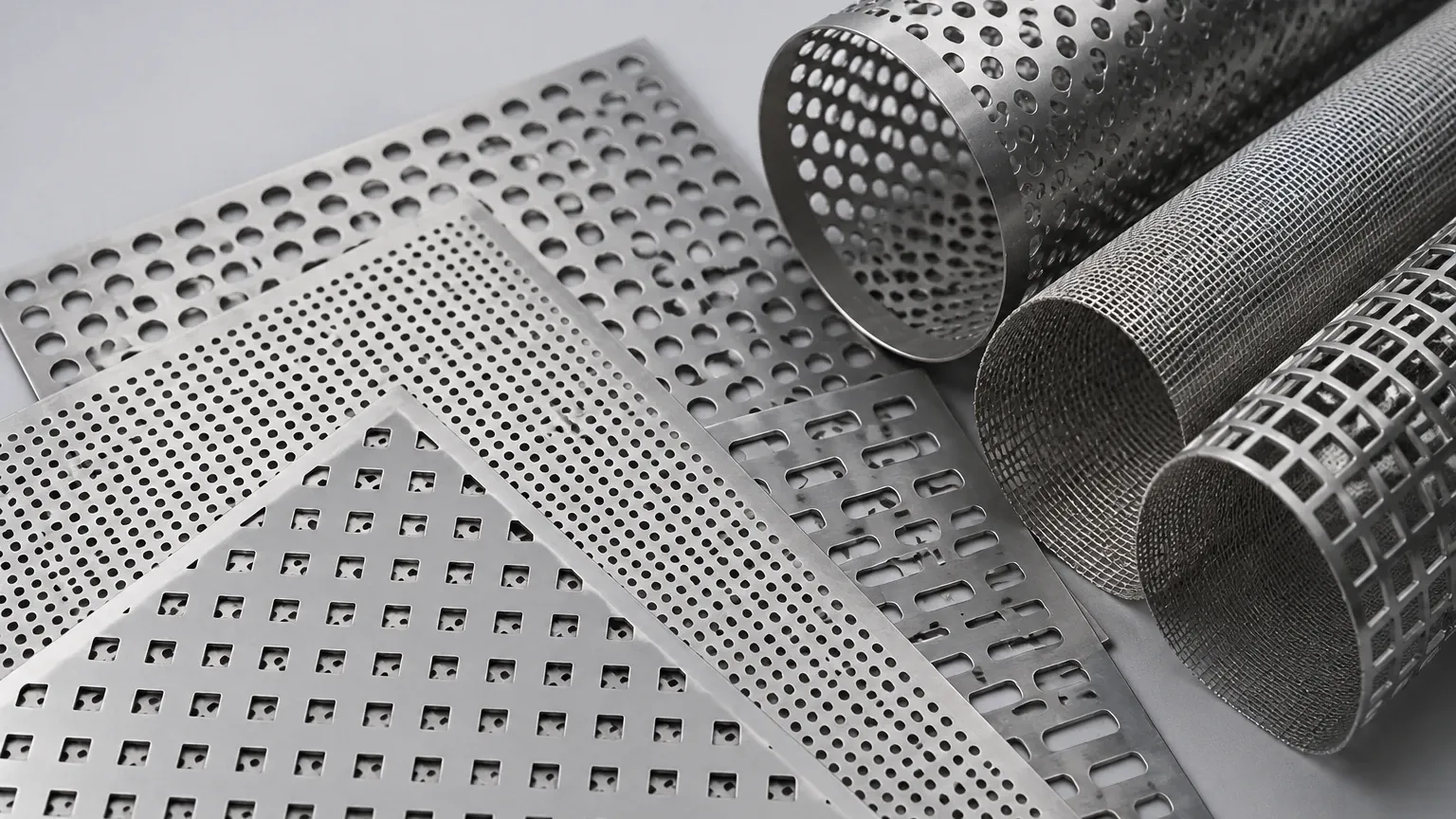
Round holes are the most common configuration due to their structural integrity and ease of manufacturing. However, depending on the application, other shapes may be required:
* Round Holes: Offer the best balance of strength and open area. They are typically arranged in a 60-degree staggered pattern to maximize the number of holes per square inch.
* Square Holes: Provide a higher open area compared to round holes of the same width, making them suitable for applications requiring high flow rates at lower pressures.
* Slotted Holes: Often used for the separation of elongated particles or in applications where the direction of flow requires specific orientation to prevent clogging.
Calculating Open Area
The "open area" is the percentage of the sheet that is comprised of holes. This is the most critical factor for determining the pressure drop across the filter. For a standard 60-degree staggered round hole pattern, the open area is calculated using the formula:
*Area % = (D² × 90.69) / R²*
(Where D is the hole diameter and R is the center-to-center pitch).
Engineers must balance the desire for a high open area (to reduce energy costs and pressure drop) with the requirement for mechanical strength. A perforated metal net with too high an open area may deform under high-pressure differentials, leading to system failure.
Material Selection for Industrial Environments
Kaifil specializes in stainless steel filtration solutions because industrial applications frequently involve corrosive fluids, high temperatures, and strict hygiene requirements. The choice of alloy significantly impacts the total cost of ownership and the replacement cycle of the perforated metal net.
Stainless Steel 304
Grade 304 is the standard for general industrial use. It provides excellent corrosion resistance in most atmospheric conditions and is widely used in food and beverage processing. It is a cost-effective choice for applications where the medium is not exposed to high concentrations of chlorides or acids.
Stainless Steel 316 and 316L
For more aggressive environments, such as chemical processing or marine applications, Stainless Steel 316 is preferred. The addition of molybdenum enhances resistance to pitting and crevice corrosion. 316L (low carbon) is specifically used in applications involving welding, as it prevents carbide precipitation that can lead to intergranular corrosion. This is a critical consideration for custom-fabricated filter cartridges where the perforated metal net is rolled and seam-welded.
Specialty Alloys
In extreme cases involving high-temperature oxidation or highly acidic environments, specialty alloys like Monel, Inconel, or Hastelloy may be used. These materials ensure that the perforated structure maintains its integrity even when exposed to harsh chemical reagents.
The Role of Perforated Metal Net in Multi-Stage Filtration
While a perforated metal net can act as a primary coarse filter (straining particles measured in millimeters), its most common role in high-precision industrial filtration is as a support structure.
Structural Support for Fine Mesh
Fine stainless steel wire mesh, which can filter down to several microns, lacks the inherent rigidity to withstand high-pressure flows. In these configurations, a perforated metal net acts as the "skeleton" or support core. The wire mesh is wrapped around or sintered to the perforated sheet. This hybrid design allows the filter to achieve high filtration accuracy while maintaining the structural strength necessary to resist collapsing or bursting under hydraulic surges.
Flow Distribution
In large-scale chemical reactors or water treatment vessels, perforated sheets are used as internal distributors. The precise hole arrangement ensures that the fluid is distributed evenly across the entire surface of the primary filter bed or catalyst, preventing "channeling" where the fluid takes the path of least resistance and bypasses the filtration media.
Engineering Considerations: Pressure Drop and Clogging
When specifying a perforated metal net, engineers must account for the fluid dynamics of the specific application. Two primary concerns are the initial pressure drop and the rate of blinding (clogging).
Pressure Drop Analysis
The pressure drop is influenced by the fluid viscosity, flow velocity, and the open area of the perforated sheet. A lower open area increases the velocity of the fluid as it passes through the holes, which can lead to turbulence and a significant increase in energy consumption for pumps. Kaifil provides technical consultation to ensure the selected pitch and hole size align with the system's pump curves and flow requirements.
Mitigating Blinding and Clogging
Blinding occurs when particles become lodged in the holes. In perforated media, the risk of blinding is often lower than in woven mesh because the holes are smooth and lack the "pockets" found in wire intersections. To further reduce this risk, manufacturers may use conical or tapered holes (wider on the discharge side), which allow particles that pass the initial opening to clear the plate easily.
Manufacturing Precision and Customization
Industrial applications often require more than just standard off-the-shelf sheets. Customization is where the technical expertise of a manufacturer like Kaifil becomes vital.
CNC Punching and Tolerances
Modern CNC punching allows for extreme precision in hole placement. This is essential for components that must fit into tight tolerances within hydraulic housings or pharmaceutical centrifuges. Precision manufacturing ensures that the margins (the unperforated areas around the edges) are consistent, which is necessary for secure mounting and welding.
Surface Finishing
Post-production treatments are often required to meet industry standards:
* Deburring: Essential for removing sharp edges that could trap debris or damage sensitive downstream components.
* Passivation: A chemical process that removes free iron from the surface, enhancing the natural corrosion resistance of the stainless steel.
* Electropolishing: Often required in the pharmaceutical and food industries to create a microscopically smooth surface that prevents bacterial growth and facilitates easy cleaning.
Perforated vs. Expanded Metal: A Comparison
While both materials are used in filtration, they serve different purposes. Perforated & Expanded Metal options are often compared based on cost and performance.
* Perforated Metal: Created by removing material. It offers higher precision in hole size and shape, making it better for specific particle size exclusion. It is generally easier to clean and has a smoother surface.
* Expanded Metal: Created by slitting and stretching the metal. There is no material waste, making it a more economical choice for large-scale structural supports. However, the openings are diamond-shaped and have angled edges, which may not be suitable for precise filtration or applications where a smooth surface is required.
Maintenance and Replacement Cycles
One of the primary advantages of a stainless steel perforated metal net is its durability. Unlike polymer-based filters, metal nets can be cleaned and reused multiple times.
Cleaning Protocols
Depending on the contaminant, perforated filters can be cleaned using:
* Backwashing: Reversing the flow to dislodge particles.
* Ultrasonic Cleaning: Using high-frequency sound waves in a solvent bath to remove fine particles from the apertures.
* Chemical Cleaning: Using mild acids or bases to dissolve organic or mineral buildup, provided the alloy is compatible with the cleaning agent.
Identifying the Need for Replacement
Despite their durability, perforated components should be inspected for:
1. Mechanical Fatigue: Cracks appearing in the bridges between holes.
2. Erosion: Thinning of the metal due to high-velocity abrasive particles.
3. Permanent Blinding: Scale buildup that cannot be removed by standard cleaning, leading to an unacceptably high baseline pressure drop.
Conclusion
The selection of a perforated metal net involves a complex interplay of material science, fluid dynamics, and mechanical engineering. By understanding the relationship between hole patterns, open area, and material grades, purchasing teams and engineers can specify components that not only meet filtration requirements but also contribute to the overall efficiency and reliability of the industrial system.
As a professional manufacturer, Kaifil provides the technical depth and manufacturing flexibility required to produce custom filtration components that stand up to the most demanding environments. Whether you require a high-strength support core for a hydraulic system or a precision-punched screen for chemical processing, choosing a high-quality perforated solution is a fundamental step toward optimized industrial performance.
