


Perforated Metal Nz
In the industrial landscape of New Zealand, from the high-output dairy processing plants of the Waikato to the marine engineering hubs in Auckland, the demand for precision-engineered components is constant. Among these, perforated metal serves as a fundamental building block for filtration, separation, and structural applications. For engineers and procurement specialists sourcing perforated metal nz solutions, understanding the technical nuances of material selection, hole geometry, and manufacturing tolerances is essential to ensuring long-term operational efficiency and compliance with local industry standards.
Industrial filtration requires more than just a sheet of metal with holes; it requires a calculated balance of open area, mechanical strength, and chemical resistance. This article explores the technical specifications and engineering considerations necessary for selecting the right perforated and expanded metal products for demanding New Zealand environments.
Understanding Perforated Metal Specifications
The performance of a perforated metal component is defined by its geometric configuration. When specifying perforated metal for industrial use, engineers must define several key parameters that dictate how the material will behave under pressure and flow.
Hole Patterns and Pitch
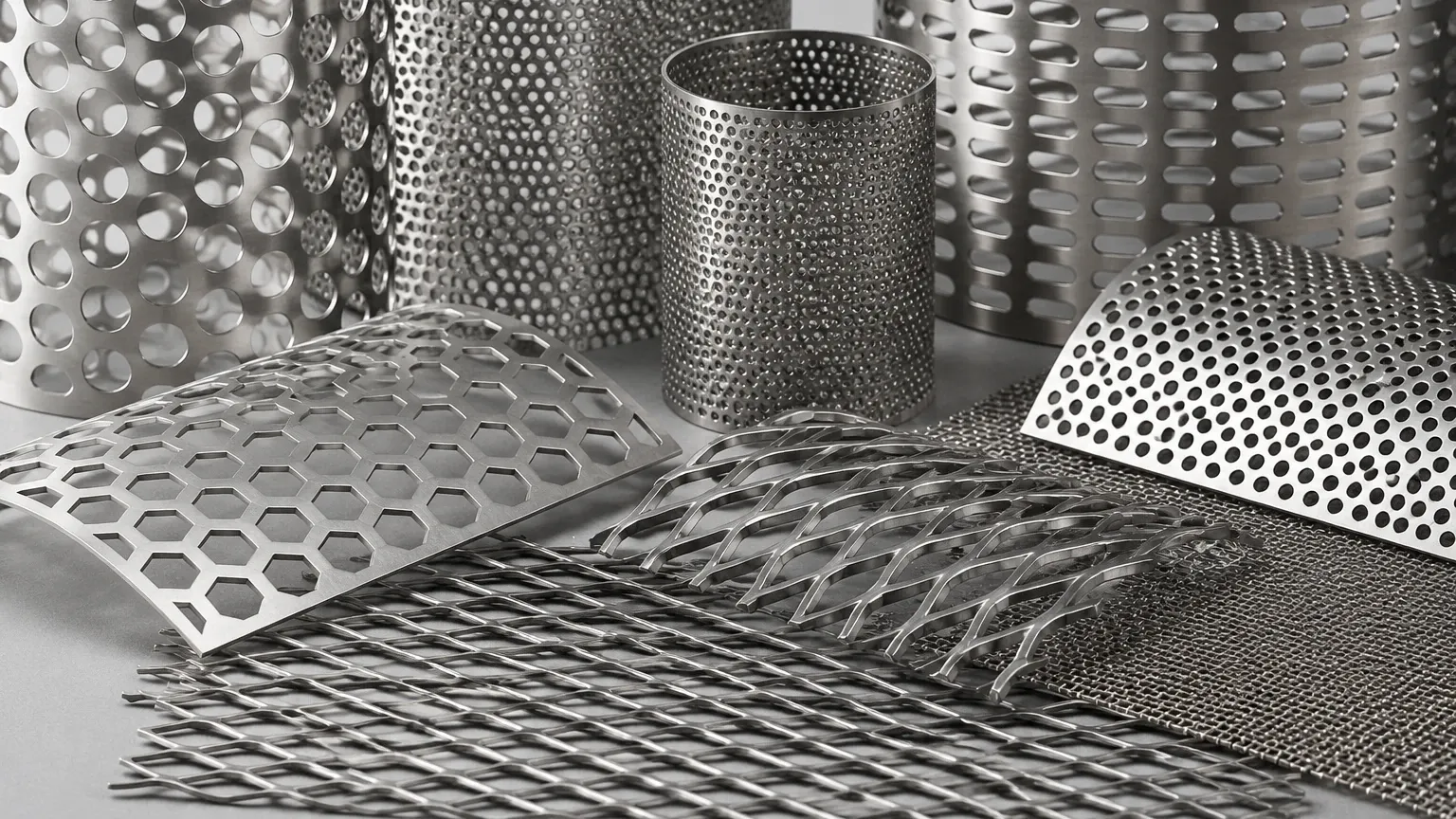
Round holes are the most common choice due to their structural integrity and ease of manufacturing. These are typically arranged in a 60-degree staggered pattern, which provides the highest degree of open area and uniform strength across the sheet. Other patterns include square holes, which offer a higher open area for airflow applications, and slotted holes, which are frequently used in the screening of elongated particles or in drainage systems.
Pitch refers to the center-to-center distance between adjacent holes. This measurement, combined with the hole diameter, determines the "Open Area" percentage. For a staggered round hole pattern, the formula for calculating the open area is:
Open Area % = (D² × 90.69) / P²
*(Where D is the hole diameter and P is the pitch)*
The Importance of Open Area
In filtration and heat exchange, the open area directly impacts the pressure drop across the medium. A higher open area reduces resistance to flow but can compromise the structural rigidity of the sheet. In the context of perforated metal nz applications—particularly in the dairy and food processing sectors—achieving the correct open area is critical to maintaining throughput while ensuring the screen can withstand the mechanical stresses of Clean-in-Place (CIP) cycles.
Material Selection: Stainless Steel for NZ Environments
New Zealand’s unique environmental conditions, characterized by high humidity and coastal salt spray, necessitate careful material selection. For industrial filtration and architectural applications, stainless steel is the gold standard.
Grade 304 vs. Grade 316L
* Grade 304: This is the standard "18/8" stainless steel. It is suitable for most indoor industrial applications and provides excellent forming and welding characteristics. It is widely used in general machinery and food processing environments where corrosive exposure is moderate.
* Grade 316L: Containing molybdenum, Grade 316L offers significantly higher resistance to pitting and crevice corrosion in chloride-rich environments. For any application near the coast or involving harsh chemical cleaning agents, 316L is the required specification to prevent premature failure.
In the New Zealand dairy industry, the use of 316L is often a regulatory or best-practice requirement for components that come into direct contact with product or sanitizing chemicals. The low carbon content ("L") in 316L also minimizes carbide precipitation during welding, ensuring the integrity of the perforated cylinders or filter housings.
Perforated & Expanded Metal: Comparing Manufacturing Methods
While often grouped together, perforated metal and expanded metal are produced through different processes, resulting in distinct physical properties. Choosing between Perforated & Expanded Metal depends on the specific requirements of the application.
Perforated Metal
Perforated metal is created by punching a series of holes into a solid sheet. This process allows for high precision in hole size and placement. It is the preferred choice for fine filtration where exact particle retention is required. Furthermore, perforated sheets can be produced with "blind margins"—solid areas around the edges or within the sheet—which facilitate easier welding and integration into filter frames or housings.
Expanded Metal
Expanded metal is manufactured by simultaneously slitting and stretching a sheet of metal. This process creates diamond-shaped openings. Because no material is lost during production, it is a highly cost-effective solution. Expanded metal is often used for:
* Support structures: Acting as a rigid backing for finer wire mesh filters.
* Safety guards: Protecting machinery while allowing airflow.
* Walkways: Providing non-slip surfaces in industrial plants.
However, expanded metal lacks the precise aperture control of perforated metal, making it less suitable for high-accuracy filtration tasks.
Engineering Considerations for Filtration Performance
When designing a filtration system using perforated metal nz components, engineers must look beyond the initial purchase price and consider the Total Cost of Ownership (TCO). This involves evaluating how the filter will perform under real-world operational loads.
Mechanical Strength and Pressure Differential
In hydraulic and high-pressure liquid filtration, the perforated metal must resist deformation. As debris accumulates on the surface of the filter, the pressure differential (ΔP) increases. If the material thickness or the ligament width (the distance between holes) is insufficient, the screen may buckle or tear. Engineering teams should calculate the maximum allowable pressure drop and select a gauge thickness that provides a safety factor of at least 2:1 or 3:1 depending on the criticality of the system.
Surface Finish and Cleanability
In the pharmaceutical and food sectors, the surface finish of the metal is as important as the hole size. A rough surface can harbor bacteria and biofilms. Electropolishing or mechanical polishing to a specific Ra (Roughness Average) value is often necessary to meet hygiene standards. Perforated stainless steel is inherently easier to clean than woven wire mesh, making it a preferred primary filter in sanitary applications.
Customization and OEM Solutions
Standard off-the-shelf perforated sheets rarely meet the exact needs of specialized industrial equipment. Customization is often necessary to optimize performance. For New Zealand manufacturers and maintenance teams, working with a supplier capable of providing custom OEM solutions is a strategic advantage.
Custom Fabrications
Beyond flat sheets, perforated metal can be formed into various shapes:
* Cylindrical Filters: Used in pipe systems for inline straining.
* Conical Strainers: Often used during the commissioning of new piping systems to catch construction debris.
* Basket Filters: Utilized in batch processing where high solids loading is expected.
Customization also extends to the margin widths. By specifying exact margins, engineers can ensure that the perforated area aligns perfectly with the flow path of the fluid, while the solid margins provide a robust surface for gasket sealing or structural welding.
Common Risks and Quality Assurance
Sourcing perforated metal nz requires vigilance regarding quality control. Substandard manufacturing can lead to several issues that compromise industrial systems:
1. Burrs and Sharp Edges: Incomplete punching or dull dies can leave burrs on the exit side of the hole. In filtration, these burrs can trap fibers or cause turbulence. In food processing, they represent a significant contamination risk if they break off.
2. Inconsistent Hole Pitch: Variations in the spacing between holes can lead to uneven flow distribution, causing localized wear on the filter medium and reducing the overall lifespan of the component.
3. Material Substitution: Lower-grade alloys may be incorrectly labeled as 304 or 316. Verifying material mill certificates is a necessary step in the procurement process to ensure corrosion resistance.
The Role of Perforated Metal in Sustainable Industry
As New Zealand industries move toward more sustainable practices, the durability of stainless steel perforated metal becomes a key factor. Unlike disposable synthetic filters, stainless steel components are reusable and can be cleaned repeatedly. At the end of their multi-year service life, they are 100% recyclable, aligning with circular economy goals and reducing the environmental footprint of industrial operations.
Conclusion
Selecting the right perforated metal nz solution involves a deep dive into technical variables. Whether the goal is to protect a high-pressure pump in a dairy factory or to provide a durable screen for a water treatment plant, the choice of material, hole pattern, and manufacturing precision will dictate the success of the application. By focusing on high-grade stainless steel and precise engineering specifications, New Zealand's industrial sectors can ensure reliable, long-term performance from their filtration and separation systems.
For engineers looking to optimize their systems, the integration of Perforated & Expanded Metal components offers a balance of versatility and strength that few other materials can match. When sourcing these components, confirming material certifications, hole tolerances, and customization capabilities is the final, crucial step before implementation.
