


Perforated Steel Near Me
For engineers and procurement professionals in the industrial sector, sourcing perforated steel is a task that balances logistical convenience with technical precision. While searching for "perforated steel near me" often yields local metal service centers or general hardware distributors, the requirements of industrial filtration and structural engineering frequently demand a level of customization and material integrity that standard stock items cannot provide.
Understanding the distinction between a local distributor and a specialized manufacturer is critical for ensuring the longevity and efficiency of your filtration systems. This guide examines the technical specifications, material considerations, and sourcing strategies for Perforated & Expanded Metal, focusing on how these components function within demanding industrial environments.
The Role of Perforated & Expanded Metal in Industrial Filtration
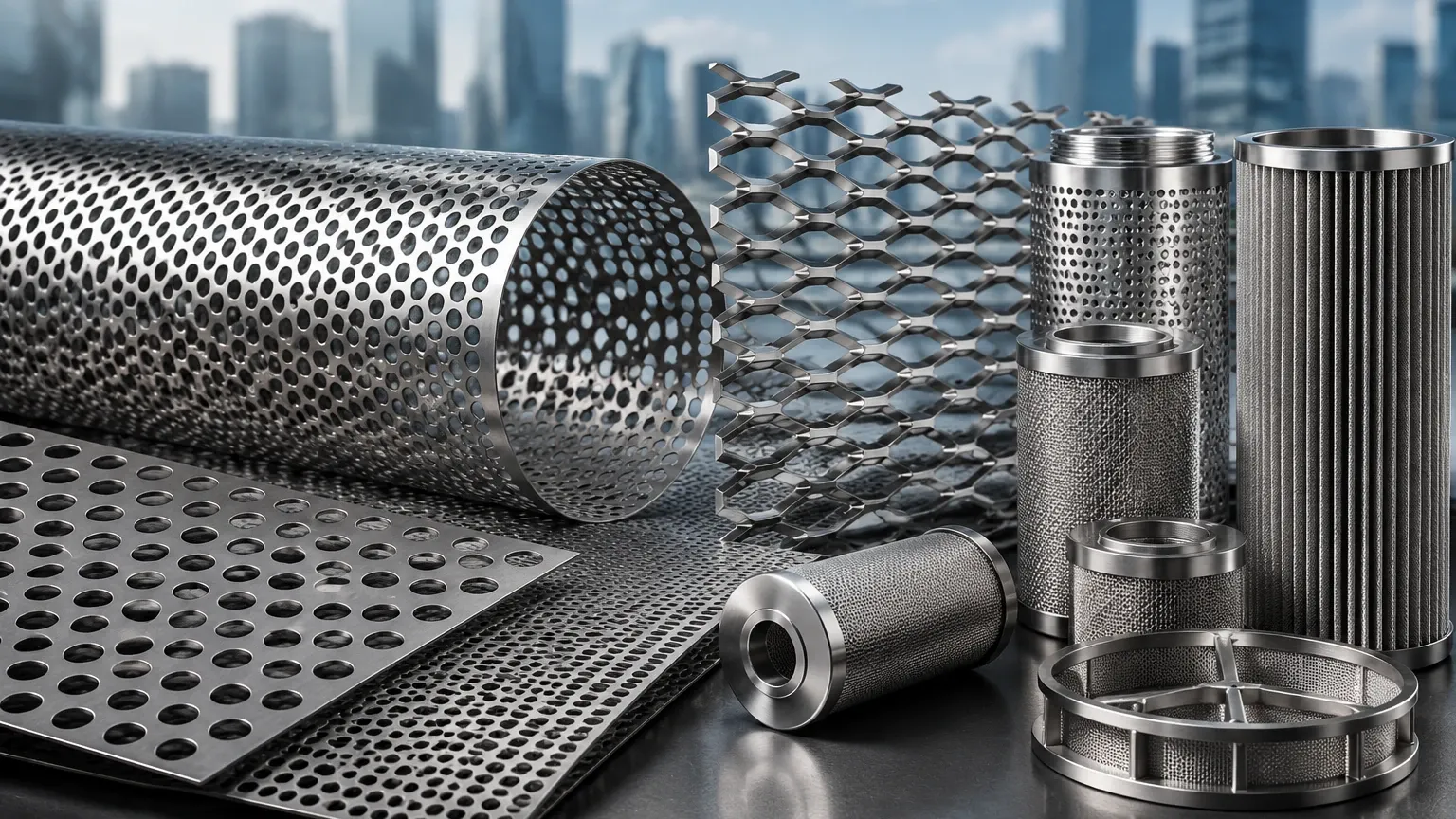
Perforated and expanded metals serve as the backbone of many industrial filtration systems. In many applications, these materials act as a primary filter medium; in others, they provide the necessary structural support for finer wire mesh or synthetic filter media.
Perforated Metal
Perforated metal is produced by mechanically punching or laser-cutting holes into a solid sheet of metal. This process allows for extreme precision in hole size, shape, and spacing. In filtration, the accuracy of the perforation directly correlates to the consistency of the flow rate and the particle retention size. Engineers often specify perforated steel for its high strength-to-weight ratio and its ability to withstand significant pressure differentials without deforming.
Expanded Metal
Expanded metal is created by simultaneously slitting and stretching a metal sheet, resulting in a diamond-shaped pattern. Unlike perforation, this process involves no material waste, making it a cost-effective solution for large-scale applications. In filtration, expanded metal is frequently used as a support cage for filter cartridges, providing a rigid framework that allows for maximum open area and minimal flow resistance.
Evaluating "Perforated Steel Near Me": Local Supply vs. Technical Manufacturing
When a project requires immediate replacement parts or small quantities of standard sheets, local suppliers are an invaluable resource. However, for B2B applications involving custom machinery, chemical processing, or high-pressure hydraulics, the "near me" search must be weighed against the technical capabilities of the supplier.
When to Use Local Distributors
Local service centers are ideal for:
* Standard 4'x8' or 5'x10' sheets of carbon steel or aluminum.
* General architectural or decorative applications.
* Small-scale maintenance and repair operations (MRO) where technical specifications are flexible.
* Projects with minimal lead times where freight costs for small orders are prohibitive.
When to Partner with a Specialized Manufacturer
For industrial filtration, a specialized manufacturer like Kaifil offers advantages that local generalists typically cannot:
* Custom Tooling: The ability to create non-standard hole patterns or specific margins required for welding and assembly.
* Material Traceability: Providing Mill Test Reports (MTRs) to verify the chemical composition of stainless steel alloys, which is essential for pharmaceutical and food-grade applications.
* Secondary Operations: In-house capabilities for rolling, welding, degreasing, and passivating the metal to ensure it is ready for immediate integration into a filtration assembly.
* Engineering Support: Assistance in calculating open areas and predicting pressure drops based on specific fluid dynamics.
Technical Specifications: Hole Patterns and Open Area Calculations
The performance of perforated steel is defined by its geometry. Selecting the right pattern is not merely an aesthetic choice; it is a functional requirement that dictates the efficiency of the entire system.
Hole Shapes
* Round Holes: The most common and versatile pattern. Round holes offer the highest structural integrity and are the easiest to manufacture, making them the most cost-effective option for most filtration needs.
* Square Holes: Provide a higher open area than round holes but may lead to stress concentrations at the corners, which can be a point of failure in high-vibration environments.
* Slotted Holes: Ideal for filtering elongated particles or for use in vibrating screens where material flow direction is critical.
Calculating Open Area
The percentage of open area determines the flow capacity and the pressure drop across the filter. For a standard 60-degree staggered round hole pattern, the formula is:
Open Area % = (D² × 90.69) / P²
Where:
* D = Hole diameter
* P = Center-to-center pitch
An engineer must balance a high open area (for better flow) with the remaining "bridge" of metal (for structural strength). If the bridge is too narrow, the perforated steel may buckle under the mechanical load of the fluid or gas being filtered.
Material Properties: Why Stainless Steel Dominates Industrial Applications
While searching for perforated steel near me, the choice of alloy is often the most critical factor in the total cost of ownership. While carbon steel is less expensive upfront, its susceptibility to corrosion often makes it unsuitable for industrial filtration.
304 Stainless Steel
304 is the standard industrial grade, offering excellent corrosion resistance to most oxidizing acids and common environmental factors. It is widely used in food and beverage processing due to its ease of cleaning and durability.
316 Stainless Steel
For more aggressive environments, such as chemical processing plants or marine applications, 316 stainless steel is preferred. The addition of molybdenum enhances its resistance to pitting and crevice corrosion in chloride-rich environments.
Specialty Alloys
In high-temperature or highly corrosive settings, engineers may specify exotic alloys like Monel, Inconel, or Hastelloy. Manufacturers specializing in filtration components are better equipped to source and process these difficult-to-work-with materials than general local suppliers.
Engineering Considerations for Filtration Applications
Integrating perforated or expanded metal into a filtration system requires more than just selecting a hole size. Several engineering factors must be confirmed before procurement.
1. Pressure Differential (ΔP)
The filter must be able to withstand the maximum expected pressure drop as the filter media becomes loaded with contaminants. This is particularly important for perforated support tubes in hydraulic systems, where sudden pressure spikes are common.
2. Edge Margins
Unlike standard stock sheets, custom-perforated components can be manufactured with "safe margins"—solid metal borders around the perforated area. These margins are essential for clean welding and to prevent the fraying or weakening of the material at the attachment points.
3. Surface Finish
In pharmaceutical and food-grade applications, the surface finish of the perforated steel is paramount. Burrs or rough edges left by the punching process can harbor bacteria or snag fibers. Specialized manufacturers provide deburring and electropolishing services to ensure a smooth, sanitary surface.
Customization and OEM Capabilities
For Original Equipment Manufacturers (OEMs), the ability to source custom-engineered components is a competitive advantage. When a standard "off-the-shelf" sheet from a local supplier does not meet the design parameters, custom fabrication becomes necessary.
Kaifil specializes in producing custom stainless steel filtration solutions that integrate perforated and expanded metal into complete assemblies. This includes:
* Filter Cartridges: Multi-layered designs where perforated steel provides the outer protection and inner support for fine wire mesh.
* Conical and Basket Strainers: Custom-shaped filters designed to fit specific pipe diameters and flow requirements.
* Precision Components: Small-scale perforated parts with micronic accuracy for specialized laboratory or medical equipment.
By working directly with a manufacturer, purchasing teams can ensure that the components are delivered to exact tolerances, reducing the need for secondary adjustments on the assembly line.
Procurement Checklist: What to Confirm Before Ordering
Before finalizing a purchase from a supplier found via a "perforated steel near me" search, engineers should confirm the following technical details:
1. Material Grade: Is the alloy verified by a mill certificate?
2. Hole Size and Pitch: Are the dimensions precise enough for the intended filtration rating?
3. Gauge/Thickness: Is the material thick enough to handle the mechanical load but thin enough to meet weight requirements?
4. Flatness Requirements: Will the sheets require leveling after the perforation process to ensure they can be rolled or welded accurately?
5. Cleaning Standards: Does the application require the removal of oils, lubricants, or burrs used during manufacturing?
Conclusion: Selecting the Right Partner
The search for "perforated steel near me" is often the starting point for a larger engineering discussion. While local availability is a factor, the success of an industrial filtration project depends on material quality, precision engineering, and the ability to customize components to specific application needs.
For high-performance environments—ranging from chemical processing to food production—partnering with a manufacturer that understands the nuances of filtration is essential. By focusing on technical specifications like open area, material grade, and structural integrity, procurement teams can secure components that offer long-term reliability and lower total costs.
For more information on technical specifications or to discuss custom requirements for your next project, Review product options and application support to see how precision-manufactured perforated and expanded metals can optimize your filtration performance.
