


Painting Perforated Metal
In industrial manufacturing and filtration engineering, the finishing of metal components is as critical as the initial fabrication. Perforated metal sheets and components serve diverse roles, from high-precision liquid filtration to structural ventilation and protective shielding. While stainless steel is often selected for its inherent corrosion resistance, many applications require additional surface treatments. Painting perforated metal is a common requirement for enhancing chemical resistance, providing safety color-coding, or achieving specific aesthetic goals in architectural-industrial hybrids.
However, applying a coating to a perforated surface introduces technical complexities that differ significantly from painting solid sheets. Engineers must account for hole occlusion, edge coverage, and the impact of coating thickness on the final open area. This guide examines the technical considerations, preparation protocols, and application methods required to ensure a high-performance finish on Perforated & Expanded Metal components.
The Role of Surface Finishes in Industrial Filtration and Components
Industrial filters and metal components often operate in aggressive environments. Whether exposed to saline atmospheres, acidic chemical processing streams, or high-humidity food production floors, the metal substrate requires protection. Painting or powder coating serves several functional purposes beyond simple aesthetics.
Corrosion Mitigation
For carbon steel perforated sheets, painting is the primary defense against oxidation. Even for certain grades of stainless steel used in highly corrosive environments, a specialized epoxy or fluoropolymer coating can provide an additional barrier against pitting and crevice corrosion. In filtration systems, where the metal may be submerged or subjected to frequent pressure washing, the integrity of this barrier is paramount.
Identification and Safety
In complex industrial plants, color-coding is used to identify the contents of a filtration system or the safety level of a machine guard. Painting perforated metal allows engineers to integrate these components into a facility-wide safety protocol, ensuring that maintenance teams can quickly identify specific filter housings or protective barriers.
Friction and Flow Characteristics
Certain industrial coatings are designed to reduce surface friction. In air filtration or material handling, a smooth, painted surface can prevent the accumulation of debris (blinding) on the surface of the perforated metal, thereby extending the service life between cleaning cycles.
Material Compatibility and Substrate Preparation
The success of painting perforated metal depends heavily on the preparation of the substrate. Without proper pre-treatment, the coating will fail to adhere, leading to delamination—a critical failure mode that can contaminate the very fluid streams the filter is meant to protect.
Substrate Selection
* Stainless Steel: Typically requires an acid etch or mechanical abrasion to create a profile for paint adhesion. Due to its passive oxide layer, standard paints will not bond without specific primers.
* Carbon Steel: Must be completely free of mill scale and rust. It is often treated with a zinc-rich primer to provide cathodic protection.
* Aluminum: Requires a conversion coating (such as chromate or non-chromate pre-treatment) to prevent the formation of aluminum oxide under the paint film.
Cleaning and Degreasing
Perforated metals are often manufactured using lubricants and cooling oils during the punching or expanding process. These residues must be removed using industrial degreasers or alkaline cleaners. If oils remain in the small crevices of the perforations, the paint will pull away from the edges, leaving the metal exposed to the environment.
Mechanical Pre-treatment
For heavy-duty industrial applications, sandblasting or bead blasting is recommended. This process removes surface contaminants and creates a "micro-anchor" pattern. For fine-mesh perforated sheets, care must be taken to ensure the blasting media does not deform the thin metal bridges between the holes.
Critical Techniques for Painting Perforated Metal
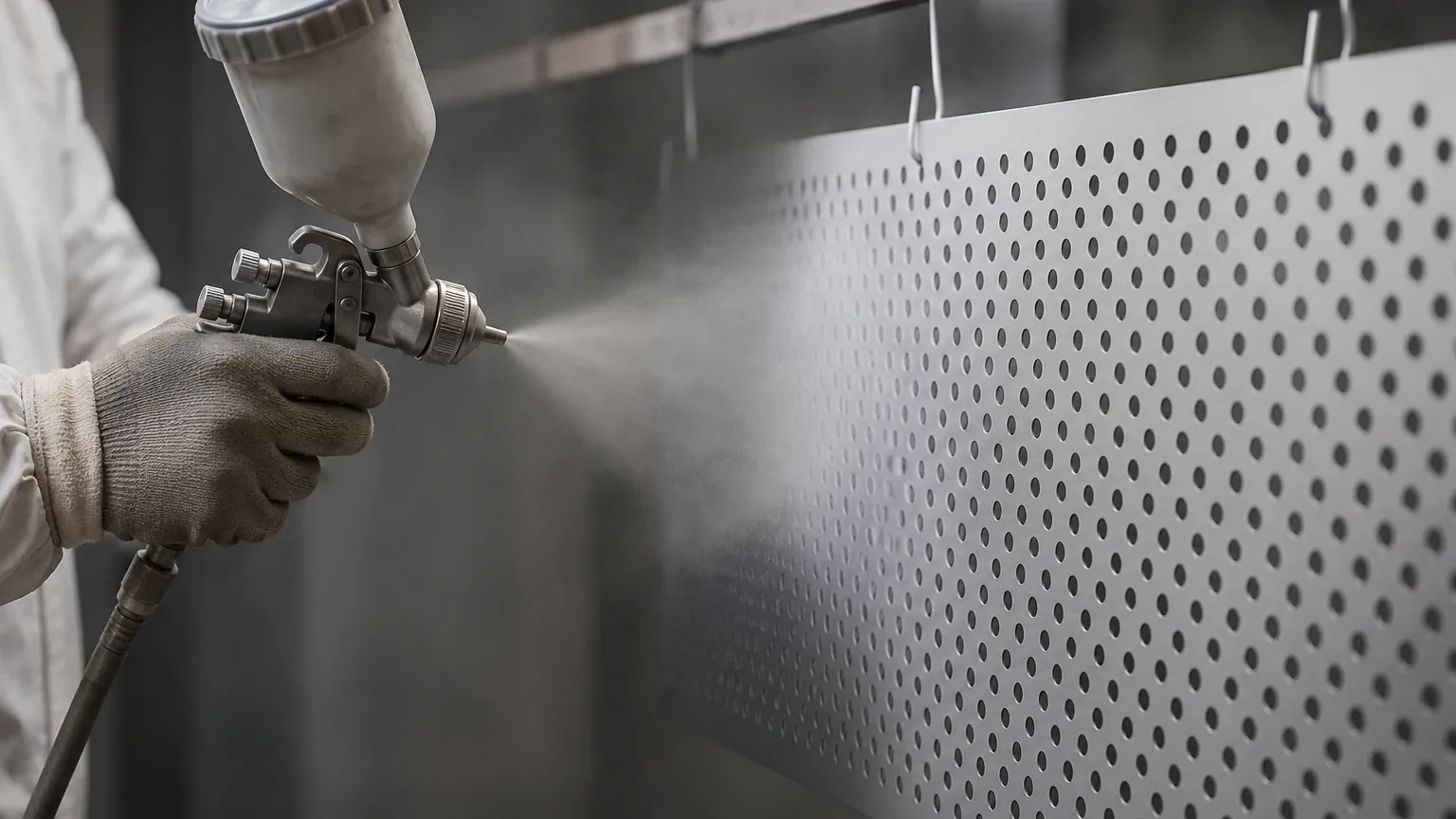
When painting perforated metal, the primary challenge is achieving uniform coverage on the "internal" edges of the holes without clogging the openings. There are three primary methods used in B2B manufacturing environments.
1. Powder Coating
Powder coating is the industry standard for perforated components. The process involves applying electrostatically charged powder to the grounded metal part. This creates a "wrap-around" effect where the powder is drawn into the holes and covers the sharp edges of the perforations more effectively than liquid spray. The part is then cured in an oven, resulting in a durable, thick, and chemically resistant finish.
2. Liquid Spray Painting (HVLP and Airless)
High-Volume Low-Pressure (HVLP) spraying is often used for smaller batches or when specific chemical-resistant liquid epoxies are required. The technician must use a cross-hatch spraying pattern to ensure the interior walls of the perforations are coated. However, liquid paint is more prone to "bridging," where the surface tension of the liquid causes it to span across a small hole, effectively blocking it.
3. E-Coating (Electrophoretic Deposition)
For high-volume OEM components, E-coating is highly effective. The perforated part is submerged in a tank of paint, and an electric current is applied. This ensures 100% coverage of every surface, including the most complex internal geometries of expanded metal. It provides a very thin, uniform layer that is ideal for precision filtration components where maintaining the exact hole diameter is critical.
Engineering Impacts: Managing Open Area and Hole Occlusion
From an engineering perspective, the most significant risk when painting perforated metal is the reduction of the "Open Area." The open area percentage determines the flow rate, pressure drop, and filtration efficiency of the component.
Calculating the Reduction in Open Area
When a coating is applied, it adds thickness to every surface. If a perforated sheet has 2.0mm diameter holes and a 100-micron (0.1mm) coating is applied to the interior of the hole, the effective diameter is reduced to 1.8mm.
For a standard 60-degree staggered pattern, the formula for open area is:
**OA = (D^2 * 90.69) / P^2**
*(Where D is hole diameter and P is pitch)*
If the diameter (D) decreases due to paint thickness, the open area can drop significantly. In high-precision liquid filtration, a 5% reduction in open area can lead to a measurable increase in backpressure, potentially straining pumps and reducing system efficiency.
Avoiding Bridging
Bridging occurs when the paint film spans the gap of the perforation. This is a common risk when the hole diameter is less than 3mm or when using high-viscosity coatings. To prevent this, engineers should specify:
* Lower viscosity coatings for fine perforations.
* Controlled dry film thickness (DFT).
* Air-blow steps immediately following liquid application to clear the holes.
Performance Evaluation and Quality Control
In B2B procurement, verifying the quality of the finish is essential to ensure the component meets the design specifications of the project. Quality control for painted perforated metal should include several key tests.
Adhesion Testing (ASTM D3359)
The cross-hatch tape test is the standard for checking how well the paint adheres to the metal substrate. For perforated sheets, this test should be performed on the solid margins of the sheet as well as near the perforated zones to ensure consistency.
Thickness Measurement
Using an eddy current or ultrasonic thickness gauge, quality control teams must verify that the paint thickness stays within the specified range. Excessive thickness leads to hole occlusion, while insufficient thickness leads to premature corrosion.
Salt Spray Testing (ASTM B117)
For components destined for marine or outdoor industrial use, salt spray testing validates the corrosion resistance of the paint system. This is particularly important for expanded metal, which has many sharp edges that are traditionally difficult to coat perfectly.
Maintenance and Total Cost of Ownership
When specifying painting perforated metal, engineers must consider the long-term maintenance cycle. While a painted finish adds to the initial capital expenditure (CAPEX), it can significantly reduce the total cost of ownership (TCO) by extending the interval between component replacements.
Inspection Intervals
In filtration applications, the coating should be inspected during every filter cleaning cycle. Any signs of chipping or bubbling indicate that the coating has been compromised. In food-grade applications, any paint failure is a critical risk for batch contamination and requires immediate replacement of the component.
Refurbishment vs. Replacement
For large-scale industrial screens, it may be more cost-effective to strip and repaint the metal rather than manufacture a new component. However, for precision stainless steel filter cartridges, the cleaning process required to remove old paint often damages the delicate metal structure, making replacement the preferred engineering choice.
Conclusion
Painting perforated metal is a precise technical process that requires a balance between protection and performance. By understanding the relationship between coating thickness and open area, engineers can ensure that their filtration and structural components remain functional throughout their service life. Whether opting for powder coating for durability or E-coating for precision, the key lies in rigorous substrate preparation and clear technical specifications.
For organizations requiring specialized filtration solutions, Kaifil provides expertise in the manufacturing and finishing of high-performance metal components. By integrating advanced manufacturing with precise coating protocols, we ensure that every component meets the demanding standards of modern industrial applications. Before proceeding with your next project, confirm the environmental conditions and flow requirements to determine the optimal coating strategy for your perforated metal needs.
