


Panel Perforated Metal
Panel perforated metal serves as a critical component in modern industrial filtration and structural engineering. Unlike standard sheet goods, a dedicated panel perforated metal solution is engineered to meet specific mechanical and chemical requirements, acting as either a primary filtration medium or a robust support structure for finer filter meshes. In demanding environments such as chemical processing, food and beverage production, and pharmaceutical manufacturing, the selection of these panels directly impacts system efficiency, longevity, and safety.
As a specialized manufacturer, Kaifil provides high-precision Perforated & Expanded Metal solutions designed to withstand the rigorous stresses of industrial applications. Understanding the technical nuances of hole geometry, material properties, and manufacturing tolerances is essential for engineers and procurement teams tasked with optimizing filtration performance.
The Role of Panel Perforated Metal in Industrial Systems
In industrial contexts, perforated metal panels are more than just sheets with holes; they are precision-engineered components. Their primary function is often to provide a predictable flow path for fluids or gases while retaining solids of a specific size.
Primary Filtration vs. Support Structures
In many liquid-solid separation processes, the perforated panel acts as the first line of defense, capturing large particulates before they reach more sensitive downstream equipment. However, in high-pressure hydraulic or chemical systems, the panel perforated metal often serves as a "backup" or support cage for stainless steel wire mesh. Because fine mesh lacks the structural rigidity to withstand high differential pressures, the perforated panel provides the necessary mechanical strength to prevent the mesh from collapsing or deforming.
Versatility in Design
The versatility of perforated panels allows them to be integrated into various filter housings, including basket strainers, duplex filters, and custom-designed cartridge filters. By adjusting the hole size and pattern, engineers can fine-tune the balance between filtration accuracy and flow resistance.
Key Engineering Specifications for Perforated Panels
When specifying a panel perforated metal component, several geometric and mechanical factors must be calculated to ensure the part performs as intended within a larger system.
Hole Patterns and Geometry
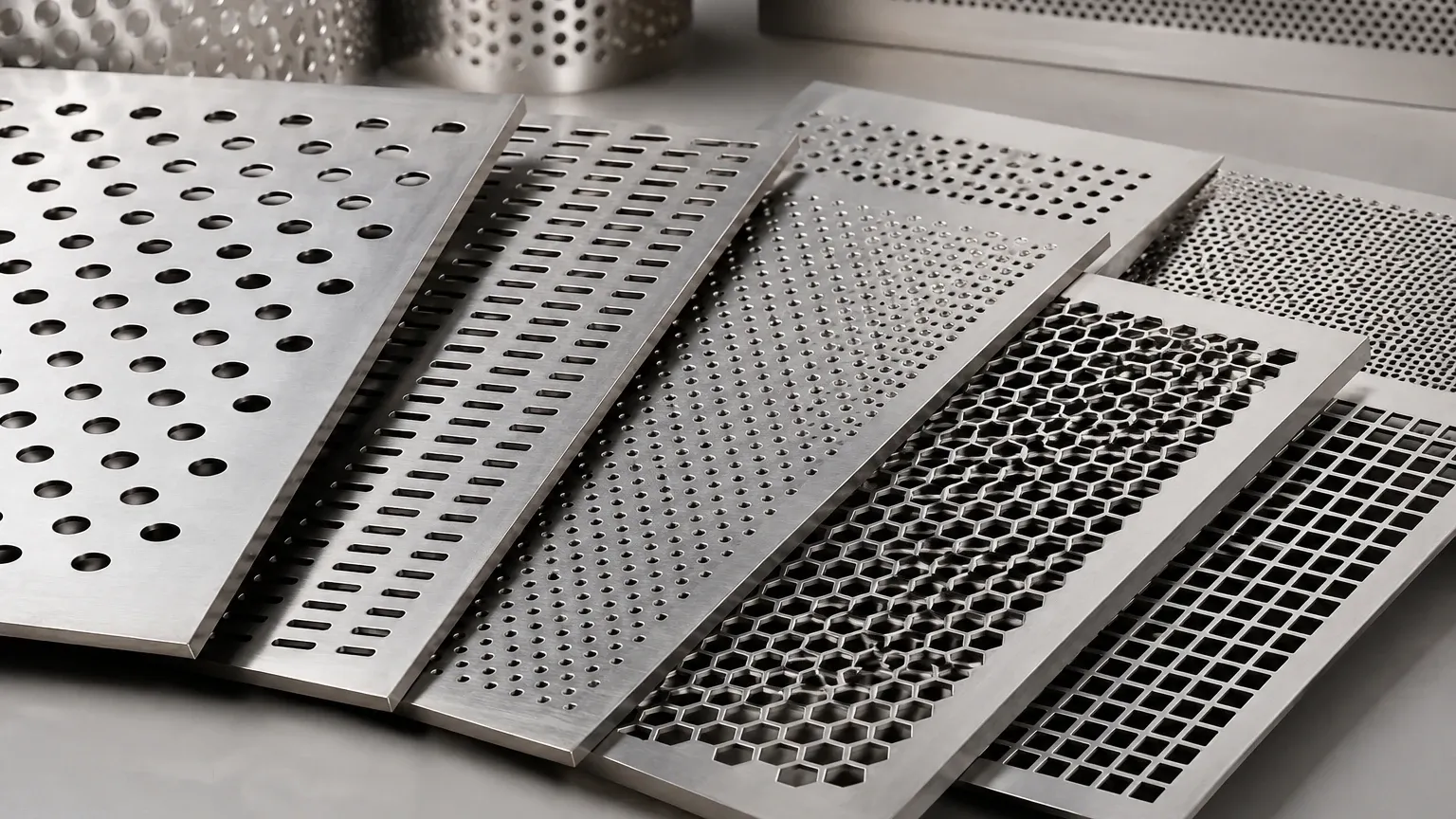
The most common hole pattern is the 60-degree staggered round hole. This configuration is preferred in industrial filtration because it provides the highest percentage of open area and the greatest structural uniformity. Other patterns include:
- Straight Row Round Holes: Used when specific directional flow is required, though they offer lower structural integrity than staggered patterns.
- Square and Slotted Holes: Often utilized in sorting or sifting applications where the shape of the particulate matters as much as its size.
- Custom Geometric Patterns: Specialized designs for aesthetic or highly specific fluid dynamic requirements.
Calculating Open Area
The "Open Area" percentage is perhaps the most critical metric for a filtration engineer. It determines the flow capacity and the pressure drop across the panel. For a standard 60-degree staggered round hole pattern, the formula is:
Open Area % = (D² × 90.69) / P²
Where *D* is the hole diameter and *P* is the center-to-center pitch. A higher open area reduces pressure drop but can compromise the structural rigidity of the panel. Finding the "sweet spot" is essential for maintaining high flow rates without risking panel failure under load.
Pitch and Margins
The pitch refers to the distance between the centers of adjacent holes. The "bridge" is the solid material remaining between the holes. Engineers must also specify "margins"—the unperforated areas along the edges of the panel. These margins are vital for welding the panel into a filter frame or housing, as they provide a solid surface for a secure mechanical bond.
Material Selection for Demanding Environments
The performance of a panel perforated metal component is inextricably linked to the alloy from which it is fabricated. Given Kaifil’s focus on stainless steel filtration solutions, material selection usually centers on corrosion resistance and thermal stability.
Stainless Steel 304 vs. 316L
- Grade 304: The standard for most industrial applications. It offers excellent formability and good corrosion resistance for general use in water treatment and food processing.
- Grade 316L: The "L" stands for low carbon, which improves weldability and prevents sensitization. 316L contains molybdenum, making it significantly more resistant to chloride-induced pitting and crevice corrosion. This is the material of choice for pharmaceutical and marine applications.
Specialized Alloys
In extreme environments involving high temperatures or highly acidic/alkaline fluids, specialized materials like Duplex stainless steel, Monel, or Inconel may be required. These materials offer enhanced mechanical properties and resistance to stress corrosion cracking, ensuring the perforated panel does not become a point of failure in the system.
Customization and OEM Manufacturing Capabilities
Off-the-shelf perforated sheets rarely meet the precise needs of specialized industrial equipment. Customization is often necessary to ensure the panel perforated metal fits perfectly within existing hardware and meets specific performance targets.
Precision Fabrication
Kaifil’s manufacturing process involves advanced CNC punching and laser cutting technologies. This allows for the creation of panels with complex shapes, non-standard hole sizes, and precise margins. For OEM applications, panels can be pre-formed into cylinders, cones, or custom-contoured shapes to fit unique filter housings.
Surface Finishing and Post-Processing
Industrial filters often require specific surface treatments to enhance performance:
- Degreasing and Cleaning: Crucial for food-grade and pharmaceutical applications to ensure no residual oils from the punching process remain.
- Electropolishing: Smoothes the surface at a microscopic level, reducing the risk of particulate adhesion and making the filter easier to clean (CIP – Clean-In-Place).
- Deburring: High-speed punching can leave sharp edges or burrs. Professional deburring is essential to prevent these burrs from breaking off and contaminating the filtrate or damaging downstream components.
Critical Evaluation Criteria for Engineers
Before finalizing a purchase or design for a panel perforated metal component, engineers should evaluate the following criteria to ensure long-term reliability:
1. Pressure Drop and Flow Rate
Every filter introduces a restriction to the flow. Using the open area calculation, engineers must model the expected pressure drop (∆P). If the ∆P is too high, it can lead to increased energy consumption by pumps and potential cavitation issues. Conversely, a panel that is too "open" may not provide the necessary support for secondary filter media.
2. Mechanical Strength and Fatigue Resistance
In systems with pulsating flows or frequent backwashing, the perforated panel is subjected to cyclic loading. The material thickness and bridge width must be sufficient to resist metal fatigue. A common mistake is selecting a panel that is too thin in an attempt to save weight or cost, only to have it fail prematurely under operational stress.
3. Filtration Accuracy
While perforated metal is generally used for "coarse" filtration (typically 0.5mm and above), the consistency of the hole size is paramount. If the punching process allows for significant variance in hole diameter, the reliability of the filtration process is compromised. Quality manufacturers maintain tight tolerances to ensure every hole meets the specification.
Common Risks and Quality Assurance in Procurement
Procuring industrial filtration components involves navigating several risks that can impact the total cost of ownership.
The Risk of Inferior Materials
One of the most common issues in the global supply chain is material substitution or the use of low-quality alloys that do not meet international standards (like ASTM or AISI). A panel that is supposed to be 316L but lacks sufficient molybdenum will corrode rapidly in chemical environments. Always confirm material certifications (MTRs) before production.
Flatness and Stress Relieving
The process of punching thousands of holes into a metal sheet introduces significant internal stresses, which can cause the panel to curl or warp. For high-precision applications, the panels must undergo a leveling process to ensure they are perfectly flat. A warped panel can lead to gaps in the filter housing, allowing bypass—where unfiltered fluid escapes around the edges of the filter.
Burr Management
As mentioned previously, burrs are a byproduct of the perforation process. In high-purity industries, even a single metal shard breaking off a perforated panel can lead to catastrophic product contamination or equipment damage. Ensuring the manufacturer has a robust deburring and inspection protocol is non-negotiable.
Total Cost of Ownership vs. Initial Price
When evaluating panel perforated metal options, it is tempting to focus solely on the initial purchase price. However, for industrial operators, the total cost of ownership (TCO) is a much more relevant metric.
Factors that influence TCO include:
- Replacement Frequency: A high-quality stainless steel panel may cost more upfront but last five times longer than a cheaper alternative.
- Maintenance Labor: Panels that are easier to clean (due to electropolishing or superior hole geometry) reduce downtime and labor costs.
- Protection of Downstream Equipment: A reliable perforated support prevents the failure of expensive fine-mesh filters and protects high-value pumps and valves from debris damage.
Conclusion: Selecting the Right Partner
Effective industrial filtration requires a deep understanding of both material science and mechanical engineering. Whether you are designing a new system or looking for a reliable replacement for existing components, selecting the right Perforated & Expanded Metal is a critical decision.
By focusing on precise engineering parameters, material integrity, and high-quality manufacturing standards, Kaifil helps engineers and purchasing teams achieve durable and cost-effective filtration solutions. When specifying your next panel perforated metal project, ensure you have confirmed the required open area, material grade, and post-processing needs to guarantee optimal performance in your specific application environment.
