


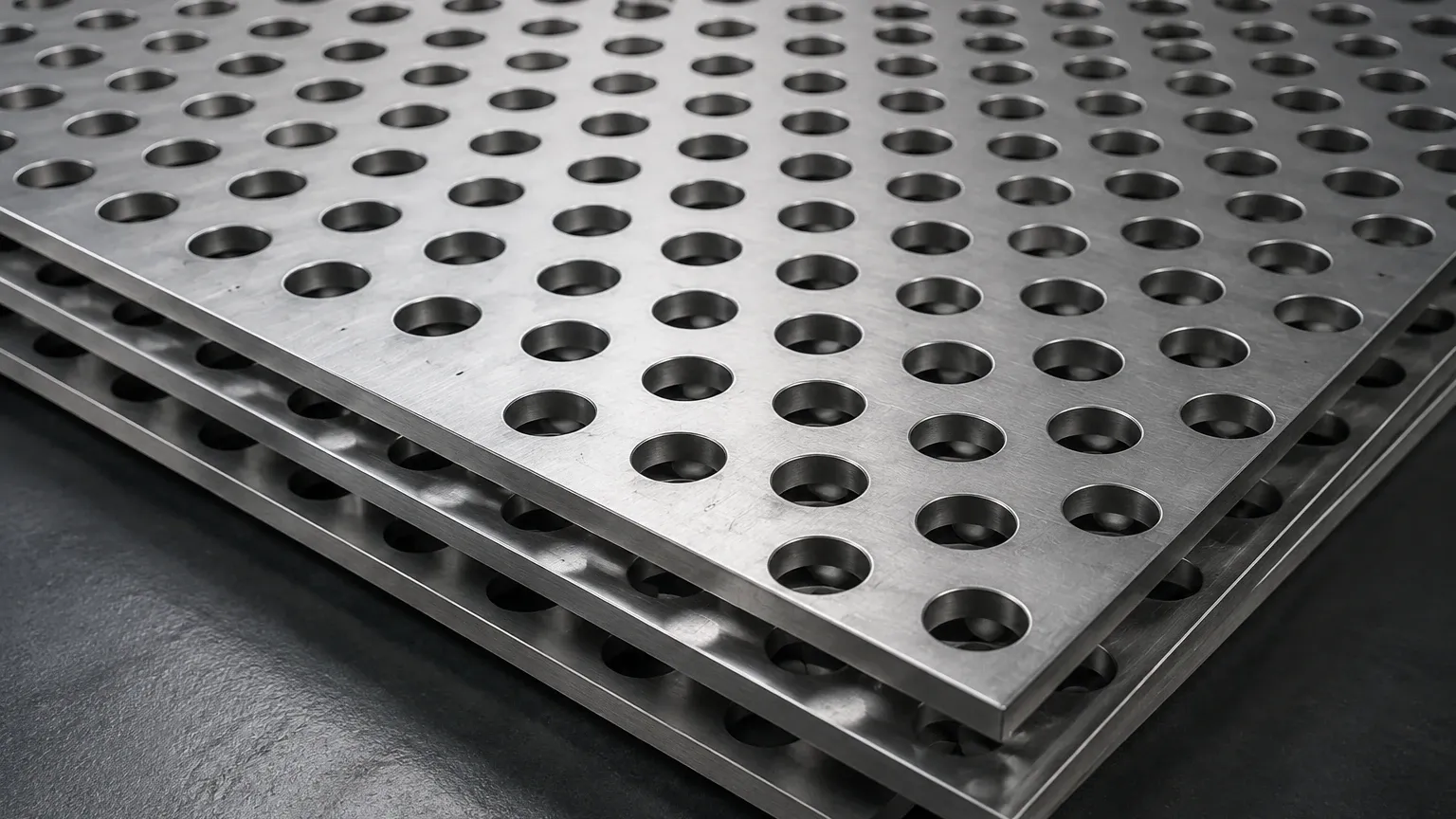
Perforated Metal Sheet 10mm
In industrial filtration and structural engineering, the specification of a perforated metal sheet 10mm often serves as a critical baseline for medium-to-heavy-duty applications. Whether the "10mm" refers to the hole diameter, the center-to-center pitch, or the thickness of the plate itself, understanding the technical nuances of these dimensions is essential for ensuring the longevity and efficiency of industrial systems. As a specialized manufacturer of stainless steel filtration solutions, Kaifil provides precision-engineered Perforated & Expanded Metal components designed to meet the rigorous demands of chemical processing, food production, and water treatment sectors.
This guide examines the technical parameters, material considerations, and engineering trade-offs involved when selecting a perforated metal sheet with 10mm specifications, providing the factual data necessary for informed procurement and design.
Defining the 10mm Specification: Diameter vs. Pitch vs. Thickness
When an engineer requests a "perforated metal sheet 10mm," the first step in technical validation is clarifying which dimension the 10mm refers to. In the context of industrial filtration and screening, this measurement typically applies to one of three variables:
1. Hole Diameter (D)
A 10mm hole diameter is common in primary filtration stages where large debris or solid particulates must be separated from a fluid or gas stream. It is also a standard size for protective grilles and ventilation panels. Round holes are the most frequent geometry due to their structural stability and ease of manufacturing.
2. Center-to-Center Pitch (P)
The pitch is the distance from the center of one hole to the center of the adjacent hole. If the pitch is 10mm and the hole diameter is 8mm, the "bridge" (the metal remaining between holes) is 2mm. The relationship between diameter and pitch determines the open area percentage, which directly impacts flow rate and pressure drop.
3. Sheet Thickness (T)
While less common for standard filtration mesh, a 10mm thick perforated plate is used in heavy industrial applications, such as mining screens, hammer mill screens, or structural architectural elements. Perforating a 10mm thick plate requires high-tonnage hydraulic presses and specialized tooling, as the hole diameter generally cannot be smaller than the material thickness without risking tool breakage.
Material Selection and Corrosion Resistance
The performance of a perforated metal sheet 10mm is heavily dependent on the alloy used. Industrial environments often involve exposure to corrosive chemicals, high temperatures, or abrasive particulates. Kaifil specializes in stainless steel variants to ensure maximum service life.
* Grade 304 Stainless Steel: The industry standard for general-purpose applications. It offers excellent formability and good corrosion resistance for water treatment and architectural uses.
* Grade 316/316L Stainless Steel: Recommended for marine environments, chemical processing, and pharmaceutical applications. The addition of molybdenum provides superior resistance to chlorides and pitting corrosion.
* Duplex Stainless Steel: Used in high-stress environments where both high mechanical strength and exceptional corrosion resistance are required, such as in offshore oil and gas filtration.
Selecting the correct grade is not just about chemical compatibility; it also affects the "cleanability" of the filter component. In food and beverage applications, 316L stainless steel is often preferred to prevent metallic contamination and withstand rigorous CIP (Clean-in-Place) cycles.
Calculating Open Area and Flow Dynamics
For engineers, the most critical performance metric of a perforated metal sheet 10mm is the percentage of open area. This figure determines the throughput capacity of the filter and the magnitude of the pressure drop across the media.
For a standard 60-degree staggered round hole pattern, the formula for open area (OA%) is:
OA% = (D² × 90.69) / P²
If we consider a common configuration where the hole diameter (D) is 10mm and the pitch (P) is 15mm:
* OA% = (10² × 90.69) / 15²
* OA% = (100 × 90.69) / 225
* OA% = 40.3%
An open area of approximately 40% provides a balanced compromise between structural rigidity and flow efficiency. If the application requires higher flow rates, the pitch can be reduced (increasing the hole density), though this will decrease the mechanical strength of the sheet. Conversely, increasing the pitch creates a more robust plate but increases the resistance to flow (delta P).
Structural Integrity and Mechanical Load
A 10mm perforated sheet must often double as a structural component, supporting the weight of filter media or withstanding high-pressure differentials. Several factors influence the mechanical limits of the perforated sheet:
1. Unperforated Margins: Keeping solid borders (margins) around the perforated area significantly increases the sheet's resistance to buckling and simplifies welding or mechanical fastening into a housing.
2. Hole Orientation: The direction of the staggered pattern relative to the load can affect the yield strength. In most industrial applications, the "stagger" should run parallel to the direction of the greatest stress.
3. Equivalent Solid Properties: Engineers often use "effective elastic modulus" and "effective Poisson's ratio" to treat the perforated area as a solid material with reduced stiffness for FEA (Finite Element Analysis) purposes.
Industrial Applications of 10mm Perforated Sheets
Due to the versatility of the 10mm dimension, these sheets are utilized across a wide spectrum of industrial sectors:
Industrial Filtration and Strainers
In large-scale water intake systems or chemical pipelines, 10mm perforated sheets serve as primary strainers. They protect downstream equipment, such as pumps and fine Perforated & Expanded Metal cartridges, from large debris, stones, or scale.
Food and Beverage Processing
In the malting and brewing industry, perforated plates with 10mm openings (or 10mm pitch) are used in grain drying and lautering tuns. The precision of the perforation ensures uniform airflow or liquid drainage, which is vital for product consistency.
Petrochemical and Refining
Perforated metal is used in reactor internals to support catalyst beds. The 10mm specification is often used for the support grids that must hold tons of catalyst material while allowing gas or liquid reactants to pass through with minimal restriction.
Acoustic Dampening and Ventilation
In power plants and heavy machinery enclosures, 10mm perforated sheets are used as the facing for acoustic insulation. The holes allow sound waves to pass into the absorbing material while protecting the delicate insulation from mechanical damage.
Customization and Manufacturing Precision
Standard off-the-shelf perforated sheets often fail to meet the exact requirements of specialized industrial equipment. Customization is where Kaifil adds significant value to the procurement process. When ordering a perforated metal sheet 10mm, several custom parameters should be specified:
* Hole Shape: While round is standard, square, hexagonal, or slotted holes may be required for specific separation tasks. Slotted holes are particularly effective for vibrating screens where elongated particles are present.
* Surface Finish: For pharmaceutical or food-grade applications, the sheet may require electropolishing to remove burrs and achieve a specific Ra (roughness average) value. This prevents bacterial growth and facilitates easier cleaning.
* Forming and Fabrication: Perforated sheets often need to be rolled into cylinders for filter cartridges or bent into complex shapes for machine guards. Kaifil’s manufacturing capabilities include precision rolling, welding, and assembly of these components to ensure they fit perfectly into the end-user's system.
Common Risks and Quality Control
Procuring industrial-grade perforated metal involves more than just verifying dimensions. Technical buyers must be aware of potential quality risks:
* Burrs and Slag: Low-quality punching processes can leave sharp burrs on the exit side of the hole. In filtration, these burrs can trap fibers or particulates, leading to premature clogging and making the filter difficult to clean.
* Planarity (Flatness): The perforation process introduces internal stresses into the metal, which can cause the sheet to bow or curl. Precision leveling is required post-perforation to ensure the sheet remains flat for installation.
* Dimensional Tolerance: In high-precision applications, such as centrifuge baskets, the tolerance on the 10mm hole diameter must be strictly controlled. Even a 0.5mm variance can significantly alter the filtration profile.
Kaifil addresses these risks through stringent quality management systems, ensuring that every Perforated & Expanded Metal product meets the specified tolerances and surface finish requirements.
Total Cost of Ownership (TCO) in Filtration
When evaluating the cost of a perforated metal sheet 10mm, engineers should look beyond the initial purchase price. The Total Cost of Ownership (TCO) includes:
1. Service Life: A higher-grade stainless steel may cost more upfront but will last significantly longer in corrosive environments, reducing replacement frequency.
2. Maintenance Efficiency: Sheets with high-quality surface finishes and precise hole geometries are easier to backwash or clean, reducing downtime.
3. Energy Consumption: A well-designed open area minimizes pressure drop, which in turn reduces the energy required by pumps and fans to move fluid through the system.
Conclusion: Making an Informed Selection
The selection of a perforated metal sheet 10mm is a decision that impacts the structural integrity and operational efficiency of an entire industrial process. By clearly defining whether the 10mm refers to hole size, pitch, or thickness, and by selecting the appropriate material grade and hole pattern, engineers can optimize their filtration and screening systems for long-term performance.
As a professional manufacturer, Kaifil provides the technical expertise and manufacturing precision required to deliver custom stainless steel filtration solutions. From material selection to final fabrication, our focus is on providing reliable, high-performance components that meet the specific needs of demanding industrial environments. For technical teams and purchasing departments, confirming these engineering variables early in the design phase ensures that the final product will deliver the required filtration accuracy and durability.
