


12mm Perforated Metal Sheet
In industrial engineering and heavy-duty filtration, the 12mm perforated metal sheet represents a specific intersection of structural integrity and functional permeability. Whether the "12mm" refers to the aperture (hole diameter) or the plate thickness, these components are essential in demanding environments such as chemical processing, large-scale water treatment, and heavy machinery manufacturing. Selecting the correct specifications requires a deep understanding of material science, mechanical loads, and fluid dynamics.
As a specialized manufacturer, Kaifil provides high-precision Perforated & Expanded Metal solutions designed to meet the rigorous standards of global industrial sectors. This guide explores the technical nuances of 12mm perforated metal, offering engineers and purchasing teams the data necessary to optimize their filtration and structural systems.
Understanding Technical Specifications of 12mm Perforated Metal
When discussing a 12mm perforated metal sheet, it is critical to define whether the dimension applies to the hole diameter, the center-to-center pitch, or the thickness of the base material. Each configuration serves a distinct industrial purpose.
Hole Diameter vs. Sheet Thickness
In most coarse filtration and screening applications, a 12mm hole diameter is used for primary separation. However, in heavy industrial settings, a sheet with a 12mm thickness (plate) is often required for structural support or high-pressure environments.
* 12mm Aperture: Typically used in mining, agriculture, and large-scale waste-water intake screens. It allows for high flow rates while capturing large debris.
* 12mm Thickness: Known as heavy plate perforation, this is used in vibrating screens or as a protective housing for high-pressure filter cartridges. Perforating a 12mm thick plate requires specialized hydraulic presses and high-strength tooling to ensure clean edges and dimensional accuracy.
Hole Patterns and Pitch
The arrangement of the perforations significantly impacts both the strength of the sheet and its filtration efficiency. The two most common configurations are:
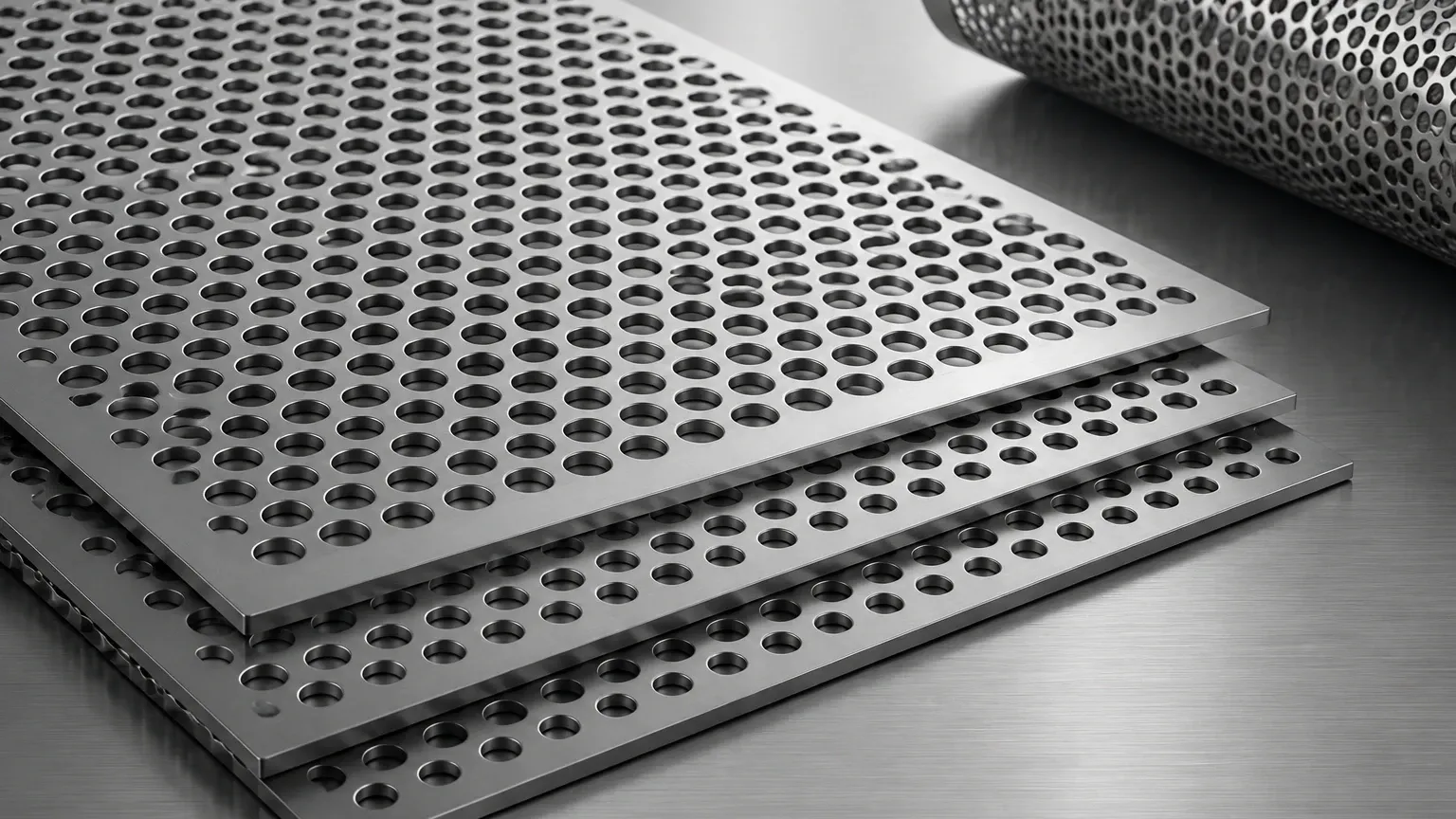
1. Staggered Pattern (60-degree): This is the industry standard due to its inherent structural balance and high open area potential. It provides uniform stress distribution across the metal sheet.
2. Straight Pattern: Often used for aesthetic or specific mechanical alignment purposes, though it generally offers lower structural rigidity than staggered layouts.
Material Selection for Industrial Environments
The performance of a 12mm perforated metal sheet is largely dictated by its metallurgy. At Kaifil, we focus on stainless steel alloys to ensure longevity in corrosive or high-temperature settings.
Stainless Steel 304/304L
Grade 304 is the most versatile and widely used stainless steel. It offers excellent corrosion resistance to most oxidizing acids and is highly durable. For applications involving welding, 304L (low carbon) is preferred to prevent carbide precipitation and ensure the integrity of the perforated zones.
Stainless Steel 316/316L
For marine environments, chemical processing plants, or pharmaceutical applications, SS316 is the standard. The addition of molybdenum provides superior resistance to chlorides and pitting. In 12mm perforated sheets used for seawater filtration or acidic chemical baths, SS316L is essential for maintaining a long service life and reducing the total cost of ownership.
Exotic Alloys and Carbon Steel
While stainless steel is the primary focus for filtration, certain heavy-duty industrial applications may require galvanized carbon steel for cost-effectiveness in non-corrosive environments, or specialized alloys like Monel or Inconel for extreme temperature and chemical resistance.
Engineering Performance: Open Area and Structural Integrity
One of the most critical calculations for an engineer is the "Open Area Percentage." This figure determines the flow rate, pressure drop, and efficiency of the 12mm perforated metal sheet.
Calculating Open Area
For a standard 60-degree staggered round hole pattern, the formula is:
Open Area % = (D² × 90.69) / P²
* *D* = Hole Diameter (e.g., 12mm)
* *P* = Pitch (center-to-center distance between holes)
If the pitch is too small relative to the hole size, the "bridge" (the metal between the holes) becomes too thin, compromising the structural integrity of the sheet. Conversely, if the pitch is too large, the open area decreases, leading to higher pressure drops across the filter medium. For a 12mm hole, a typical pitch might range from 15mm to 20mm, depending on the required mechanical strength.
Pressure Drop Considerations
In filtration systems, the 12mm perforated metal sheet often acts as a support basket for finer wire mesh or as a standalone coarse screen. Engineers must ensure that the open area is sufficient to prevent cavitation in pumps or excessive energy consumption due to flow resistance. A well-designed perforated sheet balances the need for particle retention with the requirement for unimpeded fluid flow.
Applications of 12mm Perforated Metal in Industrial Filtration
Due to its robust nature, 12mm perforated metal is utilized across several heavy industries where precision and durability are non-negotiable.
Chemical and Petrochemical Processing
In large-scale reactors and distillation columns, perforated plates serve as catalyst support grids. A 12mm thickness or aperture may be specified to handle the immense weight of catalyst beds while allowing for uniform gas or liquid distribution.
Food and Beverage Industry
In the processing of grains, pulses, or large-scale fruit juice extraction, 12mm perforated sheets are used in rotary screens and vibrating separators. The use of food-grade stainless steel ensures compliance with hygiene standards while providing the mechanical strength to handle bulk materials.
Water Treatment and Intake Screens
For municipal water treatment or industrial cooling water intakes, 12mm perforated metal is an ideal primary screen. It prevents large debris, aquatic life, and trash from entering the system, protecting downstream pumps and finer filtration components from damage.
Hydraulic and Lubrication Systems
In heavy machinery, perforated metal cylinders act as the primary support for hydraulic filter elements. The 12mm dimension might be utilized in large-scale industrial bypass filters or as a protective outer wrap for high-pressure filter cartridges.
Customization and OEM Manufacturing Considerations
Standard off-the-shelf perforated sheets rarely meet the specific needs of complex industrial projects. Customization is where engineering expertise becomes vital.
Precision Tolerances
In B2B procurement, dimensional accuracy is paramount. Whether it is the flatness of the sheet, the concentricity of the holes, or the margin (the unperforated area around the edges), Kaifil adheres to strict tolerances. This ensures that the 12mm perforated metal sheet fits perfectly into existing housings or frames without the need for on-site modifications.
Surface Treatments
Depending on the application, the metal may require additional processing:
* Pickling and Passivation: Essential for stainless steel to restore the chromium oxide layer after the perforation process, ensuring maximum corrosion resistance.
* Electropolishing: Provides a mirror-like finish and removes microscopic burrs, which is critical in pharmaceutical and food applications to prevent bacterial growth.
* Powder Coating or Galvanizing: Used for carbon steel variants to provide a protective barrier against oxidation.
Fabrication Services
Beyond simple flat sheets, many industrial applications require the metal to be formed into specific shapes. Kaifil offers comprehensive fabrication, including:
* Rolling: Forming the 12mm perforated metal into cylinders for filter baskets.
* Welding: Utilizing TIG, MIG, or spot welding to create reinforced structures.
* Edge Hemming: Providing a smooth, safe edge for handling and installation.
Maintenance and Longevity in Demanding Applications
The total cost of ownership (TCO) of a filtration component is determined by its durability and ease of maintenance. A 12mm perforated metal sheet, especially when manufactured from high-grade stainless steel, is designed for long-term service.
Cleaning Cycles
Unlike disposable filter media, perforated metal is cleanable and reusable. In applications like food processing or wastewater, the sheets can be cleaned using backwashing, ultrasonic cleaning, or high-pressure steam. The smooth surface of a properly finished perforated sheet prevents "blinding" (clogging) and allows for efficient debris removal.
Monitoring Wear and Corrosion
In abrasive environments, such as mining or slurry filtration, the edges of the perforations can wear down over time, increasing the effective hole size. Regular inspections should confirm that the aperture remains within the specified 12mm tolerance to ensure consistent filtration performance. Similarly, in chemical environments, checking for signs of stress corrosion cracking or pitting is essential for preventing catastrophic failure.
Key Factors to Confirm Before Purchasing
Before finalizing a purchase order for 12mm perforated metal, technical professionals should confirm several variables to ensure the product is fit for purpose:
1. Exact Dimensions: Confirm the hole diameter, pitch, and sheet thickness. Specify if the 12mm refers to the aperture or the gauge.
2. Material Grade: Ensure the alloy (e.g., SS304 vs. SS316) is compatible with the operating environment's temperature and chemical profile.
3. Open Area Requirements: Verify that the calculated open area meets the flow rate requirements of the system.
4. Margin Specifications: Define the width of the unperforated borders required for mounting or welding.
5. Compliance Standards: Ensure the manufacturing process meets relevant industrial standards (ISO, ASTM, or industry-specific certifications).
By focusing on these technical details, engineering teams can secure reliable, high-performance filtration components that minimize downtime and maximize operational efficiency.
For more information on customized solutions and technical support, explore our full range of Perforated & Expanded Metal products. Kaifil remains committed to delivering precision-engineered filtration components that withstand the most challenging industrial conditions.
