


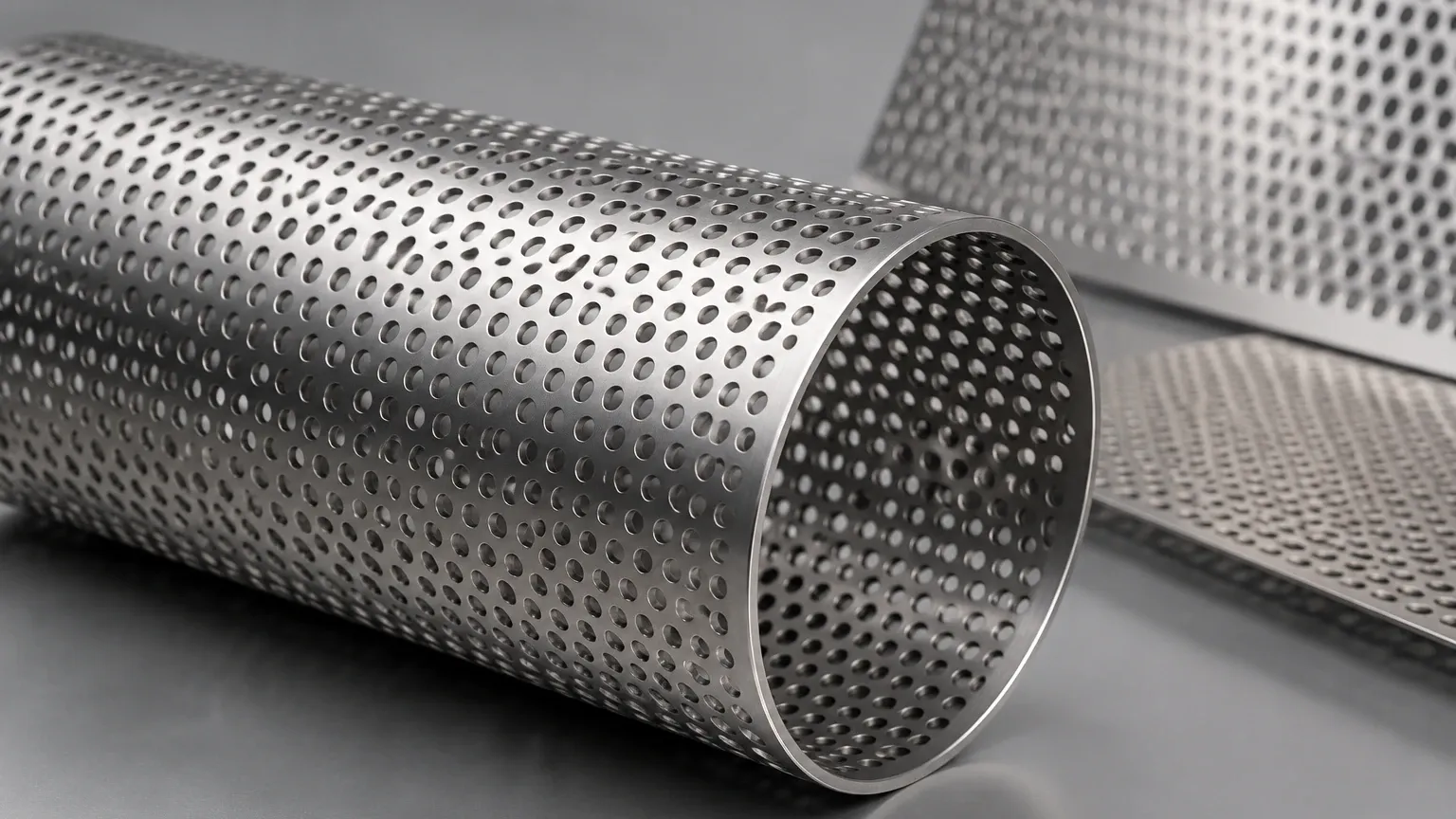
6 Perforated Steel Pipe
In industrial filtration and fluid handling, the 6 perforated steel pipe serves as a foundational component for high-capacity systems. Whether utilized as a structural support core for fine mesh filter elements or as a standalone coarse strainer in water treatment and petrochemical processing, the engineering specifications of these pipes dictate the efficiency and longevity of the entire filtration assembly. Selecting the correct Perforated & Expanded Metal configuration requires a deep understanding of material science, fluid dynamics, and mechanical stress factors.
A 6 perforated steel pipe typically refers to a pipe with a 6-inch nominal diameter that has been processed to include a specific pattern of punched or drilled holes. These components are essential in environments where high flow rates must be maintained while ensuring structural rigidity under significant pressure differentials. For engineers and procurement specialists, the challenge lies in balancing the "open area" required for flow with the wall thickness necessary to prevent collapse or deformation.
Technical Specifications and Engineering Considerations
When specifying a 6 perforated steel pipe, the first technical hurdle is defining the hole pattern and the resulting open area percentage. The open area is the ratio of the total area of the holes to the total area of the pipe surface. This metric directly influences the pressure drop ($ΔP$) across the filter. A higher open area reduces resistance to flow but can compromise the mechanical strength of the pipe.
Hole Patterns and Geometry
The most common configuration for industrial applications is the 60-degree staggered round hole pattern. This geometry is preferred because it provides the highest degree of structural integrity while maximizing the open area. In a staggered pattern, the holes in adjacent rows are offset, ensuring that there is no straight line of weakness along the longitudinal axis of the pipe.
Other patterns include:
- Straight Line Patterns: Easier to manufacture but generally weaker under torsional or compressive stress.
- Slotted Perforations: Often used in well screens or applications involving fibrous materials where round holes might bridge and clog.
- Square Holes: Provide a high open area but are more prone to stress concentrations at the corners, which can lead to premature fatigue failure in high-vibration environments.
Calculating Open Area
For a standard staggered round hole pattern, the open area percentage can be calculated using the following formula:
$$OA = \frac{D^2 \times 90.69}{C^2}$$
Where:
- D is the hole diameter.
- C is the center-to-center distance (pitch) between holes.
For a 6 perforated steel pipe, maintaining an open area between 40% and 60% is common for filtration cores, providing a balance between hydraulic efficiency and the ability to support external filter media like stainless steel wire mesh.
Material Selection: SS304 vs. SS316L
The choice of material for a 6 perforated steel pipe is largely dictated by the chemical composition of the fluid being processed and the operating temperature. At Kaifil, we emphasize the use of high-grade stainless steel to ensure durability in demanding industrial environments.
Stainless Steel 304
SS304 is the industry standard for general-purpose applications. It offers excellent formability and welding characteristics. In applications such as food and beverage processing or standard water filtration, SS304 provides sufficient corrosion resistance at a cost-effective price point. However, it is susceptible to pitting and crevice corrosion in high-chloride environments.
Stainless Steel 316L
For chemical processing, pharmaceutical manufacturing, or marine applications, SS316L is the preferred choice. The addition of molybdenum enhances its resistance to chlorides and acidic solutions. The "L" designation stands for low carbon, which is critical for the 6 perforated steel pipe manufacturing process. Low carbon content prevents carbide precipitation during welding, ensuring that the welded seams of the pipe remain as corrosion-resistant as the base metal.
Manufacturing Processes and Quality Standards
Producing a 6 perforated steel pipe involves more than simply punching holes in a pre-existing pipe. To ensure precision and consistency, industrial manufacturers typically follow a multi-step process that begins with flat sheet or coil stock.
1. Perforating: The flat stainless steel sheet is perforated using high-speed CNC presses. This allows for extreme precision in hole placement and diameter, which is vital for ensuring uniform flow distribution.
2. Rolling: The perforated sheet is then precision-rolled to the 6-inch diameter specification. During this stage, it is critical to ensure that the roundness of the pipe is maintained within strict tolerances to allow for seamless integration with end caps or housings.
3. Welding: The longitudinal seam is welded using advanced techniques such as TIG (Tungsten Inert Gas) or Plasma welding. These methods provide a clean, strong bond without the need for filler metals that might introduce impurities or different corrosion profiles.
4. Finishing: Post-weld treatments, including pickling and passivation, are essential. These processes remove surface contaminants and restore the chromium oxide protective layer, which is crucial for the longevity of the 6 perforated steel pipe in corrosive environments.
Applications in Industrial Filtration
The versatility of the 6 perforated steel pipe allows it to function across a wide spectrum of industries. Its primary role is often as a "support tube" or "center core" within a larger filtration assembly.
Oil and Gas Filtration
In upstream and midstream operations, perforated pipes are used to manage sand and debris. A 6 perforated steel pipe can handle the high-pressure environments found in downhole applications, where it supports the outer filtration layers against the massive force of incoming hydrocarbons and produced water.
Water Treatment and Desalination
In large-scale water treatment plants, these pipes serve as intake screens or as housings for resin traps. The corrosion resistance of SS316L is particularly valuable here, especially in desalination plants where salt concentrations are high. The 6-inch diameter allows for high-volume throughput, minimizing the number of individual filter units required for the facility.
Chemical and Pharmaceutical Processing
In these sectors, purity is paramount. The smooth, passivated surfaces of a stainless steel 6 perforated steel pipe prevent bacterial growth and allow for easy cleaning (CIP – Clean In Place). They are often used as the internal support for pleated filter cartridges that capture fine particulates in chemical synthesis or drug formulation.
Structural Integrity and Collapse Pressure
One of the most critical engineering questions when selecting a 6 perforated steel pipe is its collapse pressure. This is the maximum external pressure the pipe can withstand before it deforms. In a filtration cycle, as the filter media becomes loaded with contaminants, the pressure differential between the outside and the inside of the pipe increases.
Engineers must consider the "Effective Wall Thickness." Because the perforations remove material, the structural strength of the pipe is reduced. A common rule of thumb is that the strength of a perforated pipe is roughly proportional to the remaining metal (100% minus the open area percentage). However, for high-pressure applications, finite element analysis (FEA) is often employed to predict exactly how the 6 perforated steel pipe will behave under load.
Customization and OEM Solutions
Standard off-the-shelf pipes often fail to meet the specific requirements of complex industrial systems. This is where custom manufacturing becomes essential. When sourcing a 6 perforated steel pipe, engineers should confirm the following customization options:
- End Fittings: Does the application require NPT threaded ends, flanged connections, or simple beveled ends for butt-welding?
- Variable Perforation Zones: Some applications require "blank" or unperforated sections at the ends of the pipe to facilitate welding into a manifold without compromising the integrity of the holes.
- Surface Treatments: Beyond standard passivation, some applications may benefit from electropolishing to achieve a mirror-like finish, further reducing the risk of particle adhesion.
- Internal Support: For extremely high-pressure applications, a 6 perforated steel pipe can be reinforced with internal rings or a thicker gauge of metal.
Procurement Checklist for Engineers
Before finalizing a purchase order for a 6 perforated steel pipe, technical teams should verify the following data points with their manufacturer:
1. Material Certification: Request Mill Test Reports (MTRs) to verify the chemical composition of the steel.
2. Tolerance Standards: Confirm the tolerances for diameter, ovality, and straightness. For a 6-inch pipe, even a small deviation in roundness can make installation into a filter housing difficult.
3. Burr Removal: Inquire about the deburring process. Internal burrs can damage delicate filter membranes, while external burrs can create turbulence and uneven flow.
4. Weld Integrity: Ensure the longitudinal weld has undergone non-destructive testing (NDT) if the pipe will be used in high-pressure or safety-critical environments.
Conclusion
The 6 perforated steel pipe is a critical component that demands rigorous engineering oversight. By focusing on material grade, hole geometry, and structural limits, industrial professionals can ensure their filtration systems operate at peak efficiency. As a specialist in Perforated & Expanded Metal solutions, Kaifil provides the technical expertise and manufacturing precision necessary to deliver high-performance filtration components tailored to specific industrial needs. From material selection to final quality control, every step in the production of a 6 perforated steel pipe is designed to meet the rigorous demands of modern industrial applications.
