


Sink Strainers
In the landscape of industrial fluid management and facility maintenance, sink strainers represent a critical first line of defense. While often associated with residential plumbing, industrial-grade sink strainers are sophisticated components engineered to withstand corrosive chemicals, high temperatures, and heavy particulate loads. For engineers and procurement specialists in sectors such as chemical processing, food and beverage, and pharmaceuticals, selecting the correct strainer is not merely about preventing clogs; it is about protecting downstream equipment, ensuring sanitary compliance, and optimizing the total cost of ownership.
As a specialized manufacturer, Kaifil provides a comprehensive range of Strainers & Baskets designed to meet the rigorous demands of industrial environments. This guide explores the technical nuances of sink strainers, from material science to custom engineering considerations.
The Role of Sink Strainers in Industrial Filtration Systems
Industrial sink strainers serve as a primary filtration stage in various processing environments. Their main function is to capture large solids and debris before they enter the drainage or recycling systems. In a B2B context, these components are vital for protecting expensive downstream infrastructure, such as centrifugal pumps, heat exchangers, and sensitive sensors.
In chemical processing plants, for instance, a failed strainer can allow debris to enter a pump casing, leading to mechanical seal failure or impeller damage. In the food and beverage industry, sink strainers must facilitate rapid drainage while ensuring that organic waste does not accumulate in hard-to-clean areas, which could lead to bacterial growth. By integrating high-quality sink strainers into the system design, facilities can significantly reduce unplanned downtime and maintenance costs.
Material Science: Why Stainless Steel Dominates Industrial Strainer Design
Material selection is the most critical factor in determining the longevity and performance of a sink strainer. While plastic or brass might suffice for light commercial use, industrial applications almost exclusively demand stainless steel. Kaifil utilizes advanced alloys to ensure that each component can withstand the specific stressors of its intended environment.
Grade 304 Stainless Steel
Grade 304 is the standard for most industrial applications. It offers excellent corrosion resistance to a wide range of chemicals and atmospheric conditions. It is highly durable and cost-effective for general industrial wash stations and food processing areas where standard cleaning agents are used.
Grade 316 and 316L Stainless Steel
For more demanding environments, such as pharmaceutical manufacturing or marine applications, Grade 316 (and its low-carbon variant, 316L) is preferred. The addition of molybdenum provides superior resistance to chlorides and pitting corrosion. In facilities where aggressive sanitization protocols or acidic chemical processing occur, 316L stainless steel ensures the structural integrity of the sink strainers over years of continuous service.
Surface Finishes and Sanitary Requirements
In industries like pharmaceuticals, the surface finish of the strainer is as important as the alloy itself. Electropolishing or high-grit mechanical polishing reduces surface roughness, minimizing the areas where microbes can reside. This "sanitary design" is essential for compliance with global health and safety standards.
Technical Specifications: Mesh, Perforation, and Filtration Accuracy
When specifying sink strainers, engineers must balance filtration efficiency with flow capacity. This balance is achieved through the choice of the straining medium: perforated metal or wire mesh.
Perforated Metal Strainers
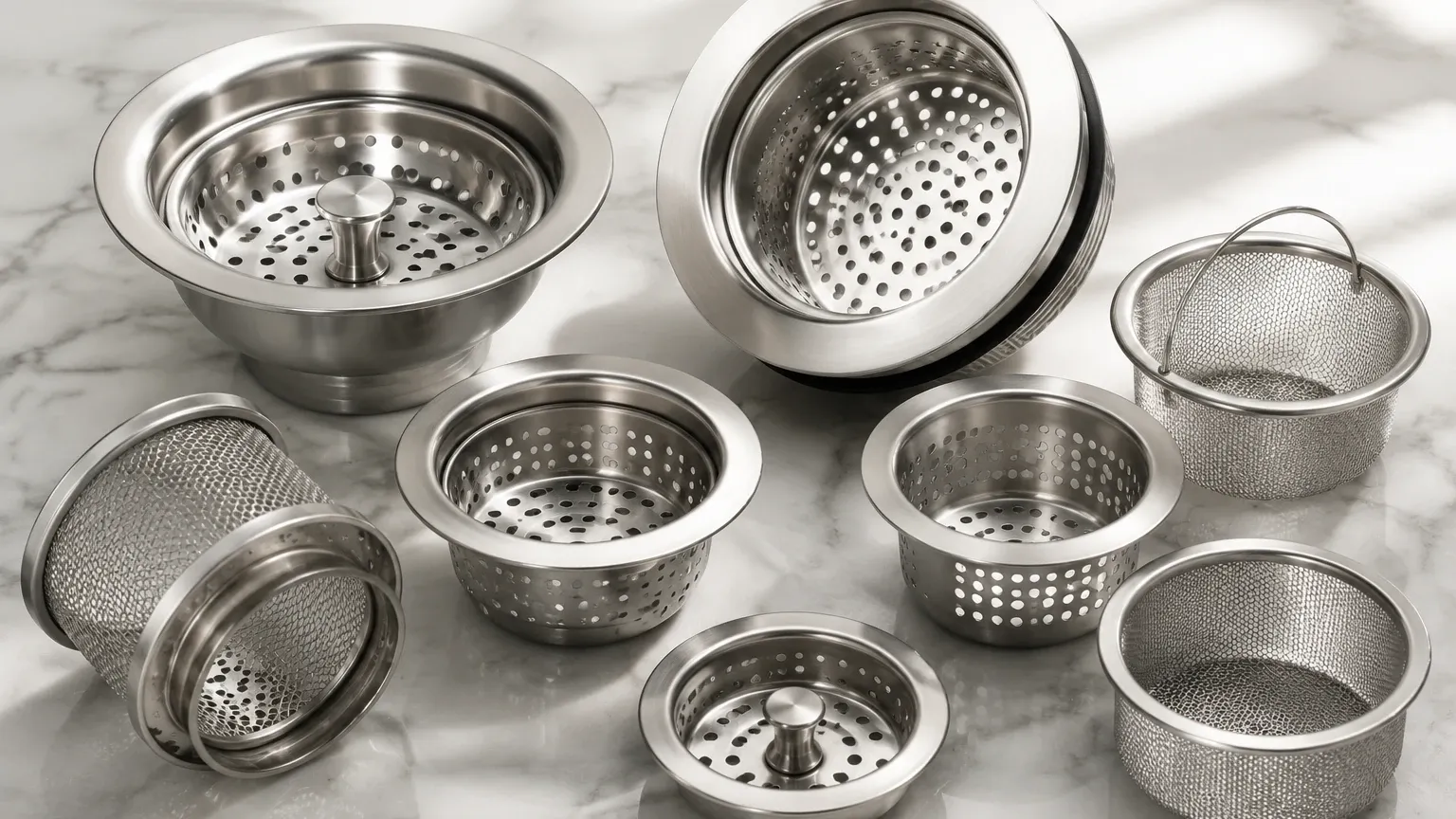
Perforated strainers are typically used for coarse filtration. They are constructed from solid sheets of stainless steel with punched holes. These are exceptionally robust and can handle high-pressure flows and heavy debris without deforming. Common hole patterns include round, square, or staggered, with the "open area ratio" being the key metric for engineers to evaluate. A higher open area ratio allows for greater flow but may reduce the structural rigidity of the basket.
Wire Mesh Liners
For applications requiring finer filtration, sink strainers can be equipped with stainless steel wire mesh liners. These liners allow for the capture of much smaller particles, down to the micron level. In industrial laboratories or precision manufacturing, these fine-mesh strainers prevent micro-contaminants from entering the waste stream. Kaifil’s expertise in wire mesh allows for the customization of these liners to meet specific filtration targets without significantly compromising the flow rate.
Customization and OEM Solutions for Specialized Applications
Standard off-the-shelf solutions rarely meet the exact needs of a complex industrial facility. Customization is often required to fit unique sink geometries, handle specific flow volumes, or integrate with existing piping systems.
Dimensional Customization
Industrial sinks vary greatly in depth and diameter. A strainer that does not fit perfectly can allow bypass, where debris escapes around the edges of the strainer. Custom-fabricated Strainers & Baskets ensure a precision seal, directing 100% of the fluid through the filtration media.
Handle and Lifting Configurations
In high-volume environments, strainers must be emptied frequently. Custom handle designs, such as fixed bails, folding handles, or extended reach bars, allow operators to remove and clean the baskets safely and efficiently, even when the sink is full of fluid. This ergonomic consideration is vital for maintaining operational speed and worker safety.
Integrated Magnetic Separators
In metalworking or machining facilities, sink strainers can be customized with magnetic inserts. These inserts capture ferrous particles that might be too fine for the mesh but could cause significant damage to downstream magnetic-drive pumps.
Operational Considerations: Flow Rates and Pressure Management
An improperly specified sink strainer can become a bottleneck in a production line. Engineers must calculate the maximum expected flow rate and ensure the strainer’s open area can accommodate it without causing significant backpressure.
Calculating Open Area
The ratio of the total area of the holes to the total area of the strainer surface determines the flow capacity. For industrial applications, a common rule of thumb is to have an open area at least three to four times the cross-sectional area of the discharge pipe. This "safety factor" accounts for the gradual clogging of the strainer between cleaning cycles, ensuring that drainage remains consistent even as debris accumulates.
Pressure Drop (Delta P)
As a strainer fills with debris, the pressure drop across the media increases. In gravity-fed sink systems, an excessive pressure drop leads to slow drainage and potential flooding. By selecting a basket with an optimized geometry—such as a deep-draw design—engineers can increase the available surface area, thereby extending the time between cleanings and maintaining a low pressure drop.
Maintenance Protocols and Total Cost of Ownership (TCO)
While the initial purchase price is a factor, the total cost of ownership for sink strainers includes maintenance labor, replacement frequency, and the cost of potential downstream damage. High-quality stainless steel strainers from Kaifil are designed for longevity, but they still require a structured maintenance protocol.
Cleaning Cycles
In B2B environments, cleaning cycles should be data-driven. Monitoring the time it takes for a sink to drain can indicate when a strainer is reaching capacity. In automated facilities, differential pressure sensors can be used to alert maintenance teams to clean the baskets.
Durability and Replacement
Unlike thin-gauge retail products, industrial sink strainers are built to be cleaned and reused thousands of times. They should be resistant to the mechanical stress of being knocked against waste bins during emptying. Investing in a heavy-duty, welded-construction strainer reduces the frequency of replacements, leading to significant long-term savings.
Selection Criteria for Purchasing Teams: A Checklist
Before finalizing a purchase order for industrial sink strainers, purchasing teams and engineers should confirm the following technical details:
1. Chemical Compatibility: Does the alloy (304 vs. 316L) match the chemicals present in the waste stream?
2. Filtration Target: What is the smallest particle size that needs to be captured to protect downstream equipment?
3. Flow Requirements: What is the peak flow rate the sink must handle, and does the strainer’s open area support it?
4. Physical Dimensions: Are the flange diameter, basket depth, and clearance compatible with the existing sink housing?
5. Regulatory Compliance: Does the product meet FDA, 3A, or other industry-specific sanitary standards?
6. Custom Features: Are specialized handles, magnetic inserts, or reinforced bottoms required for the specific application?
By addressing these factors, organizations can ensure they are implementing a filtration solution that enhances process efficiency rather than hindering it.
Conclusion
Sink strainers are a fundamental yet often overlooked component of industrial infrastructure. Whether used in a pharmaceutical cleanroom or a heavy industrial wash bay, the quality of these components directly impacts the reliability of the entire fluid management system. Kaifil’s commitment to precision manufacturing and high-grade materials ensures that our Strainers & Baskets provide the durability and filtration accuracy required by modern industry. By focusing on engineering excellence and customized solutions, we help our partners achieve optimized performance and long-term operational stability.
