


Paint Strainers
In industrial coating and finishing operations, the integrity of the final surface finish is directly proportional to the purity of the coating material. Paint strainers serve as the primary line of defense against contaminants that can compromise aesthetic quality, mechanical adhesion, and equipment longevity. While disposable options exist for minor touch-ups, industrial-scale applications require robust, reusable, and precision-engineered Strainers & Baskets to handle high volumes, varying viscosities, and chemically aggressive solvents.
For engineers and procurement professionals, selecting the appropriate paint strainer involves more than just choosing a mesh size. It requires a comprehensive understanding of fluid dynamics, material compatibility, and the structural demands of high-pressure delivery systems. This guide examines the technical nuances of industrial paint filtration, focusing on stainless steel solutions that offer durability and precision.
The Role of Strainers & Baskets in Industrial Coating
Industrial paint systems, including those used in automotive, aerospace, and heavy machinery manufacturing, rely on consistent fluid properties. Contaminants such as undissolved pigments, dried paint skins, dust, and metal shavings can enter the system at various stages of the supply chain or during the mixing process. If these particles reach the spray nozzle, they cause "spitting," uneven atomization, or complete blockages.
Using high-quality stainless steel strainers and baskets ensures that only particles within the specified micron range pass through to the application equipment. Unlike paper or plastic alternatives, stainless steel components provide the structural rigidity necessary to withstand the differential pressure (ΔP) generated by industrial pumps. Furthermore, the use of permanent, cleanable filtration media reduces the total cost of ownership by eliminating the recurring expense and waste associated with single-use filters.
Technical Specifications: Material Selection and Compatibility
When specifying paint strainers for industrial environments, material selection is the most critical engineering decision. The chemical composition of the coating—whether water-based, solvent-based, or high-solids—dictates the required corrosion resistance of the strainer.
Stainless Steel Grade 304 vs. 316L
Most industrial paint strainers are manufactured from Grade 304 stainless steel, which offers excellent resistance to water and many common solvents. However, for coatings containing highly corrosive chemicals or for applications in marine environments, Grade 316L is preferred. The addition of molybdenum in 316L provides superior resistance to pitting and crevice corrosion, ensuring the strainer maintains its structural integrity over years of service.
Chemical Resistance
Industrial coatings often involve aggressive solvents like MEK (Methyl Ethyl Ketone), toluene, or specialized thinners. Stainless steel is inert to these chemicals, preventing material degradation that could lead to downstream contamination. Additionally, for water-borne coatings, the oxidation resistance of stainless steel prevents rust particles from being introduced into the paint line, a common failure point for carbon steel or low-grade alloy components.
Understanding Mesh Count and Micron Ratings
The efficacy of paint strainers is defined by their ability to capture particles of a specific size. In the filtration industry, this is measured by mesh count or micron rating. Engineers must balance the need for fine filtration with the requirement for adequate flow rates.
1. Mesh Count: This refers to the number of openings per linear inch. A higher mesh count indicates a finer filter. For example, a 100-mesh screen is significantly finer than a 40-mesh screen.
2. Micron Rating: This is a more precise measurement representing the actual size of the openings in micrometers (μm). For industrial paint applications, common ratings range from 50 microns (very fine) to 500 microns (coarse).
Selecting the wrong micron rating can lead to two primary issues. If the mesh is too coarse, contaminants will pass through and damage the finish or the spray tips. If the mesh is too fine, the strainer will clog prematurely, causing frequent downtime for cleaning and potentially starving the pump of fluid, leading to cavitation.
Structural Designs: Basket vs. Inline Strainers
The physical configuration of the strainer must align with the system's plumbing and the volume of fluid being processed.
Basket Strainers
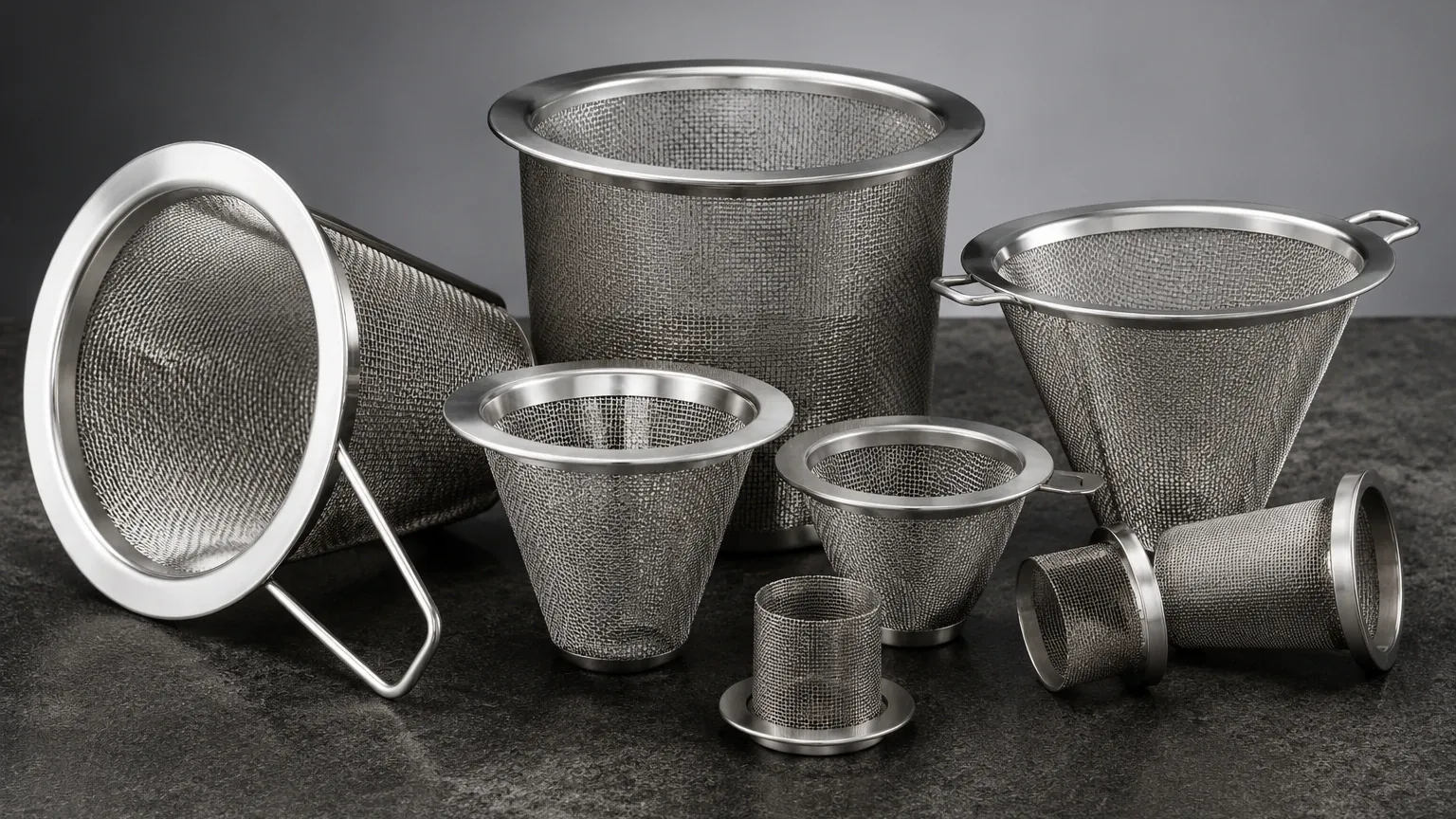
Basket strainers are designed for high-volume applications where significant contaminant loading is expected. The "basket" design provides a large surface area, which minimizes pressure drop and extends the time between cleaning cycles. These are typically used at the intake of the pump or in large-scale mixing tanks. The robust construction of Strainers & Baskets allows them to be easily removed, cleaned, and reinstalled without replacing the entire housing.
Inline and Cone Strainers
For localized protection closer to the point of application, inline or cone strainers are often employed. Cone strainers (sometimes called "witch's hat" strainers) are frequently used during system startups to capture construction debris or in temporary piping runs. Inline strainers are integrated directly into the fluid line and are ideal for protecting sensitive valves and spray nozzles from fine particulates that may have bypassed primary filtration.
Engineering Evaluation: Flow Rate and Pressure Drop
A critical factor in filter selection is the relationship between the fluid's viscosity, the desired flow rate, and the resulting pressure drop across the strainer. Paint is a non-Newtonian fluid, meaning its viscosity can change under shear stress. This complexity must be accounted for during the design phase.
Calculating Effective Filtration Area (EFA)
To maintain a low pressure drop, the Effective Filtration Area (EFA) must be maximized. A larger EFA allows for a lower velocity through the mesh, which reduces the likelihood of "extruding" soft contaminants through the openings and minimizes the mechanical stress on the wire mesh. For high-viscosity coatings, such as primers or thick protective linings, engineers often specify oversized basket strainers to ensure the system maintains the required flow without overworking the pumps.
Burst Strength and Structural Integrity
In high-pressure airless spray systems, the strainer may be subjected to significant pressure differentials, especially as it becomes loaded with debris. Industrial paint strainers must be engineered with reinforced support structures—such as perforated metal backings—to prevent the fine wire mesh from collapsing or tearing under load.
Maintenance, Cleaning, and Total Cost of Ownership
One of the primary advantages of stainless steel paint strainers in a B2B context is their reusability. However, the economic benefits are only realized if a proper maintenance protocol is followed.
Cleaning Procedures
Unlike disposable filters, stainless steel strainers can be cleaned using ultrasonic baths, high-pressure washing, or chemical solvent soaking. Because the mesh is precision-woven, it is essential to avoid abrasive cleaning methods that could distort the wire spacing and alter the micron rating. Regular inspection for mechanical wear or "blinding" (permanent clogging of the mesh) is necessary to ensure consistent performance.
Long-Term Value
While the initial capital expenditure for stainless steel strainers is higher than for disposable alternatives, the total cost of ownership (TCO) is significantly lower. Factors contributing to this include:
* Reduced Waste: Elimination of thousands of single-use filters per year.
* Equipment Protection: Prevention of expensive spray tip replacements and pump repairs.
* Quality Assurance: Reduction in "rework" costs caused by surface defects.
Customization and OEM Solutions
Every industrial coating line has unique requirements based on the chemistry of the paint, the flow requirements of the application, and the physical constraints of the facility. Standard off-the-shelf strainers may not always provide the optimal balance of filtration efficiency and flow capacity.
Customized filtration solutions allow for the adjustment of flange types, housing dimensions, and mesh configurations to meet specific engineering challenges. Whether it is a unique basket geometry for a compact mixing station or a specialized multi-layered mesh for high-solids coatings, working with a manufacturer that understands the nuances of stainless steel fabrication is essential for optimizing system performance.
Conclusion
Paint strainers are critical components in the industrial finishing ecosystem. By prioritizing high-grade materials, precise micron ratings, and robust structural designs, engineers can ensure a reliable and efficient coating process. Investing in professional-grade Strainers & Baskets not only protects sensitive downstream equipment but also guarantees the high-quality surface finishes required in modern manufacturing. When selecting a filtration partner, focus on technical expertise, material traceability, and the ability to provide tailored solutions that address the specific complexities of your industrial application.
