


Oxo Strainers
In the landscape of industrial filtration, the term "oxo strainers" often serves as a point of reference for high-quality, fine-mesh filtration tools. While the name is widely recognized in consumer and professional culinary environments for ergonomic design and reliable mesh integrity, the requirements for industrial-grade Strainers & Baskets are significantly more rigorous. For engineers and procurement specialists in the chemical, pharmaceutical, and food processing sectors, transitioning from standard commercial tools to precision-engineered industrial components is essential for maintaining process integrity, equipment longevity, and safety.
Industrial filtration demands more than just a fine mesh; it requires structural stability, chemical compatibility, and the ability to withstand high differential pressures. This article explores the technical nuances of high-performance strainers, the engineering considerations that separate industrial solutions from consumer-grade products, and the critical factors involved in selecting the right filtration components for demanding applications.
The Engineering Behind High-Performance Mesh Strainers
When evaluating oxo strainers or similar fine-mesh components for technical use, the primary focus is on the wire mesh quality. In industrial applications, the mesh is not merely a screen but a precision-engineered barrier. The performance of these components is dictated by the weaving technology and the physical properties of the wire used.
Weave Types and Aperture Precision
Industrial Strainers & Baskets utilize various weave patterns depending on the required filtration fineness and mechanical strength:
* Plain Weave: The most common type, where each warp wire crosses alternately over and under each weft wire. This provides high precision in aperture size, making it ideal for standard straining tasks.
* Twill Weave: Used for finer filtration, where each weft wire passes over and under two warp wires. This allows for a heavier wire diameter for a given mesh count, increasing the durability of the strainer.
* Dutch Weave: This pattern uses a larger diameter for the warp wires and a smaller diameter for the weft wires, resulting in a dense, strong mesh with very fine filtration capabilities, often used in high-pressure environments.
For B2B applications, the consistency of these apertures is critical. Unlike consumer-grade oxo strainers, industrial components must adhere to strict tolerances to ensure that particles above a specific micron rating are consistently captured without bypassing the filter media.
Comparing Consumer-Grade Designs with Industrial Requirements
The popularity of oxo strainers in professional kitchens and laboratories stems from their user-friendly ergonomics and stainless steel construction. However, in a heavy industrial setting—such as a chemical refinery or a large-scale hydraulic system—these tools face limitations that only purpose-built Strainers & Baskets can address.
Structural Integrity and Pressure Resistance
Consumer strainers are designed for manual use under atmospheric pressure. In contrast, industrial strainers are often integrated into pressurized piping systems. An industrial basket must be able to withstand "slug loading" or sudden surges in pressure without deforming. This is achieved through the use of reinforced frames, perforated metal backing, and heavy-duty support cages that prevent the fine mesh from collapsing under the weight of the captured debris or the force of the fluid flow.
Connection and Sealing Mechanisms
While a handheld strainer relies on a simple rim, industrial strainers require sophisticated sealing to prevent fluid bypass. This includes the integration of flange connections, NPT threads, or specialized O-ring seals. Ensuring a leak-proof interface is vital in pharmaceutical and chemical processing where the loss of product or exposure to hazardous materials must be zero.
Material Selection: Beyond Standard Stainless Steel
While many high-end commercial strainers use stainless steel, the specific grade of the alloy is a defining factor in industrial performance. Most consumer-grade oxo strainers utilize 304-grade stainless steel, which is excellent for general corrosion resistance. However, industrial environments often necessitate more robust materials.
316L Stainless Steel
For applications involving chlorides, acids, or high-salinity fluids, 316L stainless steel is the industry standard. The addition of molybdenum provides superior resistance to pitting and crevice corrosion. In the food and beverage industry, 316L is preferred for its "cleanability" and resistance to the harsh chemicals used in Clean-in-Place (CIP) cycles.
Specialized Alloys
In extreme cases, such as highly corrosive chemical processing or high-temperature steam filtration, even 316L may be insufficient. Manufacturers like Kaifil provide customized Strainers & Baskets in specialized alloys including:
* Monel: Excellent for hydrofluoric acid and seawater applications.
* Hastelloy: Offers exceptional resistance to a wide range of aggressive chemicals and high temperatures.
* Duplex Stainless Steel: Provides high mechanical strength and excellent resistance to stress corrosion cracking.
Performance Evaluation: Flow Rate and Micron Ratings
Engineers must calculate the specific performance metrics of a strainer before integration. The two most critical factors are the micron rating and the Effective Filtration Area (EFA).
Micron Rating vs. Capture Efficiency
A common misconception is that the micron rating is an absolute value. In reality, it is important to distinguish between nominal and absolute ratings. A nominal rating indicates the ability of the strainer to retain the majority of particles of a certain size, while an absolute rating (often achieved through multi-layered sintered mesh) ensures that 99.9% of particles above that size are captured. When replacing a standard oxo strainer with an industrial component, the required capture efficiency must be clearly defined to protect downstream equipment like pumps and spray nozzles.
Managing Differential Pressure (ΔP)
The EFA determines how long a strainer can operate before it becomes clogged. A larger EFA reduces the initial pressure drop across the filter and extends the time between cleaning cycles. Industrial basket strainers are engineered with pleated or multi-layered designs to maximize the surface area within a compact footprint, a feature not typically found in standard mesh strainers.
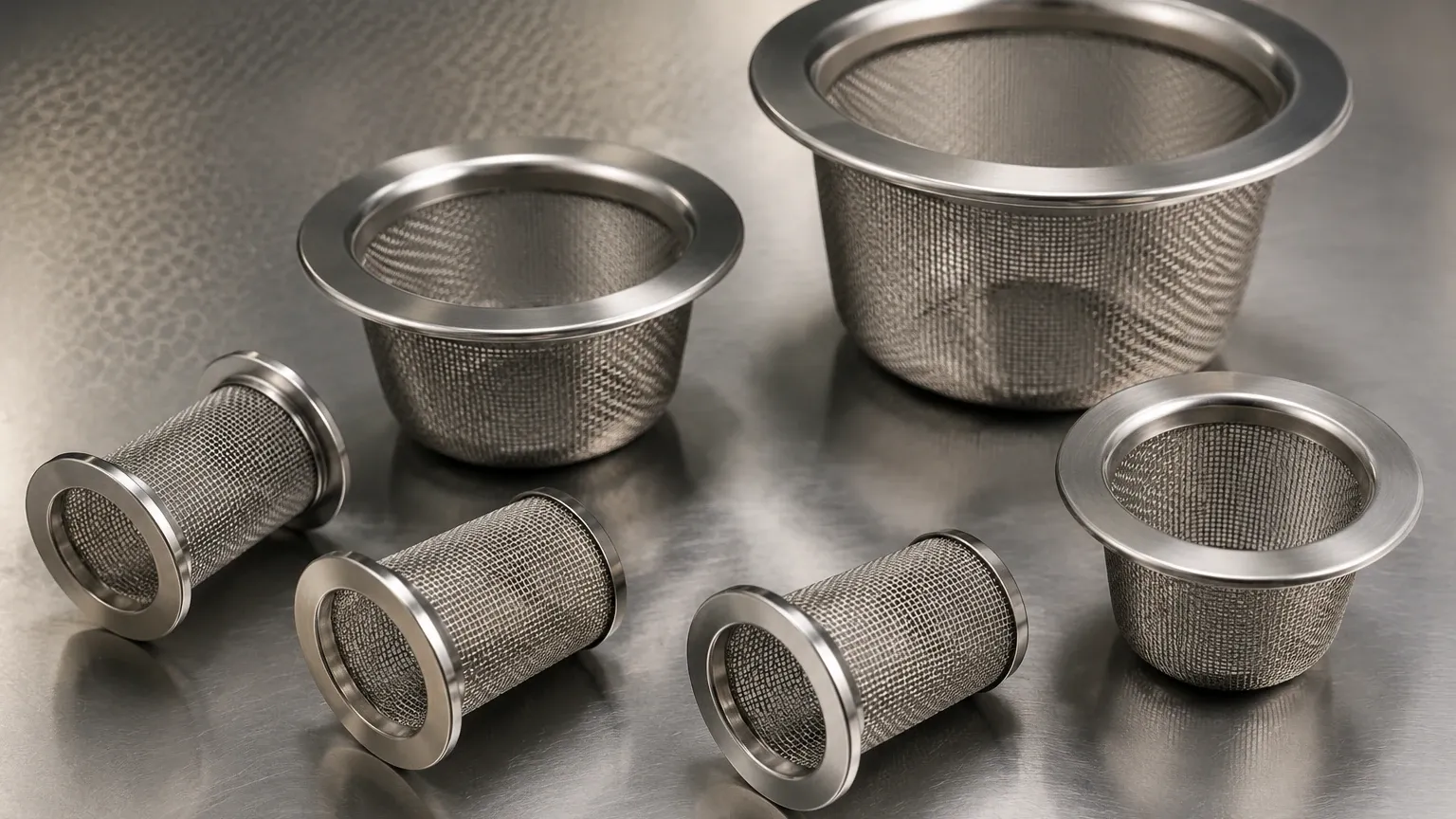
Customization and OEM Capabilities for Precision Filtration
One of the primary advantages of working with a professional manufacturer like Kaifil is the ability to customize Strainers & Baskets to fit specific machinery or process requirements. While off-the-shelf oxo strainers come in fixed sizes, industrial applications often require unique geometries.
Tailored Geometric Designs
Customization options include:
* Conical and Hat Strainers: Designed for temporary filtration during system start-up to protect turbines and compressors.
* T-Type and Y-Type Baskets: Engineered to fit specific pipe configurations while allowing for easy removal and cleaning.
* Multi-Stage Filtration: Combining a coarse perforated outer layer with a fine mesh inner liner to handle high solids loading while maintaining fine filtration.
Engineering Collaboration
B2B procurement involves more than just selecting a part number. It requires collaboration between the manufacturer and the end-user to ensure that the filtration component accounts for fluid viscosity, temperature fluctuations, and flow velocity. This technical support ensures that the final product performs reliably in the intended environment.
Maintenance, Cleaning, and Total Cost of Ownership (TCO)
In an industrial setting, the "disposable" nature of low-cost strainers is a liability. The total cost of ownership (TCO) is influenced by the durability of the component and the ease with which it can be serviced. High-quality stainless steel Strainers & Baskets are designed for long-term reuse.
Cleaning Protocols
Industrial strainers are subjected to various cleaning methods to restore their flow capacity:
* Ultrasonic Cleaning: Effective for removing fine particles trapped deep within the mesh pores.
* Backwashing: Utilizing reverse flow to dislodge accumulated debris.
* Chemical Soaking: Using specific solvents to dissolve organic or mineral scaling without damaging the stainless steel substrate.
Replacement Indicators
Engineers should monitor the differential pressure across the strainer. A significant increase in ΔP indicates that the basket is reaching its holding capacity. Unlike consumer products that may fray or break at the handle, industrial strainers are built to endure hundreds of cleaning cycles, provided they are maintained according to technical guidelines.
Conclusion: Selecting the Right Filtration Partner
While oxo strainers represent a standard for quality in their respective niche, industrial filtration requires a deeper level of engineering expertise and material science. Selecting the appropriate Strainers & Baskets involves a comprehensive analysis of the fluid properties, environmental conditions, and required filtration accuracy.
By partnering with a specialized manufacturer like Kaifil, companies gain access to high-performance stainless steel filtration solutions that are customized for durability and precision. Whether the application involves protecting a sensitive hydraulic valve or ensuring the purity of a pharmaceutical batch, the right industrial strainer is a critical investment in process efficiency and equipment protection.
