


Quick Cleaning Strainers
In industrial fluid handling, the efficiency of a filtration system is often measured not just by its ability to capture contaminants, but by how quickly it can be returned to service after a maintenance cycle. Quick cleaning strainers represent a specialized category of industrial filtration components designed to minimize downtime in high-volume or continuous-flow environments. By integrating ergonomic closure systems and optimized internal geometries, these units allow operators to remove, clean, and replace internal elements with minimal tools and time.
For engineers and facility managers, the selection of Strainers & Baskets is a critical decision that impacts the protection of downstream equipment, such as pumps, heat exchangers, and spray nozzles. Understanding the technical nuances of quick cleaning designs is essential for maintaining process integrity and reducing the total cost of ownership.
The Role of Quick Cleaning Strainers in Industrial Process Efficiency
Industrial processes in sectors like chemical processing, food and beverage, and water treatment often involve fluids containing suspended solids. If these solids are not effectively removed, they can cause abrasive wear on pump impellers, clog narrow orifices, or contaminate final products. While a standard strainer provides the necessary barrier, the labor required to service it can become a bottleneck.
Quick cleaning strainers address this by focusing on the "serviceability" aspect of the filtration component. In many traditional designs, accessing the filter basket requires the removal of multiple heavy bolts and the use of specialized wrenches. In contrast, quick cleaning versions often utilize swing bolts, V-band clamps, or quick-opening covers that can be operated by hand or with a single tool. This reduction in service time is particularly valuable in applications where the contaminant load is high, necessitating frequent cleaning cycles.
Beyond simple ease of access, these strainers are engineered to maintain a tight seal under pressure. The transition from a standard bolted flange to a quick-release mechanism must not compromise the safety or the leak-proof nature of the housing. This is achieved through precision-machined sealing surfaces and high-performance elastomeric O-rings that provide a reliable seal even after repeated opening and closing.
Technical Specifications and Engineering Design
The performance of quick cleaning strainers is dictated by their internal architecture and the materials used in their construction. Most industrial-grade units are fabricated from stainless steel (typically Grade 304 or 316L) to ensure corrosion resistance and structural longevity. The choice of material is often driven by the chemical composition of the process fluid and the required hygienic standards.
Basket Geometry and Filtration Media
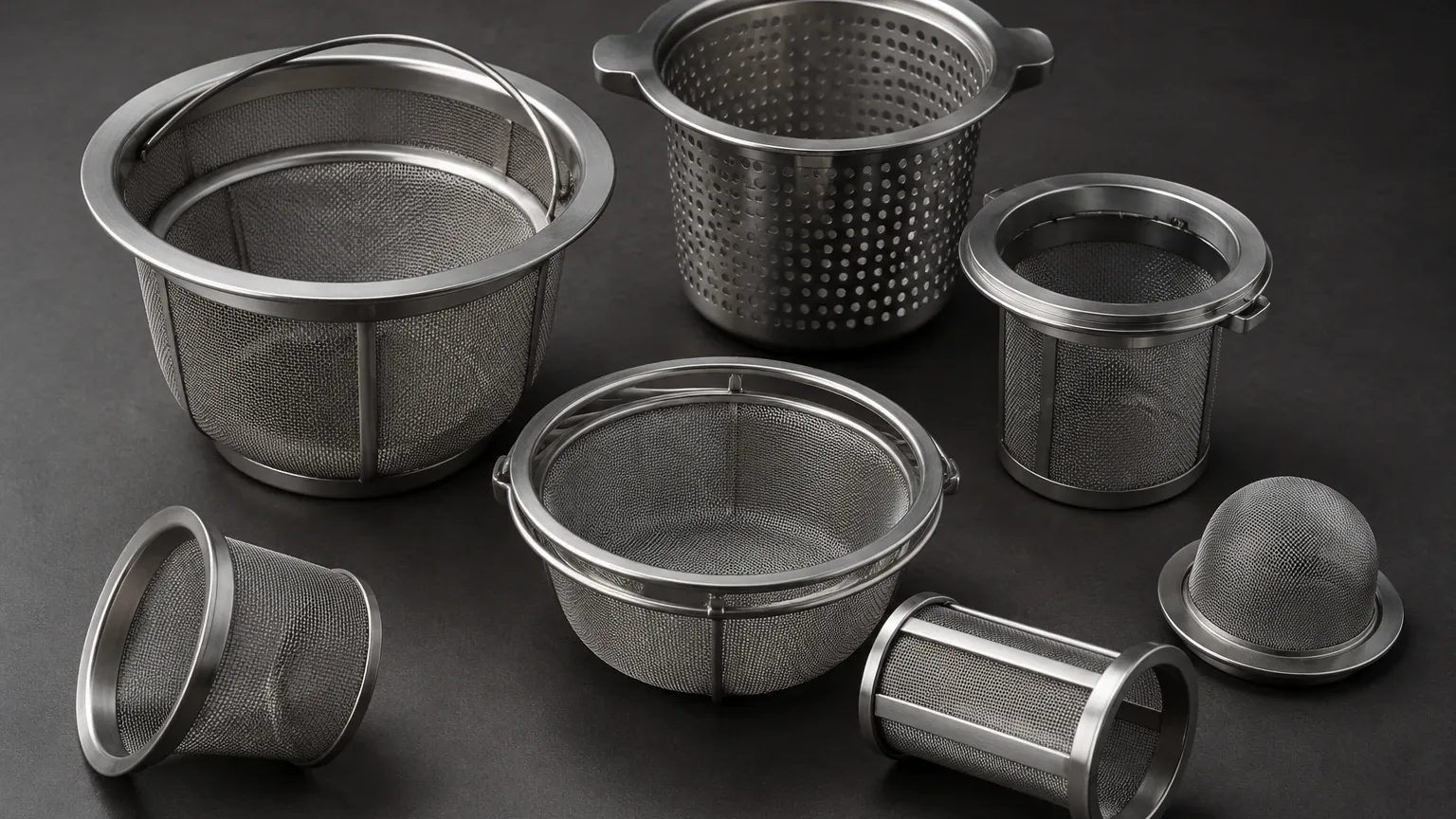
The heart of the strainer is the basket. To facilitate quick cleaning, the basket must be easily removable. Design features such as lift-out handles and tapered seats ensure that the basket can be pulled out without sticking, even if fine particles have accumulated around the edges.
The filtration media itself can vary based on the application:
* Perforated Plate: Used for coarse straining (typically 1/32" to 1/4" holes). These are robust and easy to scrub clean.
* Wire Mesh Liners: For finer filtration (down to 20 microns or less), a stainless steel wire mesh is sintered or mechanically fastened to a perforated support basket. This provides the necessary surface area for fine particle capture while maintaining the structural integrity needed to withstand differential pressure.
* Wedge Wire: Ideal for heavy-duty applications, wedge wire offers a non-clogging surface that is exceptionally easy to clean due to its V-shaped profile.
Housing Configurations
Quick cleaning strainers are available in several configurations, including Simplex and Duplex designs. A Simplex strainer is used in batch processes where the flow can be stopped for cleaning. A Duplex strainer, which consists of two separate strainer housings connected by a diverter valve, allows for continuous operation; flow is diverted to the clean chamber while the dirty chamber is serviced. The integration of quick-opening covers on Duplex systems further enhances the efficiency of continuous-flow operations.
Key Features of Quick Cleaning Mechanisms
When evaluating quick cleaning strainers, several design features distinguish a high-performance unit from a standard model. These features are engineered to address the practical challenges faced by maintenance teams in the field.
Tool-Free Closures
The most common quick-access feature is the swing-bolt closure. Unlike standard hex bolts that must be fully removed, swing bolts remain attached to the housing. Once loosened, they swing out of the way, allowing the cover to be lifted. This prevents the loss of hardware and significantly speeds up the process. Other designs may use a threaded "spin-off" cap or a yoke-style closure for smaller diameters.
Pressure Equalization and Venting
Opening a pressurized vessel is a safety hazard. Quick cleaning strainers often include integrated vent valves or pressure relief ports. This allows the operator to safely bleed off internal pressure before attempting to open the cover. Some advanced designs include safety interlocks that prevent the cover from being opened until the internal pressure has reached atmospheric levels.
Ergonomic Handling
For larger strainers, the weight of the cover and the basket can be substantial. Engineering considerations for these units include davit arms or counterbalanced hinges that support the weight of the cover as it is moved. Similarly, baskets may be equipped with heavy-duty handles or even lifting eyes for overhead crane access in large-scale industrial installations.
Material Selection for Demanding Filtration Environments
The durability of a strainer is largely dependent on its material compatibility with the process fluid. Stainless steel is the industry standard for most quick cleaning strainers due to its versatility.
* Stainless Steel 304: Suitable for general-purpose applications, including water treatment and mildly corrosive industrial fluids. It offers good strength and cost-effectiveness.
* Stainless Steel 316/316L: Preferred for chemical processing, pharmaceutical, and marine environments. The addition of molybdenum provides superior resistance to chlorides and pitting corrosion.
* Specialty Alloys: In highly aggressive environments, such as those involving hot concentrated acids, alloys like Hastelloy or Monel may be required for the internal baskets to prevent premature failure.
In addition to the metal components, the selection of seal materials is critical. EPDM is commonly used for water and steam, while Viton (FKM) is preferred for oils and many chemicals. For the most demanding chemical applications, PTFE-encapsulated O-rings provide near-universal chemical resistance. The ease of replacing these seals during a quick cleaning cycle is a vital part of the strainer's maintenance profile.
Operational Considerations: Flow Rate and Pressure Drop
An often-overlooked aspect of strainer selection is the impact of the unit on system hydraulics. Every strainer introduces a pressure drop (Delta P) into the system. As the basket collects debris, the open area of the mesh decreases, and the pressure drop increases.
Calculating the Clean Pressure Drop
Engineers must ensure that the initial pressure drop of a clean strainer does not exceed the system's allowable limits. This is typically calculated based on the fluid's viscosity, specific gravity, and flow velocity. Quick cleaning strainers are often designed with oversized baskets to provide a higher "open area ratio" (the ratio of the total open area of the mesh to the cross-sectional area of the inlet pipe). A higher ratio (e.g., 6:1 or 8:1) results in a lower initial pressure drop and longer intervals between cleaning cycles.
Monitoring Differential Pressure
To effectively utilize a quick cleaning strainer, it is recommended to install differential pressure gauges across the inlet and outlet ports. This provides a real-time indication of the basket's condition. Most manufacturers recommend cleaning the basket when the differential pressure reaches 5-10 psi above the clean reading. Waiting too long can result in "basket bypass" (where fluid forces its way around the seals) or, in extreme cases, the structural collapse of the basket itself.
Maintenance Protocols and Service Life Optimization
While quick cleaning strainers are designed for ease of use, following a structured maintenance protocol is essential for long-term reliability. A well-maintained strainer can last for decades, whereas a neglected unit may suffer from bypass or housing damage.
1. Regular Inspection of Seals: During every cleaning cycle, the O-ring or gasket should be inspected for nicks, compression set, or chemical degradation. A damaged seal is the primary cause of external leaks and internal bypass.
2. Basket Cleaning Techniques: Depending on the contaminant, baskets should be cleaned using appropriate methods. For soft organic solids, a high-pressure water spray is often sufficient. For scale or chemical deposits, an ultrasonic bath or a compatible chemical soak may be necessary. It is important to avoid using wire brushes that are made of a different metal than the basket (e.g., using a carbon steel brush on a stainless steel basket), as this can embed particles that lead to galvanic corrosion.
3. Spare Parts Inventory: To truly maximize the benefit of a quick cleaning design, facilities should maintain a stock of spare baskets and seals. This allows for a "swap and go" approach: the dirty basket is removed and immediately replaced with a clean spare, allowing the process to restart while the dirty basket is cleaned offline.
Customization and OEM Solutions
No two industrial processes are identical, and off-the-shelf strainers may not always meet specific engineering requirements. Customization is often necessary to address unique flow patterns, space constraints, or specialized filtration levels.
Working with a manufacturer like Kaifil allows for the development of tailored Strainers & Baskets that fit exact application needs. Customization options can include:
* Non-Standard Micron Ratings: Precision-engineered mesh to capture specific particle sizes while maximizing flow.
* Unique Inlet/Outlet Orientations: Offset or angled nozzles to fit into compact piping skids.
* Reinforced Baskets: Heavy-duty support structures for high-pressure or high-viscosity applications where standard baskets might deform.
* Specialty Coatings: Electropolishing for hygienic applications or specialized linings for abrasive slurries.
By focusing on these technical details, engineers can ensure that their quick cleaning strainers provide the necessary protection for their equipment without becoming a source of operational frustration. The goal is a seamless integration of filtration and maintenance that supports continuous, high-quality production.
