


Que Es Strainers
In industrial fluid handling and process engineering, the term "strainer" refers to a critical component designed to protect downstream equipment from damage caused by debris, scale, and other solid contaminants. When professionals ask "que es strainers," they are typically seeking a technical understanding of mechanical separation devices that use a perforated plate or wire mesh screen to remove coarse solids from a flowing medium—whether liquid, gas, or steam. Unlike fine filters, strainers are generally used for the removal of larger particles, serving as the primary line of defense for pumps, valves, meters, and heat exchangers.
Industrial Strainers & Baskets are engineered to handle high flow rates with relatively low pressure drops. They are permanent components of a piping system, designed for durability and ease of maintenance. Understanding the nuances of strainer design, material selection, and application-specific requirements is essential for engineers and purchasing teams tasked with maintaining system integrity and operational efficiency.
Understanding the Core Function of Industrial Strainers
The fundamental purpose of a strainer is the mechanical removal of solids from a process stream. This is achieved by passing the fluid through a removable screen or basket. As the fluid flows through the openings in the mesh or perforated metal, any solid particle larger than the opening is trapped within the element.
In many industrial contexts, the distinction between a strainer and a filter is based on the size of the particles being removed. Strainers are typically used for "coarse" filtration, often measured in mesh sizes or millimeters, whereas filters are used for "fine" separation, often measured in microns. However, the engineering principles remain similar: protecting the process and the equipment.
For engineers, the question of "que es strainers" also involves understanding the "open area ratio." This is the ratio of the total area of the openings in the strainer element to the cross-sectional area of the inlet pipe. A higher ratio generally indicates that the strainer can operate for longer periods before the accumulated debris causes a significant pressure drop, which could otherwise lead to cavitation in pumps or reduced flow in the process line.
Types of Strainers and Baskets in Industrial Systems
Selecting the correct configuration is vital for system performance. The geometry of the strainer housing and the design of the internal basket are dictated by the nature of the fluid, the pressure of the system, and the frequency of cleaning required.
Y-Strainers
The Y-strainer is perhaps the most common type due to its compact design and versatility. It is shaped like the letter "Y" and is typically used in pressurized lines, either liquid or gas. Because of its structural rigidity, it can handle high pressures that might compromise other designs. Y-strainers are often preferred for steam applications or where the amount of debris is relatively low, as they have a smaller holding capacity compared to basket-style strainers.
Simplex Basket Strainers
Basket strainers feature a vertical cylinder that houses a removable basket. These are used in horizontal pipelines and offer a much larger dirt-holding capacity than Y-strainers. This makes them ideal for applications with higher concentrations of solids. Because the basket is serviced from the top, maintenance is generally easier, though the flow must be stopped to clean or replace the internal element.
Duplex Basket Strainers
In critical processes where the flow cannot be interrupted, duplex strainers are employed. These consist of two separate strainer chambers connected by a diversion valve. When one basket becomes clogged, the operator can switch the flow to the clean chamber without shutting down the system. This is common in fuel oil systems, cooling water lines, and chemical processing plants where continuous operation is mandatory.
Material Selection and Engineering Considerations
The performance and lifespan of Strainers & Baskets depend heavily on the materials used in their construction. In demanding industrial environments, stainless steel is the gold standard due to its corrosion resistance and mechanical strength.
Stainless Steel Grades
* Grade 304: Suitable for general industrial use, providing excellent resistance to atmospheric corrosion and many organic and inorganic chemicals. It is frequently used in food and beverage applications where sanitation is a priority.
* Grade 316/316L: Contains molybdenum, which provides superior resistance to chlorides and acids. This is the preferred material for pharmaceutical, chemical processing, and marine environments where the risk of pitting and crevice corrosion is high.
Mesh and Perforation Types
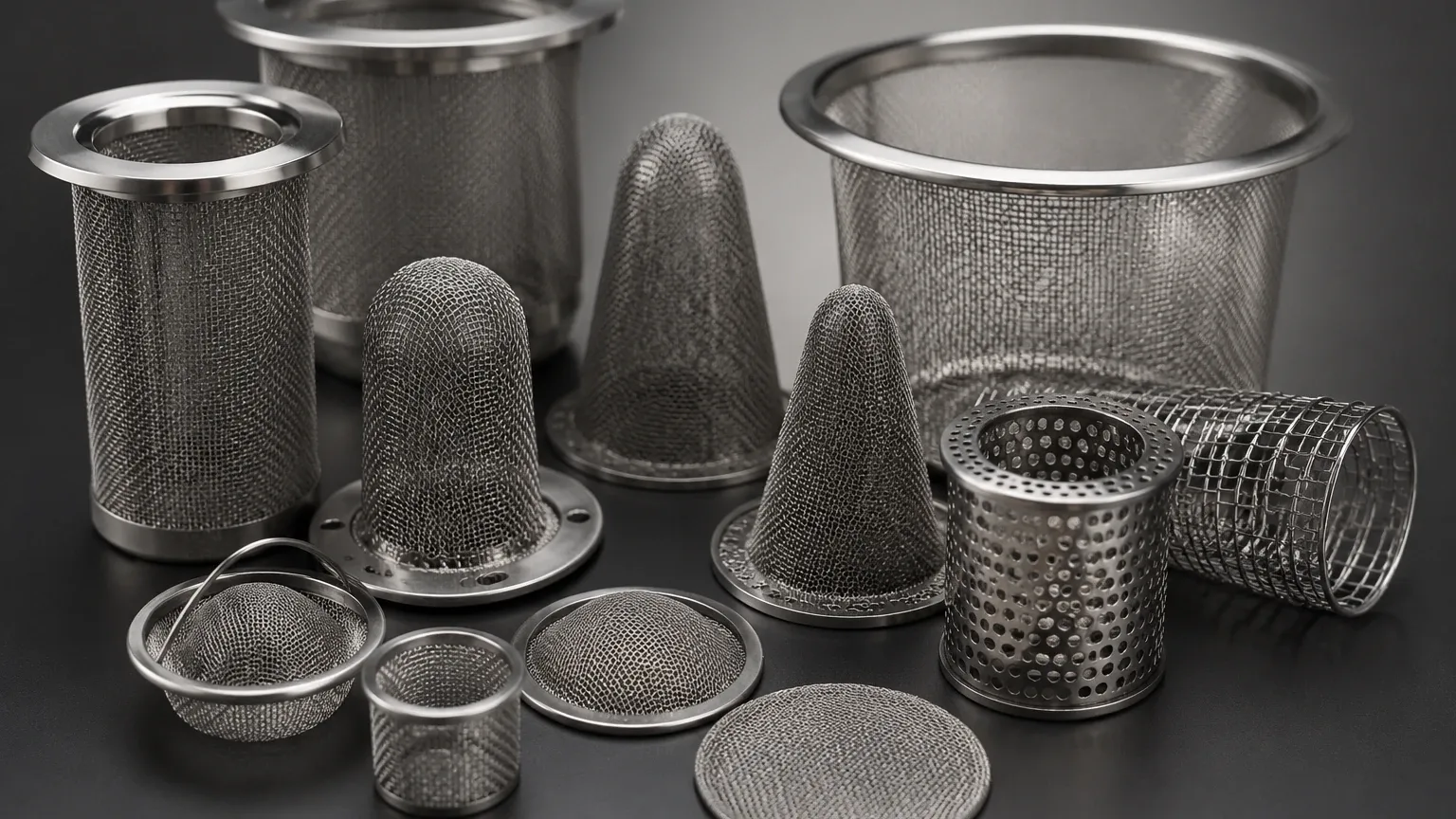
The internal element—the basket or screen—is the heart of the strainer. It can be constructed from perforated metal, woven wire mesh, or a combination of both (where the mesh is supported by a perforated metal backup).
* Perforated Metal: Best for removing large debris. The hole size and pattern (staggered vs. straight) affect both the strength of the basket and the flow characteristics.
* Woven Wire Mesh: Used for finer straining requirements. The "mesh count" refers to the number of openings per linear inch. Engineers must balance the need for fine straining with the risk of rapid clogging and increased differential pressure.
Performance Metrics: Pressure Drop and Filtration Efficiency
When evaluating "que es strainers" for a specific project, engineers must focus on the "Clean Pressure Drop" (ΔP). Every strainer introduces some resistance to the flow. If the initial pressure drop is too high, it limits the amount of debris the strainer can collect before reaching the maximum allowable pressure drop for the system.
Factors Affecting Pressure Drop:
1. Viscosity of the Fluid: Thicker fluids (like heavy oils) require larger openings or larger strainer housings to maintain acceptable flow rates.
2. Flow Velocity: Higher velocities increase the pressure drop exponentially. Most industrial systems aim for a velocity that minimizes turbulence while ensuring efficient transport of the fluid.
3. Percentage of Open Area: As mentioned previously, a basket with a 4:1 open area ratio will have a much lower pressure drop and longer service life than one with a 2:1 ratio.
It is also important to consider the "burst pressure" of the basket. If a strainer becomes completely clogged, the full system pressure is exerted against the basket. Custom-manufactured baskets from specialists like Kaifil are engineered to withstand these stresses without collapsing, preventing catastrophic failure where debris would be flushed downstream into sensitive equipment.
Customization and OEM Solutions for Specific Applications
Standard off-the-shelf strainers do not always meet the rigorous demands of specialized industrial processes. Customization is often required to ensure compatibility with existing piping layouts, specific chemical environments, or unique flow requirements.
Custom Dimensions and Connections
In many retrofit projects, space is at a premium. Custom-fabricated Strainers & Baskets can be designed with specific face-to-face dimensions or specialized flange connections (such as ANSI, DIN, or JIS standards) to fit perfectly into an existing system without the need for extensive pipework modification.
Specialized Coatings and Linings
For extremely aggressive media, stainless steel strainers can be further enhanced with specialized coatings or linings. However, in most high-purity applications, such as those found in the pharmaceutical industry, high-grade polished stainless steel is preferred to prevent bacterial growth and ensure ease of sterilization.
OEM Manufacturing
For equipment manufacturers (OEMs), integrating a high-quality strainer into a larger machine—such as a hydraulic power unit or a commercial dishwashing system—requires a partner who can provide consistent quality and precise tolerances. Custom wire mesh configurations and precision-welded components ensure that the strainer performs reliably over the entire lifecycle of the equipment.
Maintenance and Operational Best Practices
A strainer is only effective if it is maintained correctly. The total cost of ownership (TCO) for a strainer system is heavily influenced by how easily it can be cleaned and how long the internal elements last.
1. Differential Pressure Monitoring: Installing pressure gauges upstream and downstream of the strainer is the most effective way to monitor its condition. A significant increase in the pressure differential indicates that the basket is full and requires cleaning.
2. Cleaning Protocols: For stainless steel baskets, cleaning often involves backwashing or manual removal and ultrasonic cleaning. It is essential to inspect the mesh for signs of fraying or bypass during every cleaning cycle.
3. Gasket and Seal Replacement: Every time a strainer is opened for cleaning, the seals should be inspected. Using high-quality O-rings or gaskets compatible with the process fluid is vital to prevent leaks when the system is repressurized.
4. Spare Baskets: To minimize downtime, many facilities keep spare baskets on hand. This allows for an immediate swap, so the dirty basket can be cleaned offline without delaying the restart of the process.
Conclusion
In summary, answering "que es strainers" requires looking beyond a simple definition. In the B2B industrial sector, strainers and baskets are sophisticated engineering tools essential for process safety and equipment longevity. By selecting the right materials, such as high-grade stainless steel, and focusing on technical specifications like pressure drop and open area ratios, engineers can ensure their systems operate at peak efficiency. Whether for chemical processing, food production, or hydraulic systems, the right filtration solution is a balance of robust construction, precise customization, and ease of maintenance.
