


Strainer vs Filter
In industrial fluid processing, the terms "strainer" and "filter" are frequently used interchangeably, yet they represent distinct engineering solutions with different performance profiles, maintenance requirements, and roles within a system. For engineers and procurement teams, understanding the technical nuances of a strainer vs filter is essential for optimizing process efficiency, protecting downstream equipment, and managing the total cost of ownership.
Choosing the wrong component can lead to frequent downtime, damaged pumps, or contaminated final products. This guide examines the technical distinctions, selection criteria, and engineering considerations necessary to specify the correct component for industrial applications.
Defining the Core Differences: Strainer vs Filter
The primary distinction between a strainer and a filter lies in the size of the particles they are designed to remove and the stage of the process in which they are deployed. While both are used to separate solids from liquids or gases, their mechanical designs and operational expectations differ significantly.
Particle Size and Micron Ratings
Generally, a strainer is used to remove larger, macroscopic particles that are visible to the naked eye. In most industrial contexts, a strainer handles particles larger than 50 to 100 microns. Conversely, a filter is designed to capture microscopic contaminants, often operating in the sub-micron to 50-micron range.
Pressure Drop and Flow Resistance
Because strainers typically utilize coarser media, such as perforated metal or heavy wire mesh, they offer lower resistance to flow. This results in a lower initial pressure drop ($ΔP$) across the component. Filters, which utilize denser media like felt, membrane, or fine sintered metal to capture smaller particles, create higher resistance. This means that for a given flow rate, a filter will almost always require more energy (pumping power) than a strainer.
Reusability and Service Life
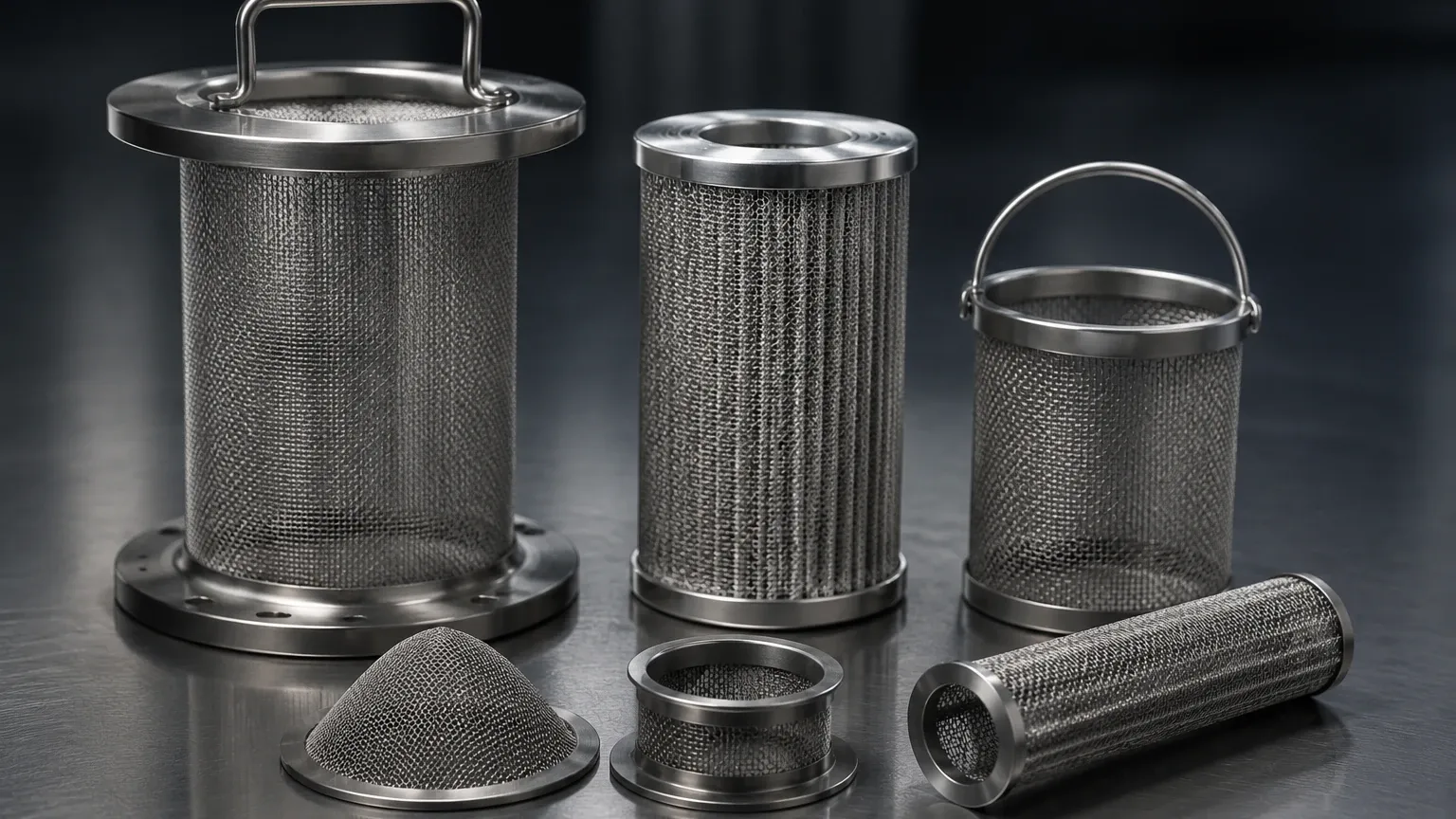
One of the most significant operational differences is the cleaning cycle. Strainers & Baskets are almost always designed to be cleaned and reused. They are robust mechanical components that can withstand repeated high-pressure wash-downs or ultrasonic cleaning. Filters are frequently (though not always) disposable or require specialized chemical regeneration processes once they reach their maximum dirt-holding capacity.
Engineering Considerations for Strainers and Baskets
In many industrial systems, strainers serve as the first line of defense. Their primary role is often "equipment protection" rather than "product purification." For example, placing a basket strainer upstream of a high-accuracy flow meter or a centrifugal pump prevents large debris—such as scale, weld slag, or stray hardware—from causing catastrophic mechanical failure.
Mechanical Strength and Housing Design
When specifying strainers, engineers must consider the structural integrity of the basket. Unlike a delicate filter membrane, a stainless steel basket must withstand the full force of the system flow if it becomes significantly clogged. High-viscosity fluids, such as heavy oils or resins, exert substantial shear stress on the mesh. Kaifil specializes in manufacturing reinforced stainless steel baskets that maintain their geometry under high differential pressures, ensuring that the media does not bypass or collapse.
The Role of Open Area Ratio
The "Open Area Ratio" (OAR) is a critical metric for strainer performance. It is the ratio of the total area of the holes in the media to the cross-sectional area of the inlet pipe. A well-designed strainer should typically have an OAR of at least 4:1. A higher OAR allows for longer intervals between cleanings and minimizes the velocity of the fluid as it passes through the mesh, which reduces the likelihood of particle "breakthrough" or impingement erosion.
Performance Metrics and Selection Criteria
To make an informed decision in the strainer vs filter debate, technical teams must evaluate several variables beyond just the size of the particle. The interaction between the fluid chemistry, the particle morphology, and the operating environment dictates the material selection and construction method.
Material Compatibility
In industries such as chemical processing or pharmaceutical manufacturing, the choice of material is non-negotiable. Stainless steel (Grade 304 or 316L) is the industry standard due to its corrosion resistance and ability to withstand high temperatures. 316L, in particular, offers superior resistance to pitting and crevice corrosion in chloride-rich environments. When selecting between a strainer or a filter, the durability of the material under cleaning cycles must be considered; a stainless steel strainer can last for years, whereas a polymer-based filter might degrade after limited exposure to certain solvents.
Flow Rate and Viscosity
Viscosity plays a massive role in component selection. High-viscosity liquids require larger surface areas to maintain acceptable pressure drops. In these cases, a large-volume basket strainer is often more practical than a filter. If fine filtration is required for a viscous fluid, the system may need to be heated to reduce viscosity or the filtration surface area must be significantly oversized to prevent the media from blinding prematurely.
Nature of the Contaminant
Are the solids hard and angular, or soft and gelatinous? Hard particles are easily captured by the fixed apertures of a wire mesh strainer. Gelatinous particles, however, can "extrude" through a mesh under pressure. In such instances, a depth filter (which captures particles throughout the thickness of the media) is more effective than a surface-type strainer.
Maintenance and Operational Impact
The long-term cost of a filtration system is rarely found in the initial purchase price; it is found in the maintenance labor and the cost of replacement media.
Differential Pressure Monitoring
Both strainers and filters should be monitored using differential pressure gauges. For a strainer, a typical cleaning threshold might be reached when the $ΔP$ increases by 5 to 10 psi over the clean baseline. Ignoring this leads to reduced flow rates and potential damage to the internal basket. Because strainers are reusable, the "cost per cleaning" is primarily labor-based.
Replacement Cycles
Filters often have a shorter operational life before they must be replaced. In high-load applications, the cost of purchasing and disposing of filter cartridges can become a significant line item in an annual budget. This is why many engineers implement a multi-stage approach: using a coarse strainer to remove the bulk of the solids, followed by a fine filter to achieve the final required purity. This "pre-filtration" strategy extends the life of the more expensive filter elements significantly.
Customization and Material Science in Industrial Filtration
Standard off-the-shelf solutions often fail to meet the specific demands of specialized industrial processes. Customization is where engineering expertise becomes a value driver.
Tailored Mesh and Perforation Patterns
At Kaifil, the manufacturing process allows for precise control over the filtration media. For example, a process might require a specific "wedge wire" construction for better backwashing capabilities, or a multi-layered sintered mesh for high-pressure gas applications. Customizing the Strainers & Baskets to fit existing housings or to handle specific flow patterns can eliminate the need for costly piping reconfigurations.
Structural Reinforcements
In applications involving high-pressure surges (water hammer) or vibrating equipment, standard baskets may suffer from fatigue. Engineering a basket with reinforced longitudinal ribs or heavier gauge perforated plate support ensures the component survives the mechanical stresses of the environment. This level of customization ensures that the filtration solution is as durable as the rest of the piping system.
Making the Final Decision: Total Cost of Ownership
When evaluating a strainer vs filter, the decision should be guided by the "Total Cost of Ownership" (TCO). This includes:
1. Initial Capital Expenditure (CAPEX): The cost of the housing and the initial internal elements.
2. Operating Expenditure (OPEX): The energy cost associated with the pressure drop.
3. Maintenance Costs: Labor for cleaning or replacing elements, and the cost of the replacement elements themselves.
4. Downtime Costs: The lost production value when the system is offline for maintenance.
For many industrial applications, a high-quality stainless steel strainer provides the best TCO because of its longevity and reusability. However, if the process requires high-purity output (such as sterile water for injection or ultra-fine chemical catalysts), the higher OPEX of a filter is a necessary investment.
Summary of Selection
- Choose a Strainer if: You need to protect pumps/valves, the particles are >50 microns, the fluid is highly viscous, or you require a reusable, low-maintenance solution.
- Choose a Filter if: You need high-purity effluent, the particles are <50 microns, or you are removing bacteria or microscopic contaminants.
- Choose Both if: You want to protect your expensive fine filters from premature clogging by using a strainer as a pre-filter.
By focusing on the technical requirements of the application—flow rate, pressure drop, particle size, and chemical compatibility—engineers can select the most efficient component. Kaifil’s expertise in custom stainless steel manufacturing ensures that whether the application calls for a standard basket or a highly specialized filtration component, the resulting solution will provide reliable, long-term performance in the most demanding industrial environments.
