


Strainer Valve Ac
In industrial fluid handling and thermal management systems, the protection of sensitive components is paramount to operational longevity. The term "strainer valve ac" typically refers to the integration of filtration components—specifically strainers—within systems involving air conditioning (AC), cooling circuits, or automatic control (AC) valves. These components serve as the first line of defense against mechanical impurities that can compromise valve seats, clog heat exchanger capillaries, or damage pump impellers.
For engineers and procurement professionals, understanding the technical nuances of Strainers & Baskets is essential for maintaining system integrity. Whether the application involves a large-scale industrial HVAC system or a precise chemical dosing line, the selection of the correct strainer configuration directly impacts the total cost of ownership and the frequency of unscheduled maintenance.
The Critical Function of Strainers in Valve Assemblies
Valves are precision-engineered devices designed to regulate flow, pressure, or direction. In systems categorized under "strainer valve ac," the strainer is positioned upstream of the valve to intercept solid particulates such as scale, rust, weld beads, and jointing compounds. Even microscopic debris can cause significant issues:
1. Seat Erosion: High-velocity particles can pit or score valve seats, leading to internal leakage (passing) when the valve is supposedly closed.
2. Sticking Actuators: In automatic control valves, debris can lodge in the guiding surfaces or the orifice, preventing the valve from reaching its commanded position.
3. Orifice Clogging: In AC and refrigeration systems, expansion valves have extremely small orifices. A failure in filtration here leads to immediate system inefficiency or compressor failure.
By utilizing robust stainless steel strainers, operators ensure that the fluid reaching the valve meets the required cleanliness levels, thereby extending the mean time between failures (MTBF) for the entire assembly.
Technical Specifications for Industrial AC Strainers
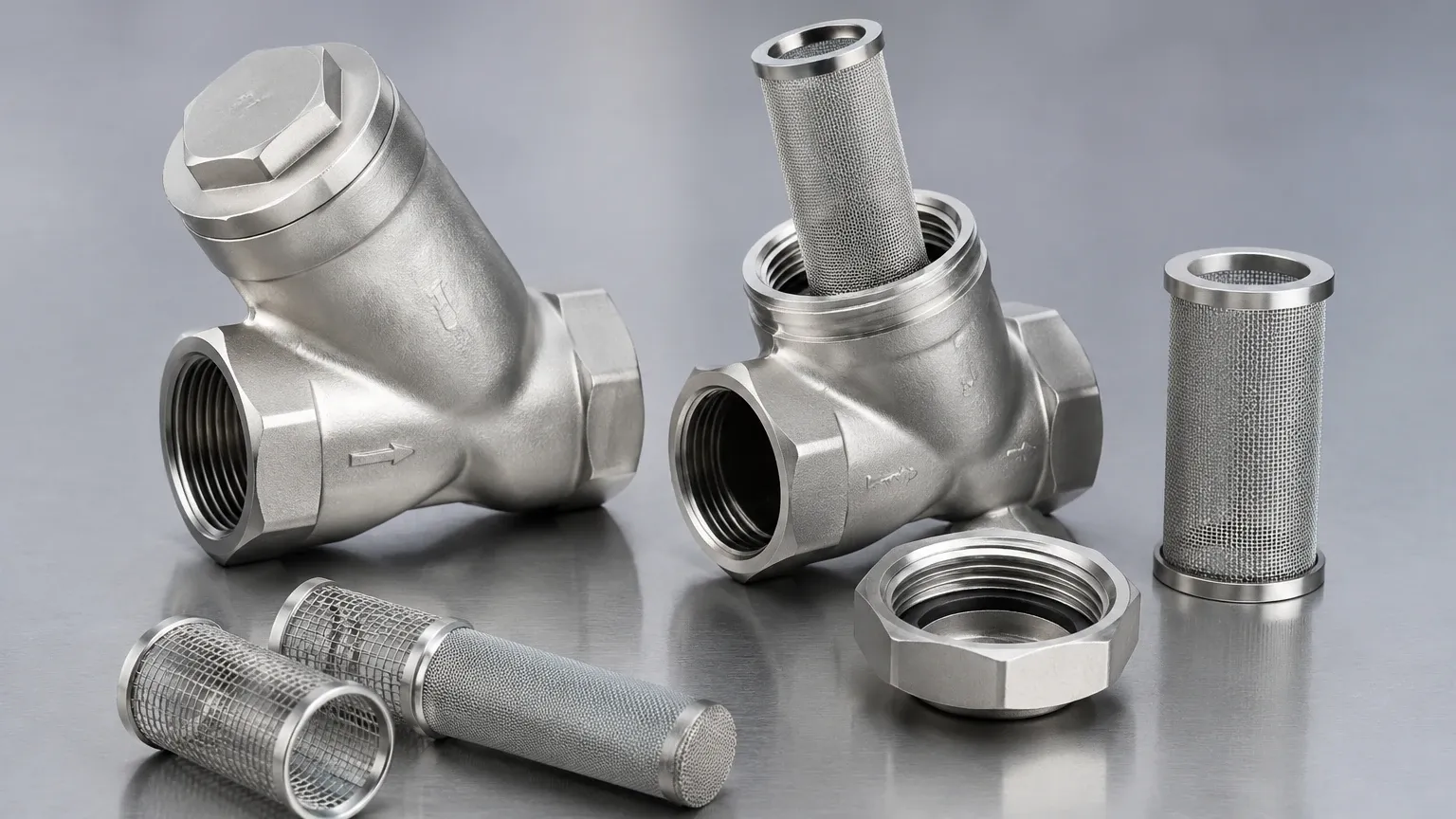
When evaluating a strainer valve ac setup, technical specifications must be aligned with the specific hydraulic and thermal demands of the process. Industrial strainers are generally categorized into two primary designs: Y-strainers and basket strainers.
Y-Strainers
Often used in high-pressure steam or liquid lines where the amount of debris is relatively low. Their compact design allows for installation in tight spaces, making them common in AC plant rooms. They can be installed horizontally or vertically (downward flow), provided the "leg" of the Y points downward to collect debris.
Basket (Simplex and Duplex) Strainers
These are preferred when higher flow rates are required or when the fluid contains a higher concentration of solids. The basket design offers a larger surface area, which results in a lower initial pressure drop and longer intervals between cleanings. In critical "AC" applications where flow cannot be interrupted, duplex basket strainers allow for one basket to be cleaned while the other remains in service.
Filtration Gradation
Filtration accuracy is defined by the mesh size or micron rating. For coarse protection, perforated metal screens (typically 1/16" to 1/4" holes) are used. For finer filtration required by sensitive control valves, a fine stainless steel wire mesh is lined inside the perforated basket. Common mesh sizes for industrial AC applications range from 20 mesh (approx. 900 microns) to 400 mesh (approx. 37 microns).
Material Selection: Why Stainless Steel Dominates Industrial Filtration
The material of the strainer element is as important as the housing itself. In the context of strainer valve ac, stainless steel (specifically Grades 304 and 316) is the industry standard for several engineering reasons:
* Corrosion Resistance: AC systems often use treated water, glycols, or refrigerants. Stainless steel resists the corrosive effects of these fluids and the chemical additives used for pH balancing or scale inhibition.
* Structural Integrity: Unlike plastic or low-grade alloy filters, stainless steel wire mesh can withstand high differential pressures without collapsing. This is critical if a strainer becomes heavily fouled and the pump continues to operate.
* Thermal Stability: Industrial cooling and heating cycles involve significant temperature fluctuations. Stainless steel maintains its mechanical properties across a wide thermal range, ensuring the mesh does not become brittle or lose its shape.
* Cleanability: Stainless steel baskets are reusable. They can be ultrasonically cleaned, backflushed, or chemically treated to remove stubborn deposits, offering a more sustainable and cost-effective solution than disposable filter cartridges.
Evaluating Pressure Drop and Flow Characteristics
One of the most common mistakes in specifying Strainers & Baskets is failing to account for the "clean" vs. "dirty" pressure drop (ΔP). Every strainer introduces a restriction into the flow path. Engineers must calculate the Cv (flow coefficient) to ensure the pump head is sufficient to overcome this resistance.
For a strainer valve ac configuration, the following factors influence ΔP:
* Open Area Ratio (OAR): This is the ratio of the total area of the holes in the screen to the internal cross-sectional area of the inlet pipe. A high-quality industrial strainer should have an OAR of at least 4:1 to ensure low pressure drop and extended service life.
* Viscosity: As the viscosity of the fluid increases (e.g., high-concentration glycol in low-temperature AC systems), the pressure drop across the mesh increases exponentially.
* Debris Loading: As the strainer collects particles, the effective open area decreases, and ΔP rises. Systems should be equipped with differential pressure gauges to alert operators when the ΔP reaches a critical threshold (typically 5-10 psi above clean drop).
Maintenance Protocols for Strainers & Baskets
Proper maintenance of the strainer valve ac components is essential to prevent cavitation in pumps and insufficient flow to heat exchangers. A proactive maintenance schedule should include:
1. Regular Inspection: Especially during the commissioning phase of a new system, strainers should be checked daily. Construction debris (metal shavings, tape, dirt) often flushes through the system in the first few weeks of operation.
2. Blow-down Procedures: Many Y-strainers are equipped with a blow-off port in the cap. By installing a ball valve on this port, operators can flush out accumulated sediment without shutting down the system or opening the strainer housing.
3. Basket Cleaning: When the differential pressure indicates fouling, the basket must be removed. It is vital to use the correct cleaning tools; abrasive wire brushes can damage fine mesh, altering the filtration rating. Soaking in a compatible solvent or using compressed air from the outside-in is often more effective.
4. Gasket Replacement: Every time a strainer cap or cover is removed, the gasket or O-ring should be inspected. Using high-quality EPDM or PTFE gaskets ensures a leak-free seal upon reassembly, which is particularly important in AC systems where air ingress can cause oxidation and pump noise.
Customization and OEM Solutions for Complex Systems
Standard off-the-shelf strainers do not always meet the rigorous demands of specialized industrial processes. In many "strainer valve ac" applications, custom-engineered solutions are required. This may include:
* Non-Standard Dimensions: Fitting a high-capacity strainer into a pre-existing piping skid with limited footprint.
* Specialized Mesh Weaves: Using Dutch weave or twilled weave for higher strength and finer filtration in hydraulic control circuits.
* Magnetic Inserts: Adding magnetic rods to the center of a basket strainer to capture fine ferrous particles (magnetite) which are common in closed-loop heating and cooling systems and are too small for standard mesh to catch.
* Reinforced Baskets: For high-flow applications where the velocity might cause standard mesh to vibrate or fatigue, reinforced perforated backing is essential.
Kaifil specializes in these types of custom stainless steel filtration solutions, providing the technical expertise required to design components that meet specific pressure, temperature, and filtration accuracy requirements.
Conclusion: Selecting the Right Partner for Filtration
Integrating the correct strainer valve ac components is not merely a matter of pipe size matching. It requires a deep understanding of fluid dynamics, material compatibility, and the specific vulnerabilities of the downstream valves. By focusing on high-quality stainless steel construction and precise engineering, facilities can significantly reduce downtime and repair costs.
When selecting Strainers & Baskets, engineers should prioritize manufacturers who offer transparency in material sourcing, rigorous quality control, and the ability to customize designs for unique industrial challenges. A well-chosen strainer is a small investment that protects the most expensive and critical assets in your fluid handling system.
