


Engineering Guide to Stainless Steel Mesh Filter Bags in Industrial Applications
In the landscape of industrial liquid filtration, the selection of filter media is a critical decision that impacts process efficiency, product purity, and long-term operational costs. While synthetic fiber filter bags are common in many general-purpose applications, the stainless steel mesh filter bag has emerged as a vital component for demanding environments where temperature, chemical reactivity, and mechanical stress preclude the use of polymers.
This article provides a technical overview of stainless steel mesh filtration technology, exploring material properties, construction methods, and the engineering criteria necessary for selecting the appropriate filtration solution. For engineers and procurement specialists, understanding the nuances of wire mesh performance is essential for optimizing system uptime and ensuring consistent filtration results.
1. Material Properties and Chemical Compatibility
The primary advantage of a stainless steel mesh filter bag lies in its metallurgy. Most industrial-grade mesh bags are fabricated from AISI 304 or 316L stainless steel. The choice between these grades is dictated by the chemical composition of the process fluid and the presence of corrosive agents.
AISI 304 Stainless Steel
Grade 304 is the standard "18/8" stainless steel. It offers excellent corrosion resistance in most atmospheric environments and is suitable for many food and beverage applications. However, it is susceptible to pitting and crevice corrosion in warm chloride environments.
AISI 316L Stainless Steel
For more aggressive chemical processing, 316L is the preferred material. The addition of molybdenum improves resistance to chlorides and acids. The "L" designation signifies low carbon content, which is crucial for components that undergo welding during fabrication. Low carbon prevents carbide precipitation, ensuring that the welded seams of the filter bag remain as corrosion-resistant as the mesh itself.
Temperature Thresholds
Unlike polypropylene or polyester bags, which typically fail or deform above 100°C to 150°C, stainless steel mesh can operate at temperatures exceeding 400°C, depending on the sealing ring material and the mechanical load. This makes them indispensable for hot oil filtration, steam processing, and high-temperature chemical synthesis.
2. Filtration Mechanisms and Mesh Weave Types
To specify a filter bag correctly, an engineer must understand how the mesh is woven. The weave pattern determines the filtration accuracy (micron rating), flow resistance, and the ease with which the bag can be cleaned. While many applications utilize standard bags, some high-pressure systems may require more rigid structures such as Wire Mesh Filter Cylinders & Tubes to prevent collapse under differential pressure.
Plain Weave
In a plain weave, each warp wire crosses over and under each weft wire. This creates a square aperture. It is the most common weave for coarse to medium filtration (25 to 800 microns). It provides a high open area, which translates to low initial pressure drop and high flow rates.
Twill Weave
Twill weaves allow for a heavier wire diameter than plain weaves of the same mesh count. The wires pass over two and under two, creating a diagonal pattern. This is often used for finer filtration where the mesh needs to maintain structural integrity under higher mechanical loads.
Dutch Weave (Plain and Twill)
Dutch weaves utilize a larger diameter warp wire and a smaller diameter weft wire woven closely together. This creates a dense, tortuous path for the fluid. Dutch weaves are used for high-precision surface filtration, often providing micron ratings down to 5–10 microns. They offer superior strength compared to square mesh but result in a higher pressure drop.
3. Structural Design and Sealing Mechanisms
The performance of a stainless steel mesh filter bag is only as reliable as its seal. If fluid bypasses the filter media through the top flange or along the seams, the filtration system fails regardless of the mesh quality.
Seam Construction
Industrial mesh bags are typically constructed using one of two methods:
1. Welded Seams: Plasma or ultrasonic welding fuses the mesh layers together. This creates a seamless transition and eliminates the needle holes associated with sewing, which can be a source of bypass for fine particles.
2. Sewn Seams: While less common for high-precision metal bags, sewing is sometimes used for very large bags. In these cases, the thread material must match the chemical and thermal resistance of the stainless steel.
Sealing Rings and Flanges
The top of the bag is fitted with a ring or flange that seats into the filter housing. Common options include:
* Stainless Steel Snap-Band Rings: These rely on the tension of the metal ring against the housing wall.
* Molded Plastic Flanges (PP or Santoprene): These provide a compression seal but limit the temperature range of the bag.
* V-Flanges or Engineered Metal Collars: Used in high-pressure or high-temperature housings to ensure a metal-to-metal or gasketed seal.
4. Engineering Considerations for Flow and Pressure
When integrating a stainless steel mesh filter bag into an existing system, engineers must calculate the clean pressure drop ($ΔP$) and estimate the dirt-holding capacity.
Open Area and Flow Velocity
The percentage of open area in the mesh directly influences the velocity of the fluid passing through the apertures. High velocity can lead to particle shearing or premature blinding of the mesh. For viscous fluids, a larger surface area is required to keep the flux (flow per unit area) within acceptable limits.
Differential Pressure Limits
Stainless steel mesh is robust, but it is not indestructible. As the bag collects contaminants, the differential pressure increases. If the $ΔP$ exceeds the structural limit of the mesh, the bag may distend or burst. In systems where high differential pressures are expected, the bag should be supported by a heavy-duty perforated basket. For extreme conditions, transitioning to Wire Mesh Filter Cylinders & Tubes provides a self-supporting alternative that can withstand significantly higher collapse pressures.
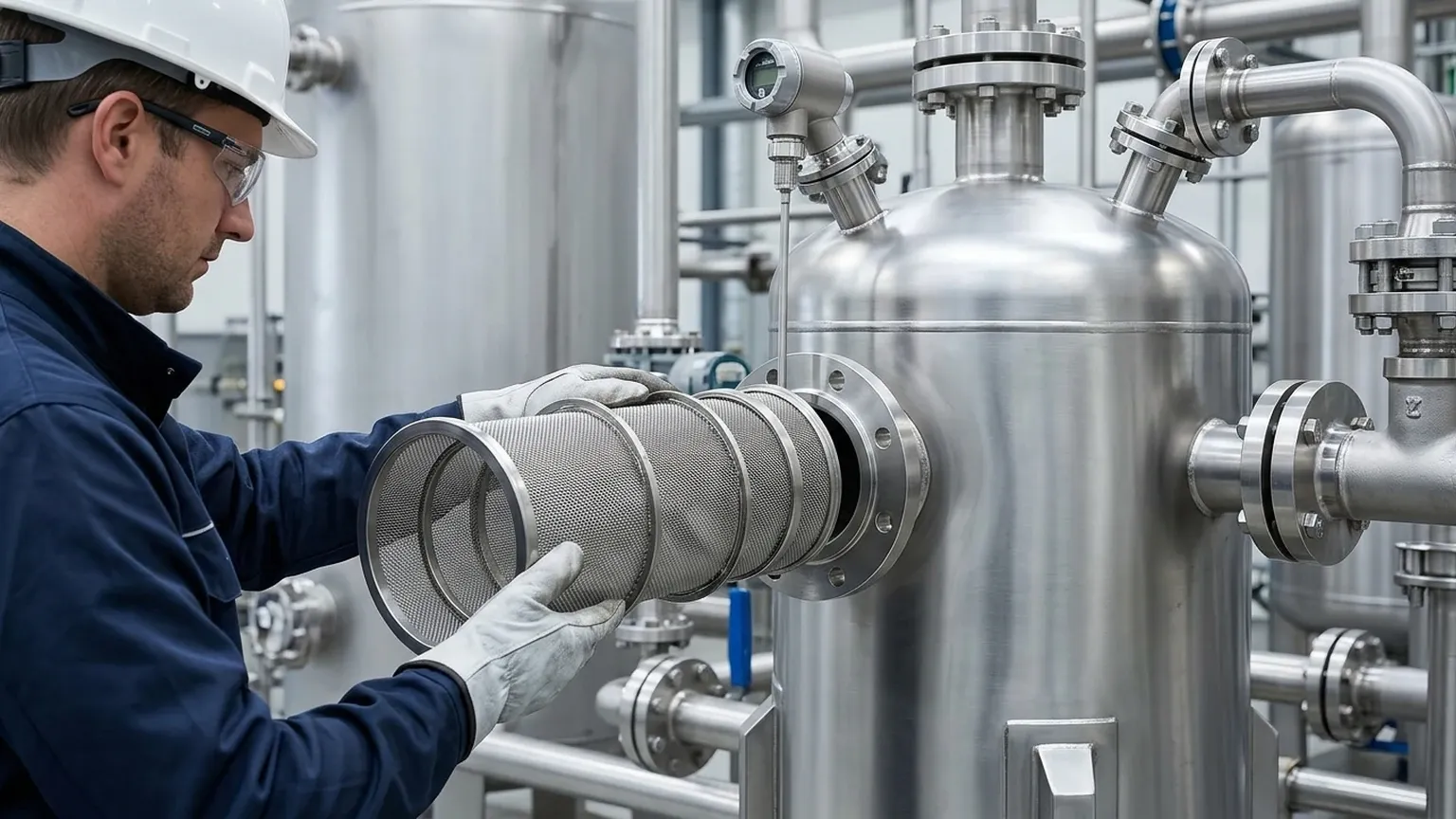
5. Maintenance, Cleaning, and Total Cost of Ownership
One of the primary B2B justifications for investing in stainless steel filtration is the shift from a "consumable" model to a "reusable" model. While the initial purchase price of a stainless steel bag is higher than a felt bag, the total cost of ownership (TCO) is often lower due to its cleanability.
Cleaning Protocols
* Backwashing: In some automated systems, a reverse flow of clean fluid can dislodge particles from the surface of the mesh.
* Ultrasonic Cleaning: For fine Dutch weaves or bags used in resin and adhesive filtration, ultrasonic baths can remove deeply embedded particles without damaging the wire structure.
* Chemical Cleaning: Stainless steel can be treated with caustic or acidic cleaning agents to dissolve organic buildup or mineral scales, restoring the bag to near-original flow conditions.
Replacement Cycles
Unlike synthetic bags that are discarded after a single cycle, a well-maintained stainless steel bag can last for months or even years. The replacement cycle is typically determined by mechanical wear, such as wire thinning from abrasive slurries or work-hardening from repeated pressure cycling.
6. Procurement Checklist for International Buyers
When sourcing stainless steel mesh filter bags for global industrial projects, technical buyers should verify the following specifications to ensure compatibility and performance:
1. Micron Rating Verification: Confirm whether the rating is "Nominal" (60-80% efficiency) or "Absolute" (98%+ efficiency). Wire mesh is typically considered a surface filter with a high degree of absolute accuracy.
2. Dimensional Tolerances: Ensure the bag diameter and length match the internal dimensions of the housing (e.g., Size #1, Size #2, or custom dimensions).
3. Material Certification: Request Mill Test Reports (MTRs) to verify the grade of stainless steel (304 vs 316L) and ensure compliance with industry standards like FDA or EC 1935/2004 for food contact.
4. Seam Integrity: Inquire about the welding method used. For critical applications, ask for pressure test data or leak-proof guarantees.
5. Support Requirements: Determine if the bag requires a specific type of restrainer basket to handle the expected flow rates and solids loading.
Conclusion
The stainless steel mesh filter bag represents a high-performance solution for industrial filtration challenges that exceed the capabilities of synthetic media. By offering superior thermal stability, chemical resistance, and the ability to be cleaned and reused, these components provide a sustainable and cost-effective choice for modern manufacturing. Whether used in chemical processing, food production, or hydraulic systems, the correct application of wire mesh technology ensures process reliability and product quality. For applications requiring even greater structural rigidity and precision, engineers should consider the advantages of Wire Mesh Filter Cylinders & Tubes as a complementary or alternative filtration strategy.
