


Yarway Strainers
In industrial fluid and steam systems, the integrity of downstream equipment such as valves, pumps, and steam traps depends heavily on the effectiveness of mechanical filtration. Yarway strainers have long been a staple in these environments, providing a reliable method for removing solid contaminants from pipelines. For engineers and procurement teams, understanding the technical nuances of these components—specifically the internal Strainers & Baskets—is essential for maintaining system efficiency and preventing costly downtime.
Industrial strainers are not merely passive components; they are engineered tools designed to balance filtration accuracy with flow dynamics. Whether integrated into high-pressure steam lines or chemical processing circuits, the performance of a strainer is determined by its geometry, material composition, and the precision of its internal mesh or perforated screen.
Understanding the Role of Yarway Strainers in Industrial Fluid Systems
Yarway strainers are primarily utilized to protect sensitive equipment from pipe scale, weld beads, and other debris that can accumulate within a piping system. In steam applications, for instance, even small particles can erode valve seats or clog the small orifices of steam traps, leading to energy loss and system failure.
The functional principle of these strainers involves directing the fluid flow through a removable screen or basket. As the fluid passes through the mesh, solids larger than the opening size are trapped. Because these units are often installed in high-temperature and high-pressure environments, the structural integrity of both the housing and the internal filtration element is critical. Engineers must consider the specific gravity of the fluid, the expected flow rate, and the nature of the contaminants when selecting the appropriate configuration.
Technical Specifications and Design Variations: Y-Type vs. Basket Strainers
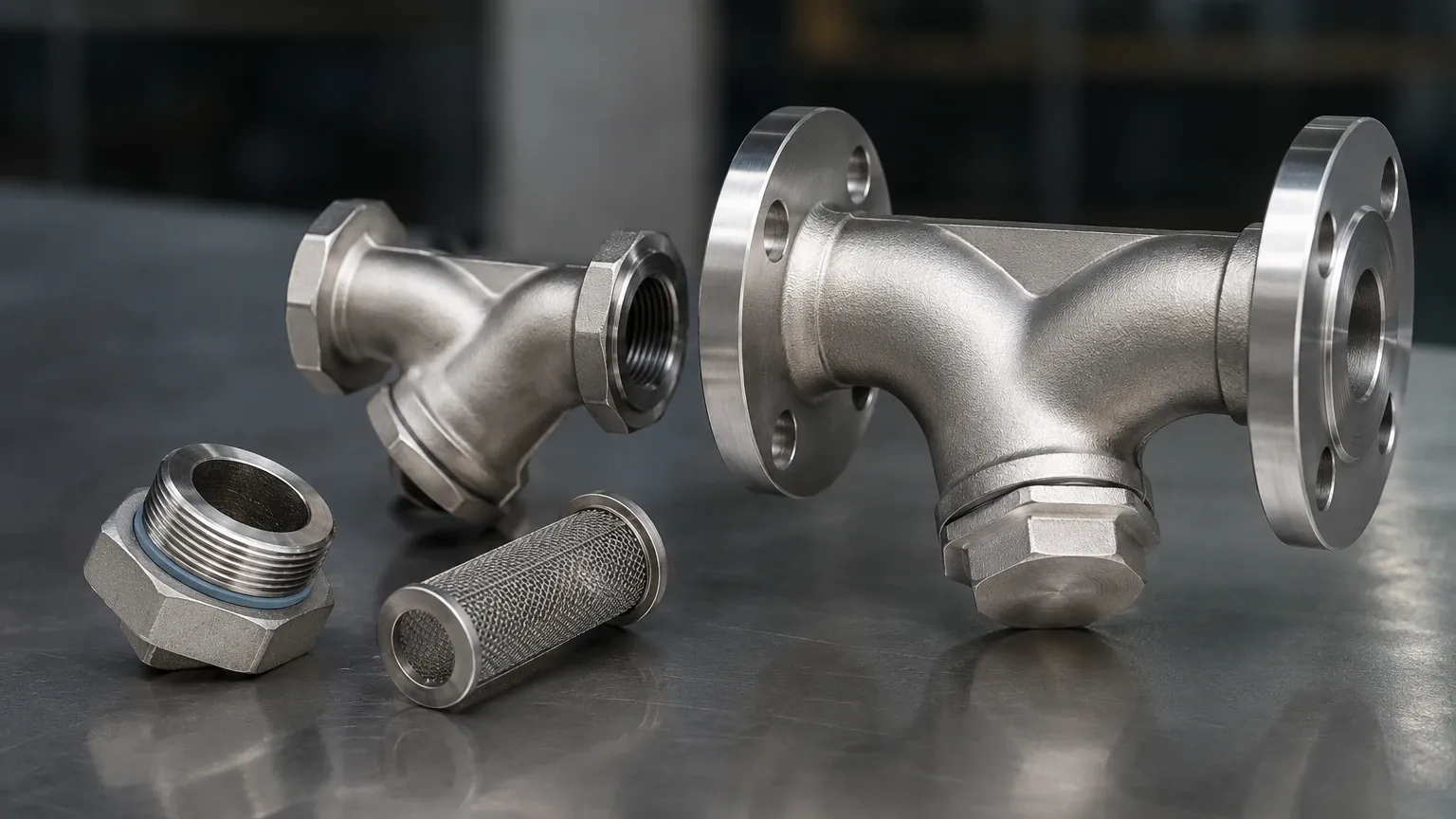
When discussing Yarway strainers, two primary configurations dominate the industrial landscape: the Y-type and the T-type (or basket) strainer. Each serves a distinct purpose based on the installation environment and the required maintenance frequency.
Y-Type Strainers
As the name suggests, Y-type strainers feature a cylindrical filtration element housed in a branch that exits the main flow path at an angle. This design is exceptionally compact and is most commonly used in steam, gas, or liquid lines where the amount of debris to be collected is relatively small. One of the primary advantages of the Y-type design is its ability to be installed in either horizontal or vertical orientations (provided the "leg" points downward). Furthermore, many Y-type units include a blow-off connection in the cap, allowing for the cleaning of the screen without removing it from the body, provided the debris is not wedged firmly in the mesh.
Basket (T-Type) Strainers
Basket strainers are designed for applications requiring a higher dirt-holding capacity. These units feature a larger, vertical chamber that houses a basket-shaped filtration element. Because the surface area of the basket is significantly larger than that of a Y-type screen, the pressure drop across the unit is generally lower, and the intervals between cleanings are longer. Basket strainers are typically limited to horizontal installations and are preferred in liquid applications where high flow rates and heavier contaminant loads are expected.
Material Selection for High-Performance Filtration Baskets
The internal components of Yarway strainers—the screens and baskets—must withstand the same corrosive and thermal stresses as the pipeline itself. Material selection is perhaps the most critical factor in ensuring the longevity of the filtration system. While the strainer body may be cast iron, carbon steel, or chrome-moly, the internal Strainers & Baskets are almost exclusively manufactured from stainless steel or high-nickel alloys.
1. Stainless Steel 304: The standard for most general-purpose applications. It offers excellent resistance to corrosion in water and steam service and maintains its structural integrity at moderately high temperatures.
2. Stainless Steel 316/316L: Preferred for chemical processing and marine environments. The addition of molybdenum provides superior resistance to pitting and crevice corrosion, particularly in the presence of chlorides.
3. Monel and Hastelloy: In highly aggressive chemical environments or extreme temperature applications, specialized alloys are required. These materials prevent the rapid degradation of the mesh, which could otherwise lead to "bypass"—where contaminants pass through holes in a corroded screen.
Beyond the alloy type, the construction method of the basket—whether it is made from perforated plate, woven wire mesh, or a combination of both—must be specified based on the required filtration grade.
Engineering Considerations for Mesh Sizing and Pressure Drop
A common challenge in strainer selection is finding the optimal balance between filtration fineness and pressure drop. If the mesh is too coarse, harmful particles will pass through. If it is too fine, the strainer will clog rapidly, causing a significant drop in system pressure and requiring frequent maintenance.
The Open Area Ratio
Engineers often look at the "Open Area Ratio" (OAR) when evaluating Strainers & Baskets. This is the ratio of the total open area of the holes in the screen to the cross-sectional area of the inlet pipe. A common industry standard is an OAR of 4:1 or 6:1. A higher ratio ensures that even as the screen begins to capture debris, there remains enough open area to maintain a low pressure drop.
Micron vs. Mesh
Filtration accuracy is measured in mesh size (the number of openings per linear inch) or microns (the actual size of the opening). For example, a 40-mesh screen has openings of approximately 400 microns. For protecting coarse equipment like pumps, a perforated plate with 1/8" holes might suffice. However, for protecting precision control valves, a fine 100-mesh or 200-mesh stainless steel liner may be necessary.
Maintenance Protocols and Replacement of Internal Components
The performance of Yarway strainers is only as good as the maintenance they receive. A clogged strainer is a bottleneck that can lead to cavitation in pumps or insufficient steam flow to heat exchangers. Monitoring the differential pressure (the difference in pressure between the inlet and outlet) is the most effective way to determine when a basket needs cleaning.
Cleaning Procedures
For Y-type strainers equipped with a blow-off valve, regular "flushing" can remove loose sediment. However, this is not a substitute for a full manual cleaning. During a scheduled shutdown, the strainer cap or cover should be removed, and the basket should be inspected for signs of damage, such as broken wires or distorted frames.
Replacement Cycles
While the housing of a strainer can last for decades, the internal mesh is a wear item. Mechanical stress from high-velocity flow or repeated cleaning can eventually fatigue the metal. It is recommended to keep replacement Strainers & Baskets on hand to ensure that a damaged element can be replaced immediately, rather than leaving the system unprotected while waiting for a new part.
Procurement and Customization for Specialized Industrial Applications
While standard Yarway strainers meet many industrial needs, specialized applications often require customized filtration solutions. In many cases, the original manufacturer's standard baskets may not provide the specific filtration grade or material durability required for a unique process. This is where custom manufacturing becomes essential.
Customized filtration components allow engineers to specify:
* Reinforced Structures: For high-pressure applications where standard mesh might collapse, baskets can be reinforced with heavy-duty perforated metal backing.
* Multi-Layer Mesh: Combining a fine inner mesh for filtration with a coarse outer mesh for structural support.
* Non-Standard Dimensions: For older systems or unique housing geometries where off-the-shelf replacements are no longer available.
When sourcing replacement components, it is vital to work with manufacturers who understand the engineering requirements of industrial filtration. Precise tolerances are necessary to ensure that the basket seats correctly within the housing; an ill-fitting basket allows fluid to bypass the filter element entirely, defeating the purpose of the strainer.
Total Cost of Ownership Considerations
When evaluating Yarway strainers and their associated components, the initial purchase price is only one part of the equation. The total cost of ownership (TCO) includes maintenance labor, the cost of replacement parts, and the potential cost of downstream equipment damage if the strainer fails. Investing in high-quality, precision-engineered Strainers & Baskets reduces the frequency of replacements and ensures that the primary assets of the plant remain protected.
In conclusion, Yarway strainers are vital for the operational health of industrial piping systems. By focusing on the technical details of design, material selection, and filtration accuracy, engineering teams can optimize their systems for both performance and longevity. Whether you are maintaining an existing steam line or designing a new chemical processing plant, the selection of the right strainer and the commitment to a rigorous maintenance schedule are key to industrial success.
