


Strainers Fine
In industrial fluid handling, the distinction between protection and precision often rests on the specification of filtration components. While standard strainers are designed to capture large debris such as scale, weld slag, and pebbles, the category of strainers fine—often referred to as fine mesh strainers or high-precision baskets—serves a more critical role. These components are engineered to remove smaller particulates that could otherwise compromise sensitive downstream equipment, contaminate batches in food and chemical processing, or lead to premature wear in hydraulic systems.
For engineers and procurement professionals, selecting the correct Strainers & Baskets involves more than just identifying a pipe size. It requires a deep understanding of the relationship between filtration fineness, flow dynamics, and material durability. This guide explores the technical nuances of fine strainers, providing the data necessary to optimize filtration performance in demanding industrial environments.
Understanding Fine Filtration in Industrial Systems
Fine straining is generally defined by the use of woven wire mesh or specialized perforated metals that target particles ranging from 40 microns to approximately 300 microns. Unlike coarse strainers that rely on simple perforated plates, strainers fine utilize complex weaves to achieve higher filtration accuracy.
Mesh Count vs. Micron Rating
The most common point of confusion in specifying fine strainers is the conversion between mesh count and micron rating. Mesh count refers to the number of openings per linear inch. As the mesh count increases, the size of the opening decreases. However, the micron rating (the actual size of the particle the mesh will block) is also influenced by the wire diameter. For instance, a 100-mesh screen made with a thicker wire will have a smaller micron rating (smaller openings) than a 100-mesh screen made with thinner wire.
When evaluating strainers fine, it is essential to request the "clear opening" or "aperture" size in microns to ensure the component meets the specific requirements of the process fluid. Relying solely on mesh count without considering wire gauge can lead to significant variances in filtration efficiency.
Engineering Considerations: Flow Rate and Pressure Drop
As the filtration fineness increases, the resistance to fluid flow also increases. This is a critical engineering trade-off. A finer mesh has a lower percentage of "open area" compared to a coarse perforated plate. If not properly accounted for, this can lead to an excessive pressure drop (Delta P) across the strainer.
The Importance of Open Area Ratio
The open area ratio is the relationship between the total area of the openings in the mesh and the cross-sectional area of the inlet pipe. For standard industrial applications, a ratio of 4:1 or 6:1 is often targeted to ensure that the strainer does not become a bottleneck in the system. When using strainers fine, achieving this ratio often requires increasing the physical size of the strainer basket or utilizing a pleated mesh design to increase the available surface area within the same housing footprint.
Managing Delta P
Engineers must calculate the clean pressure drop and estimate the terminal pressure drop (the point at which the strainer must be cleaned). Because fine strainers capture more material more quickly than coarse strainers, the rate of pressure increase is typically faster. Monitoring systems, such as differential pressure gauges, are highly recommended for any system utilizing fine filtration to prevent mesh collapse or bypass.
Material Selection and Structural Integrity
In industrial settings, the durability of the filtration media is as important as its accuracy. Strainers fine are frequently exposed to high-velocity flows, pressure surges, and corrosive chemicals.
Stainless Steel Alloys
Stainless steel is the industry standard for fine strainers due to its mechanical strength and resistance to oxidation.
- Type 304: Suitable for general industrial use, water treatment, and non-corrosive chemical applications.
- Type 316/316L: Preferred for pharmaceutical, food and beverage, and marine environments where resistance to pitting and acetic/sulfuric acids is required.
Structural Reinforcement
Fine wire mesh is inherently delicate. Under high pressure, a fine mesh screen can easily deform or tear. To prevent this, professional manufacturers like Kaifil utilize a multi-layer construction. The fine mesh is typically supported by a heavier perforated metal basket or a coarser mesh backing. This "backup" layer provides the structural rigidity needed to withstand the differential pressure, while the fine inner layer performs the actual filtration. In some high-pressure hydraulic applications, the mesh may be sintered—a process that thermally bonds the wire intersections—to create a rigid, non-deformable filter medium.
Customization Options for Specific Industrial Needs
Off-the-shelf solutions rarely satisfy the unique constraints of specialized industrial processes. Customization is often necessary to balance filtration goals with spatial and operational limits. When sourcing Strainers & Baskets, several customization factors should be considered:
1. Bespoke Dimensions: Custom basket heights and diameters can be engineered to fit existing housings while maximizing surface area.
2. Handle and Lifting Configurations: For large-scale industrial strainers, the ease of removal for cleaning is vital. Custom handles, slanted tops, or reinforced bails can be integrated based on the maintenance protocol.
3. Gasket and Seal Compatibility: The interface between the strainer basket and the housing must be leak-proof to prevent bypass. Customizing the flange or using specific O-ring materials (Viton, EPDM, PTFE) ensures compatibility with the process fluid.
4. Pleated Designs: For applications with high solids loading but limited space, pleating the fine mesh can increase the filtration area by 200% to 300%, significantly extending the time between cleaning cycles.
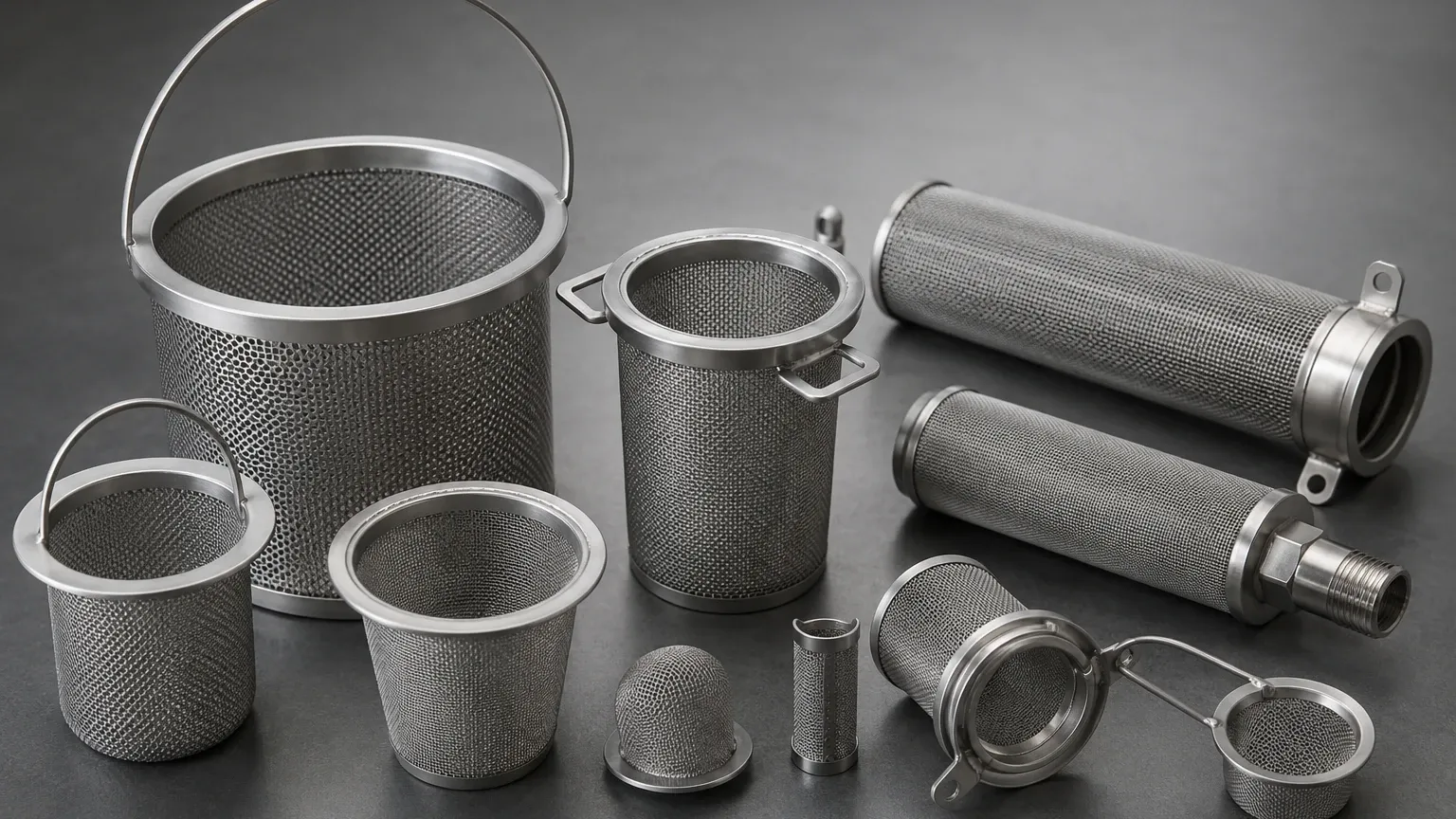
Maintenance and Operational Considerations
The longevity of strainers fine is directly linked to maintenance practices. Because these components capture fine particulates, they are more susceptible to "blinding"—a condition where particles become lodged within the mesh openings and cannot be easily dislodged by standard rinsing.
Cleaning Protocols
For many industrial applications, ultrasonic cleaning is the most effective method for restoring fine mesh strainers. This process uses high-frequency sound waves to create cavitation bubbles that lift particles out of the mesh weave. If manual cleaning is performed, it is crucial to avoid wire brushes or abrasive tools that could enlarge the mesh openings or damage the wire, thereby compromising the micron rating.
Replacement Cycles
Unlike coarse strainers which may last for years, fine strainers are considered wear items in many high-intensity processes. Factors that necessitate replacement include:
- Work Hardening: Repeated pressure cycles can cause the fine wires to become brittle and eventually fracture.
- Permanent Blinding: In some chemical processes, resins or polymers may harden within the mesh, making cleaning impossible.
- Corrosion: Even stainless steel can experience localized corrosion if the fluid chemistry changes or if the strainer is not properly passivated after cleaning.
Selection Criteria for Engineering and Purchasing Teams
When evaluating suppliers for strainers fine, technical teams should confirm the following data points to ensure the product is fit for purpose:
* Filtration Accuracy Verification: Does the supplier provide documented micron ratings and mesh specifications?
* Pressure Rating: What is the maximum allowable differential pressure (PSID) before structural failure occurs?
* Flow Capacity Curves: Are there data sheets showing the pressure drop at various flow rates for the specific mesh size selected?
* Material Certification: Can the manufacturer provide Mill Test Reports (MTRs) to verify the grade of stainless steel used?
* OEM Compatibility: If the strainer is a replacement part, does it meet the exact tolerances required by the original equipment manufacturer's housing?
Conclusion
Strainers fine represent a critical intersection of textile precision and heavy-duty engineering. By selecting the appropriate mesh weave, reinforcing the structure with perforated backing, and choosing the correct alloy, industrial operators can protect their high-value equipment from the damaging effects of fine particulate contamination.
Whether you are designing a new chemical processing line or optimizing a hydraulic system, the choice of filtration component impacts both the total cost of ownership and the reliability of the entire system. For those requiring precision-engineered solutions, exploring the technical capabilities of professional manufacturers is the first step toward achieving optimized filtration performance.
To learn more about customized filtration components and technical specifications, review product options and application support for Strainers & Baskets at Kaifil.
