


Strainers Set
In industrial fluid handling and process engineering, a strainers set represents a critical assembly of components designed to protect downstream equipment from particulate contamination. Unlike standard off-the-shelf components, an industrial-grade strainer set is engineered to meet specific flow rates, pressure ratings, and filtration accuracies required in demanding environments such as chemical processing, pharmaceutical manufacturing, and large-scale water treatment. Selecting the correct Strainers & Baskets involves a deep understanding of fluid dynamics, material compatibility, and the mechanical stresses of the application.
A professional strainers set typically includes the housing, the internal basket or screen, and the necessary sealing components. For many engineers, the challenge lies in balancing the required filtration fineness with the allowable pressure drop across the system. This article examines the technical considerations, material engineering, and selection criteria necessary for implementing a high-performance filtration solution.
Technical Role of a Strainers Set in Process Engineering
The primary function of a strainers set is the removal of solid debris from liquid or gas streams. This protection is vital for pumps, valves, heat exchangers, and spray nozzles, which can be easily damaged or clogged by suspended solids. In a multi-stage filtration system, a strainer set often serves as the primary or coarse filtration stage, capturing larger particles before the fluid reaches finer, more expensive filter cartridges.
From an engineering perspective, the efficiency of a strainer set is measured by its ability to maintain flow while capturing the target particle size. This is often dictated by the "Open Area Ratio" (OAR). The OAR is the ratio of the total open area of the strainer mesh to the internal cross-sectional area of the inlet pipe. A high-quality industrial strainer set usually maintains an OAR of at least 6:1 or 8:1. This ensures that even as the basket begins to collect debris, the system does not experience a catastrophic drop in pressure, which could lead to pump cavitation or process downtime.
Material Selection: SS304 vs. SS316L
Material integrity is the cornerstone of industrial filtration. Most high-performance strainers sets are manufactured from stainless steel due to its mechanical strength and resistance to corrosion. Kaifil specializes in custom stainless steel solutions, focusing on the two most prevalent grades in the industry:
Stainless Steel 304
SS304 is the standard choice for general industrial applications. It provides excellent corrosion resistance in water treatment and food and beverage applications where high-acid or high-salt environments are not present. It is cost-effective and maintains structural integrity at high temperatures.
Stainless Steel 316L
For chemical processing, pharmaceutical production, and marine environments, SS316L is the preferred material. The addition of molybdenum enhances its resistance to pitting and crevice corrosion, particularly in chloride-rich environments. The "L" stands for low carbon, which improves weldability and prevents intergranular corrosion in the heat-affected zones of the strainer assembly. When specifying a strainers set for corrosive fluids, engineers must confirm that all components, including the mesh, the basket frame, and the housing, are compatible with the chemical profile of the process fluid.
Design Configurations: Baskets, Cones, and Y-Strainers
An industrial strainers set can be configured in several ways depending on the installation space and the required maintenance frequency.
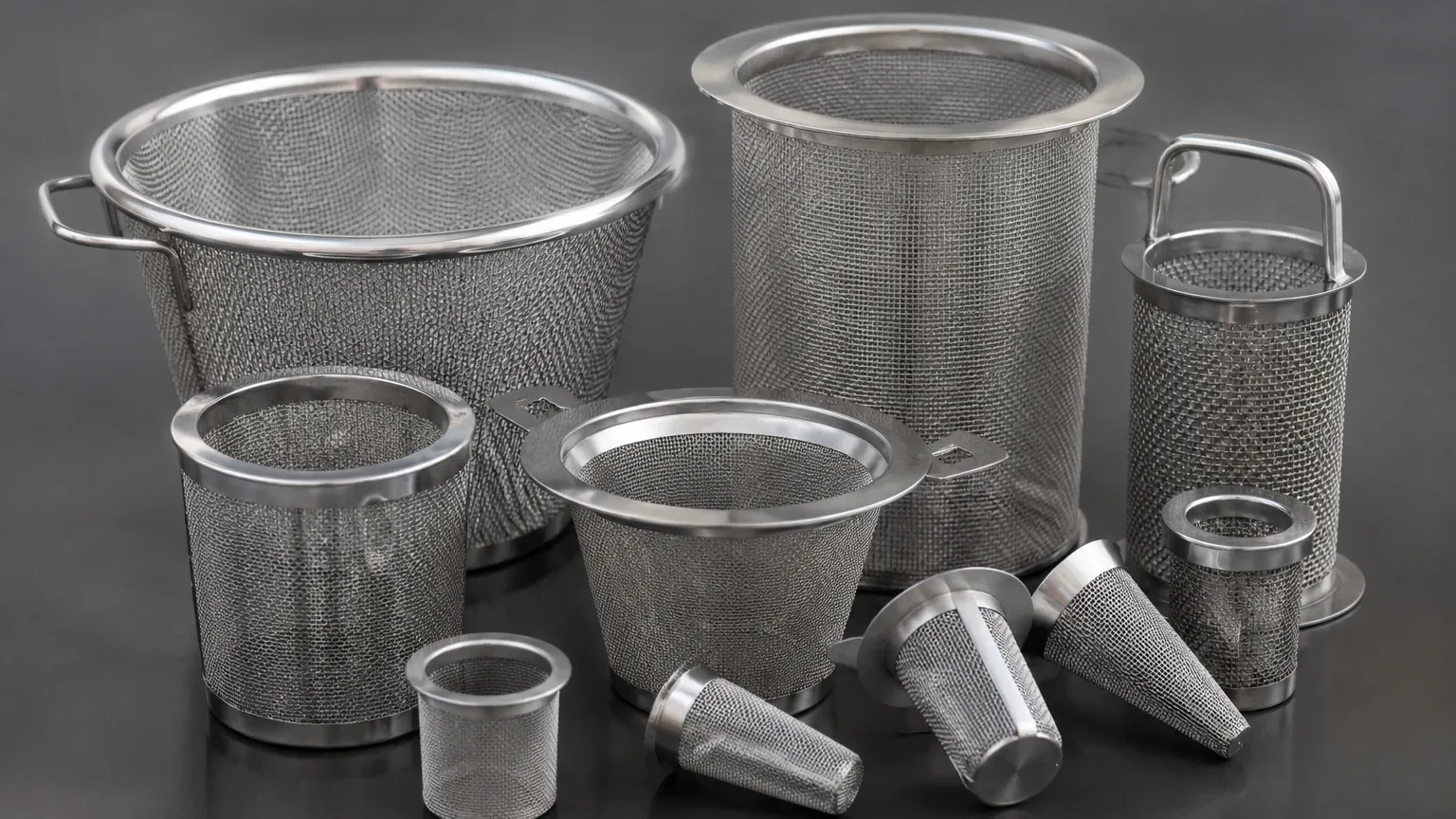
1. Basket Strainers: These are used in horizontal pipelines where high flow capacity and large debris-holding capacity are required. The "basket" design allows for easy removal and cleaning. In many systems, a duplex strainer set is used, consisting of two basket strainers connected by a diverting valve. This allows one side to be cleaned while the other remains in operation, ensuring zero downtime.
2. Y-Strainers: These are compact and typically used for smaller pipe diameters or where the amount of particulate matter is relatively low. While they offer less holding capacity than a basket, they are easier to fit into tight piping layouts.
3. Custom Conical and Plate Strainers: For temporary start-up applications or specialized machinery, custom-shaped strainers are often integrated into the piping set. These are engineered to withstand high differential pressures during the initial flushing of a new system.
Filtration Accuracy and Mesh Engineering
The performance of a strainers set is largely determined by the mesh or perforated plate used in the basket. Filtration accuracy is typically defined in microns or mesh count.
* Perforated Metal: Used for coarse filtration (typically 1/2" down to 0.033"). It provides the structural backbone for finer mesh linings.
* Wire Mesh: For finer filtration requirements, a stainless steel wire mesh is lined inside the perforated basket. This allows for precision down to 5 microns.
* Wedge Wire: In applications involving high-viscosity fluids or where backwashing is required, wedge wire screens offer superior strength and a non-clogging surface.
When selecting a strainers set, engineers must consider the "percentage of open area." A finer mesh provides better filtration but increases the resistance to flow. Therefore, the total surface area of the basket must be calculated to ensure the velocity through the mesh remains within acceptable limits to prevent particle "breakthrough" or mesh deformation.
Pressure Drop and Flow Dynamics
Every strainer set introduces a localized pressure drop ($ΔP$) into the system. Calculating this is essential during the design phase to ensure the pump head is sufficient. The pressure drop is influenced by:
* Fluid viscosity and specific gravity.
* Flow velocity.
* The percentage of open area in the strainer basket.
* The current loading (how full the basket is).
Engineers should specify a strainers set that includes differential pressure ports. By installing gauges upstream and downstream of the strainer, operators can monitor the $ΔP$. A common industry standard is to clean or replace the basket when the pressure drop reaches 10-15 psi over the clean-start pressure. Ignoring this can lead to the collapse of the internal basket, sending debris and metal fragments downstream into sensitive equipment.
Customization and OEM Capabilities
In many B2B scenarios, standard sizes do not meet the unique requirements of a specific plant layout or a specialized piece of machinery. Customization of a strainers set involves more than just changing the dimensions. It includes:
* Custom Flange Connections: Matching existing piping standards such as ANSI, DIN, or JIS.
* Reinforced Baskets: For high-pressure applications where the differential pressure might exceed 50 psi, baskets are reinforced with internal skeletons or heavy-duty perforated plate to prevent buckling.
* Surface Finishes: In the pharmaceutical and food industries, the internal surfaces of the strainer set must be polished (often to a Ra < 0.8 ¶m) to prevent bacterial growth and ensure effective Clean-in-Place (CIP) cycles.
* Specialized Gaskets: Choosing between EPDM, PTFE, or Viton based on the temperature and chemical nature of the fluid.
Total Cost of Ownership (TCO) Considerations
When purchasing a strainers set, the initial acquisition cost is only one part of the equation. Technical buyers should evaluate the Total Cost of Ownership, which includes:
* Maintenance Labor: How quickly can the basket be accessed and cleaned? Quick-opening covers (such as swing-bolt designs) can significantly reduce labor costs compared to standard bolted covers.
* Durability: A cheaper, thinner-walled strainer set may fail under pressure spikes or corrode prematurely, leading to expensive emergency repairs.
* Replacement Cycle: High-quality stainless steel baskets can be cleaned and reused hundreds of times. Lower-quality alternatives may deform during cleaning, requiring frequent replacement.
* Process Protection: The cost of a strainer is negligible compared to the cost of replacing a damaged high-pressure pump or a precision control valve.
Installation and Maintenance Best Practices
To ensure the longevity of a strainers set, proper installation is paramount. The unit must be installed with sufficient clearance to remove the basket. For basket strainers, this usually means vertical clearance above the housing.
Maintenance schedules should be data-driven. Rather than cleaning on a fixed time interval, using differential pressure sensors allows for "condition-based maintenance." This prevents unnecessary downtime while ensuring the system is never operated with a dangerously clogged strainer. When cleaning the baskets in a strainers set, it is important to use methods that do not damage the wire mesh. High-pressure air or water should be applied from the outside-in (reverse flow) to dislodge particles without stretching the mesh pores.
Conclusion
An industrial strainers set is an essential investment for any fluid-based process. By focusing on material science, flow dynamics, and structural integrity, engineers can ensure their systems operate at peak efficiency with minimal risk of equipment failure. Whether you are designing a new chemical plant or upgrading a water treatment facility, selecting the right Strainers & Baskets requires a partner who understands the technical nuances of stainless steel filtration.
Kaifil provides the engineering expertise and manufacturing precision needed to deliver customized filtration solutions that meet the most rigorous industrial standards. By confirming compatibility, performance expectations, and customization options early in the procurement process, technical teams can secure a filtration solution that offers both reliability and a low total cost of ownership.
