


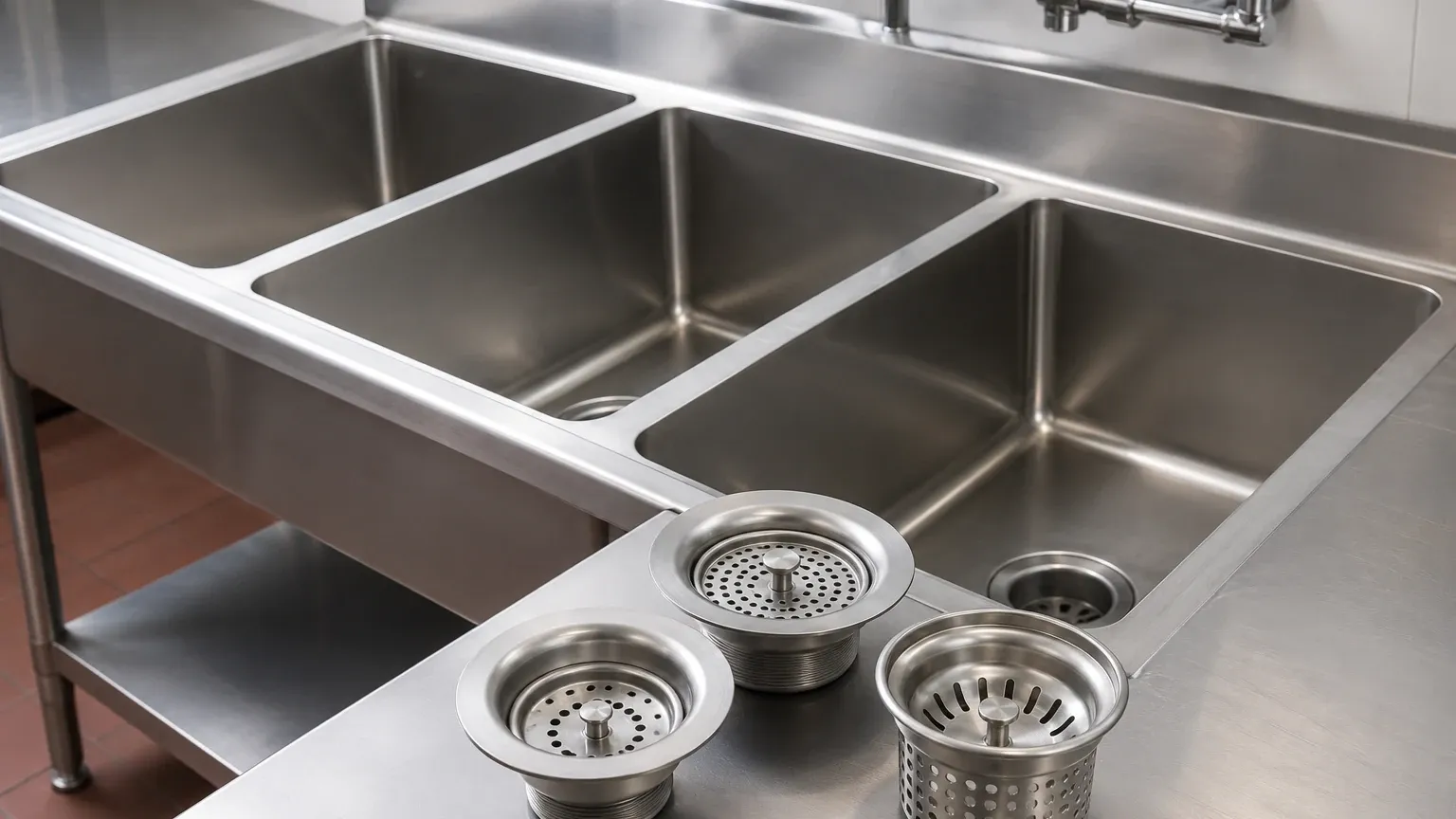
3 Compartment Sink Basket Strainers
In industrial and commercial environments, the efficiency of a drainage system is often dictated by the performance of its smallest components. For facilities utilizing multi-stage cleaning processes, such as those in food processing, pharmaceutical manufacturing, and chemical laboratories, 3 compartment sink basket strainers serve as the primary line of defense against plumbing blockages and downstream contamination. These components are not merely hardware accessories; they are engineered filtration tools designed to manage solid waste while maintaining optimal hydraulic flow.
Selecting the correct Strainers & Baskets requires an understanding of fluid dynamics, material compatibility, and the specific mechanical stresses present in high-volume industrial sinks. This guide examines the technical specifications and engineering considerations necessary for integrating high-performance basket strainers into professional 3-compartment sink systems.
The Role of Basket Strainers in Multi-Stage Systems
A standard 3-compartment sink operates on a wash-rinse-sanitize workflow. Each stage presents unique challenges for filtration. The first compartment (wash) typically handles the highest load of organic or inorganic solids. The second (rinse) deals with residual particles and detergent film, while the third (sanitize) often involves chemical solutions that can be corrosive to inferior metals.
3 compartment sink basket strainers must be tailored to these specific stages. In a wash compartment, a strainer with a larger open area and a coarser mesh may be used to prevent rapid clogging while capturing large debris. In contrast, the sanitize compartment requires a strainer made from high-grade alloys, such as SS316, to withstand prolonged exposure to sanitizing agents like chlorine or quaternary ammonium compounds. Failure to specify the correct strainer for each stage can lead to premature component failure or inefficient drainage, which impacts the overall throughput of the facility.
Material Engineering: SS304 vs. SS316
Material selection is the most critical factor in the longevity of industrial basket strainers. While plastic or low-grade plated steel may suffice for residential use, industrial applications demand the structural integrity of stainless steel.
Stainless Steel 304
Grade 304 is the industry standard for most general-purpose applications. It offers excellent corrosion resistance and durability. For the wash and rinse compartments of a 3-compartment sink, SS304 provides a cost-effective solution that can handle constant moisture and standard cleaning chemicals without pitting or rusting.
Stainless Steel 316
In environments where the effluent contains high concentrations of salts, acids, or aggressive sanitizing chemicals, SS316 is the preferred material. The addition of molybdenum in SS316 significantly enhances its resistance to chloride-induced pitting. For the sanitize compartment of 3 compartment sink basket strainers, using SS316 ensures that the filtration component does not degrade over time, maintaining the hygiene standards required in pharmaceutical and food-grade applications.
Technical Specifications: Mesh Size and Perforation
The filtration efficiency of a basket strainer is defined by its mesh size or perforation diameter. Engineers must balance the need for fine filtration with the requirement for high flow rates. If the mesh is too fine, the strainer will clog quickly, leading to standing water and operational delays. If the mesh is too coarse, solids may pass through and accumulate in the grease traps or main drainage lines, leading to costly maintenance interventions.
Typical configurations for industrial sink strainers include:
* Perforated Metal: Ideal for heavy-duty applications where large solids are common. Perforations usually range from 1/16" to 1/4". These are easy to clean and offer high mechanical strength.
* Wire Mesh Liners: For applications requiring the capture of finer particles, a wire mesh liner can be integrated into the basket. This is common in laboratory settings where fine precipitates must be recovered or contained.
When evaluating 3 compartment sink basket strainers, it is essential to calculate the "Open Area Ratio." This is the ratio of the total area of the holes to the total area of the basket. A higher open area ratio reduces the pressure drop across the strainer and allows for faster drainage, which is vital in high-pace industrial environments.
Customization and OEM Integration
Off-the-shelf solutions often fail to meet the precise requirements of specialized industrial sinks. Customization allows for the optimization of the strainer to the specific geometry of the sink drain and the nature of the waste being processed. Professional manufacturers like Kaifil offer extensive OEM capabilities to produce bespoke filtration components.
Key customization options include:
* Dimensional Accuracy: Ensuring a flush fit with the drain flange to prevent bypass, where solids escape around the edges of the basket.
* Handle Configurations: Fixed or drop-down handles designed for ease of removal even when the basket is heavily loaded.
* Reinforced Bottoms: For high-capacity baskets, a reinforced base prevents sagging and mechanical deformation over thousands of cycles.
* Integrated Seals: High-temperature or chemical-resistant gaskets can be integrated to ensure a watertight seal when the strainer is in the closed position.
By working with a manufacturer that understands the nuances of industrial filtration, procurement teams can secure components that are perfectly aligned with their equipment's specifications.
Flow Dynamics and Pressure Drop Considerations
In any filtration system, the introduction of a barrier—in this case, the basket strainer—creates a pressure drop. In a gravity-fed 3-compartment sink, this manifests as slower drainage. Engineers must consider the maximum expected flow rate (GPM) of the sink faucets and ensure the strainer can handle that volume even when partially filled with debris.
Strategic design of the basket's profile can mitigate flow restriction. For example, a tapered basket design increases the surface area available for filtration compared to a flat-bottomed disc. This allows the 3 compartment sink basket strainers to maintain a higher flow rate for a longer period before requiring manual cleaning.
Maintenance and Operational Lifespan
The total cost of ownership (TCO) for industrial strainers is heavily influenced by their maintenance requirements and replacement cycles. Low-quality strainers are prone to handle breakage, mesh tearing, and corrosion, necessitating frequent replacements and increasing the risk of downstream plumbing issues.
To maximize the lifespan of 3 compartment sink basket strainers, the following maintenance protocols are recommended:
1. Regular Inspection: Check for signs of mechanical fatigue, especially at the weld points where the handle or mesh is attached to the frame.
2. Ultrasonic Cleaning: For strainers used in pharmaceutical or precision chemical applications, periodic ultrasonic cleaning can remove microscopic particles trapped within the wire mesh that manual rinsing cannot reach.
3. Chemical Compatibility Checks: Ensure that the cleaning agents used to sanitize the sink are compatible with the grade of stainless steel specified for the strainer.
High-quality stainless steel strainers are designed for years of service. Their ability to be repeatedly sterilized without losing structural integrity makes them a superior choice over disposable or plastic alternatives.
Procurement Strategy for Industrial Filtration
When sourcing 3 compartment sink basket strainers for a large-scale facility or as part of an OEM equipment build, purchasing teams should confirm several technical details before finalizing an order:
* Certification Requirements: Does the application require NSF certification or compliance with specific food-grade or medical standards?
* Environmental Conditions: Will the strainer be exposed to extreme temperatures or high-pressure washdowns?
* Volume and Scalability: Can the manufacturer provide consistent quality across large batches for multi-site deployments?
By focusing on these technical parameters rather than just the initial unit price, organizations can reduce the long-term costs associated with plumbing repairs and operational downtime. Investing in precision-engineered Strainers & Baskets ensures that the filtration system remains a reliable part of the facility's infrastructure.
Conclusion
3 compartment sink basket strainers are vital components that protect industrial infrastructure and ensure process efficiency. Whether the application involves heavy organic waste in a commercial kitchen or chemical residues in a laboratory, the choice of material, mesh size, and structural design is paramount. By prioritizing high-grade stainless steel construction and customized engineering, facilities can achieve a balance between effective filtration and optimal flow performance. As a professional manufacturer, Kaifil provides the technical expertise and manufacturing precision required to deliver filtration solutions that meet the rigorous demands of modern industrial environments.
