


3 Inch Strainers
In industrial fluid handling, the 3-inch pipeline represents a critical threshold where flow volumes become significant enough to require robust mechanical protection for downstream equipment. 3 inch strainers are essential components designed to remove unwanted solids from liquid or gas streams, protecting pumps, valves, nozzles, and heat exchangers from damage and clogging. As a specialized manufacturer of stainless steel filtration solutions, Kaifil provides precision-engineered components that meet the rigorous demands of chemical processing, food and beverage production, and water treatment facilities.
Selecting the correct 3 inch strainers involves more than matching the pipe size. It requires a deep understanding of fluid dynamics, material compatibility, and the specific filtration requirements of the application. This guide explores the engineering considerations, material standards, and performance metrics necessary for integrating these components into industrial systems.
Engineering Fundamentals of 3 Inch Strainers
The primary function of a 3-inch strainer is to act as a sacrificial barrier. By intercepting debris before it reaches sensitive components, these devices prevent mechanical wear and operational downtime. In a 3-inch line, the velocity of the fluid can vary significantly depending on the pump capacity and system pressure, making the internal design of the strainer critical for maintaining system efficiency.
One of the most important metrics in strainer engineering is the Open Area Ratio (OAR). This is the ratio between the total open area of the strainer element (the holes in the mesh or perforated plate) and the cross-sectional area of the inlet pipe. For 3 inch strainers, an OAR of 4:1 or 6:1 is often targeted to ensure that the pressure drop across the unit remains low even as the basket begins to fill with debris. A higher OAR allows for longer intervals between cleaning cycles, which is a key consideration for high-uptime industrial environments.
Material Selection and Durability
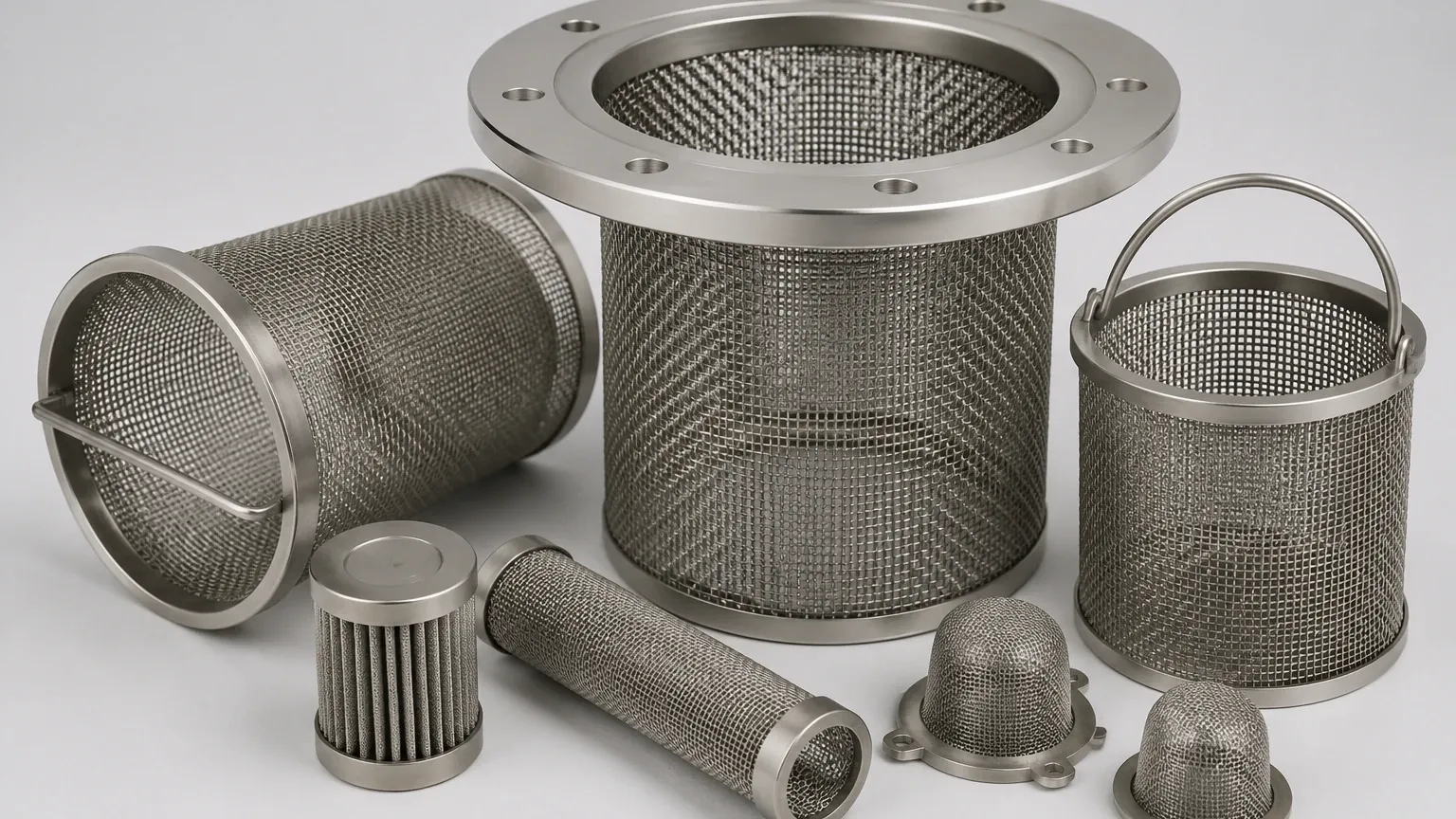
Material choice is the most significant factor in determining the service life and reliability of industrial filtration components. For most demanding applications, stainless steel is the industry standard due to its mechanical strength and resistance to corrosion. Kaifil specializes in manufacturing Strainers & Baskets using high-grade alloys to suit diverse chemical environments.
SS304 vs. SS316L
Stainless steel 304 is the most common material for general-purpose industrial strainers. It provides excellent durability and resistance to atmospheric corrosion. However, in environments involving chlorides, high temperatures, or aggressive chemicals, SS316L is preferred. The addition of molybdenum in SS316L enhances its resistance to pitting and crevice corrosion, making it the standard for pharmaceutical and marine applications.
Gaskets and Seals
The housing of a 3-inch strainer must be sealed to prevent leaks and maintain system pressure. The choice of gasket material—such as EPDM, Viton (FKM), or PTFE—must be dictated by the fluid's temperature and chemical composition. For example, Viton is often selected for its high-temperature resistance and compatibility with oils and fuels, while EPDM is widely used in water treatment and food-grade applications.
Comparing Basket and Y-Strainer Configurations for 3-Inch Lines
When specifying 3 inch strainers, engineers must choose between two primary configurations: the Y-strainer and the Basket (Simplex) strainer. The choice depends on the expected debris load and the allowable pressure drop.
Y-Strainers
Y-strainers are typically used in applications where the amount of debris to be removed is small. They are compact and can be installed in both horizontal and vertical pipelines. However, because the debris collection chamber is smaller than that of a basket strainer, they require more frequent cleaning if the fluid is heavily contaminated. In 3-inch systems, Y-strainers are frequently used for steam, gas, or high-pressure liquid lines where space is limited.
Basket Strainers
Basket strainers, also known as Simplex strainers, feature a vertical cylinder that houses a large, removable basket. This design offers a much higher dirt-holding capacity and a lower pressure drop than a Y-strainer. For 3-inch liquid lines with high flow rates, basket strainers are generally the preferred choice. The top-entry design allows for easier maintenance, as the basket can be lifted out without draining the entire piping system, provided the line is depressurized.
Technical Specifications and Performance Metrics
To ensure a 3-inch strainer performs as expected, several technical specifications must be confirmed during the procurement process. These include connection types, pressure ratings, and filtration accuracy.
Connection Types
3 inch strainers are available with various connection methods to match existing piping infrastructure:
* Flanged Connections: ANSI 150# or 300# flanges are standard for industrial applications, providing a secure, leak-proof connection that is easy to install and remove.
* NPT Threaded: Common for lower-pressure applications or where space is at a premium.
* Socket Weld/Butt Weld: Used in high-pressure or high-temperature systems where a permanent, leak-free joint is required.
Pressure and Temperature Ratings
Industrial strainers must be rated for the maximum operating pressure and temperature of the system. A standard 3-inch stainless steel basket strainer might be rated for 200-300 PSI at ambient temperatures, but these ratings decrease as the temperature increases. It is vital to consult the pressure-temperature charts provided by the manufacturer to ensure safety margins are maintained.
Micron Retention and Mesh Size
The degree of filtration is determined by the internal element. This can range from coarse perforated plates (with holes ranging from 1/32" to 1/4") to fine wire mesh linings capable of capturing particles down to 5 or 10 microns. For 3 inch strainers, engineers must balance the need for fine filtration with the risk of rapid clogging and excessive pressure drop.
Calculating Pressure Drop and Flow Capacity
Pressure drop (ΔP) is the loss of fluid pressure as it passes through the strainer. In a 3-inch system, an excessive pressure drop can lead to cavitation in pumps and reduced flow efficiency. The total pressure drop is a combination of the drop across the housing and the drop across the clean filter element.
Manufacturers provide Cv values (flow coefficients) for their strainers. The Cv value represents the flow of water in gallons per minute (GPM) that will result in a 1 PSI pressure drop across a clean strainer. For a 3-inch basket strainer, a typical Cv might range from 150 to 200. Engineers use the following formula to estimate the pressure drop:
**ΔP = (Q / Cv)² * G**
Where:
* Q = Flow rate in GPM
* Cv = Flow coefficient
* G = Specific gravity of the fluid
As the strainer collects debris, the effective Cv decreases, and the pressure drop increases. Monitoring this differential pressure is the most effective way to determine when a 3-inch strainer requires cleaning.
Industrial Applications and Chemical Compatibility
3 inch strainers are utilized across a wide spectrum of industries, each with unique requirements for cleanliness and material integrity.
* Chemical Processing: In this sector, strainers must withstand aggressive solvents and acids. Stainless steel 316L is often the baseline, with custom mesh linings designed to protect sensitive instrumentation from particulates.
* Food and Beverage: Filtration components must meet sanitary standards. This involves using 3-inch strainers with polished internal surfaces to prevent bacterial growth and ensuring that all materials are FDA-compliant.
* Water Treatment: Large-scale water filtration systems use 3-inch strainers as pre-filters for reverse osmosis (RO) membranes or UV sterilization units, removing sand, scale, and organic matter that could foul downstream equipment.
* Hydraulic Systems: Protecting high-pressure hydraulic pumps requires strainers that can handle high-viscosity fluids while maintaining precise filtration levels to prevent component wear.
Customization and OEM Requirements
Standard off-the-shelf strainers do not always meet the specific needs of complex industrial projects. Kaifil provides extensive OEM capabilities, allowing for the customization of 3 inch strainers to fit unique spatial constraints or performance criteria. Customization options include:
* Specialized Mesh Linings: Combining perforated metal for strength with fine wire mesh for precision filtration.
* Custom Dimensions: Adjusting the height or width of the basket to increase dirt-holding capacity within a fixed footprint.
* Reinforced Elements: Adding internal supports to filter baskets to prevent collapse under high differential pressure conditions.
* Surface Finishes: Providing electropolishing or specialized coatings for enhanced corrosion resistance or sanitary compliance.
By working closely with a manufacturer like Kaifil, engineering teams can ensure that their filtration components are optimized for the specific Reynolds number and flow characteristics of their 3-inch piping systems.
Maintenance and Operational Considerations
The reliability of a 3-inch strainer is heavily dependent on regular maintenance. If a strainer is neglected, the accumulated debris will eventually cause the element to rupture or the upstream pressure to reach dangerous levels.
Differential Pressure Monitoring
Installing pressure gauges upstream and downstream of the 3-inch strainer is a best practice. A common rule of thumb is to clean the basket when the differential pressure reaches 5-10 PSI over the clean pressure drop. Many modern systems use differential pressure switches to trigger an alarm or automate a cleaning cycle.
Cleaning Procedures
For simplex basket strainers, the process involves isolating the strainer using valves, venting the pressure, and removing the cover. The basket should be cleaned using a soft brush or high-pressure water/air, taking care not to damage the wire mesh. If the strainer is used in a continuous process where flow cannot be interrupted, a duplex strainer (which consists of two 3-inch strainers connected by a diverter valve) should be considered instead.
Spare Parts Management
To minimize downtime, facilities should maintain a stock of critical spare parts for their 3 inch strainers. This includes replacement baskets, cover gaskets, and O-rings. Because filtration elements are subject to mechanical stress and potential damage during cleaning, having a secondary basket allows for an immediate swap, enabling the dirty basket to be cleaned thoroughly without delaying the restart of the process.
Conclusion
3 inch strainers are a fundamental component of industrial fluid management, providing the necessary protection to ensure the longevity of expensive downstream equipment. Whether the application requires a simple Y-strainer for steam lines or a high-capacity stainless steel basket strainer for chemical processing, understanding the technical nuances of material selection, flow capacity, and maintenance is essential. By focusing on precision manufacturing and customized engineering, Kaifil ensures that every filtration component delivers reliable performance in the most demanding industrial environments.
