


3 Basket Strainers
In industrial fluid handling and process engineering, the 3-inch (3") basket strainer serves as a critical line of defense for downstream equipment. Whether integrated into a chemical processing line, a food production facility, or a hydraulic system, these components are designed to remove large-scale particulate matter that could otherwise damage pumps, valves, and meters. Choosing the right 3 basket strainers requires a deep understanding of flow dynamics, material compatibility, and the specific mechanical requirements of the application.
Industrial basket strainers, particularly those in the 3-inch size range, are favored for their high dirt-holding capacity compared to Y-strainers. The "basket" design allows for a larger surface area, which translates to longer run times between cleaning cycles and a lower pressure drop across the system. For engineers and procurement teams, the selection process involves more than just matching pipe sizes; it requires a technical evaluation of the media being filtered and the environmental conditions of the installation.
Technical Specifications and Material Selection
The performance of 3 basket strainers is fundamentally tied to the materials used in their construction. In demanding industrial environments, stainless steel is the standard due to its superior corrosion resistance and structural integrity. Most high-quality strainers are fabricated from either SS304 or SS316L.
* SS304: Suitable for general industrial applications, water treatment, and less corrosive chemical environments. It offers excellent durability and cost-effectiveness for standard filtration needs.
* SS316L: Preferred for pharmaceutical, food and beverage, and highly corrosive chemical applications. The addition of molybdenum provides enhanced resistance to pitting and crevice corrosion, particularly in chloride-rich environments.
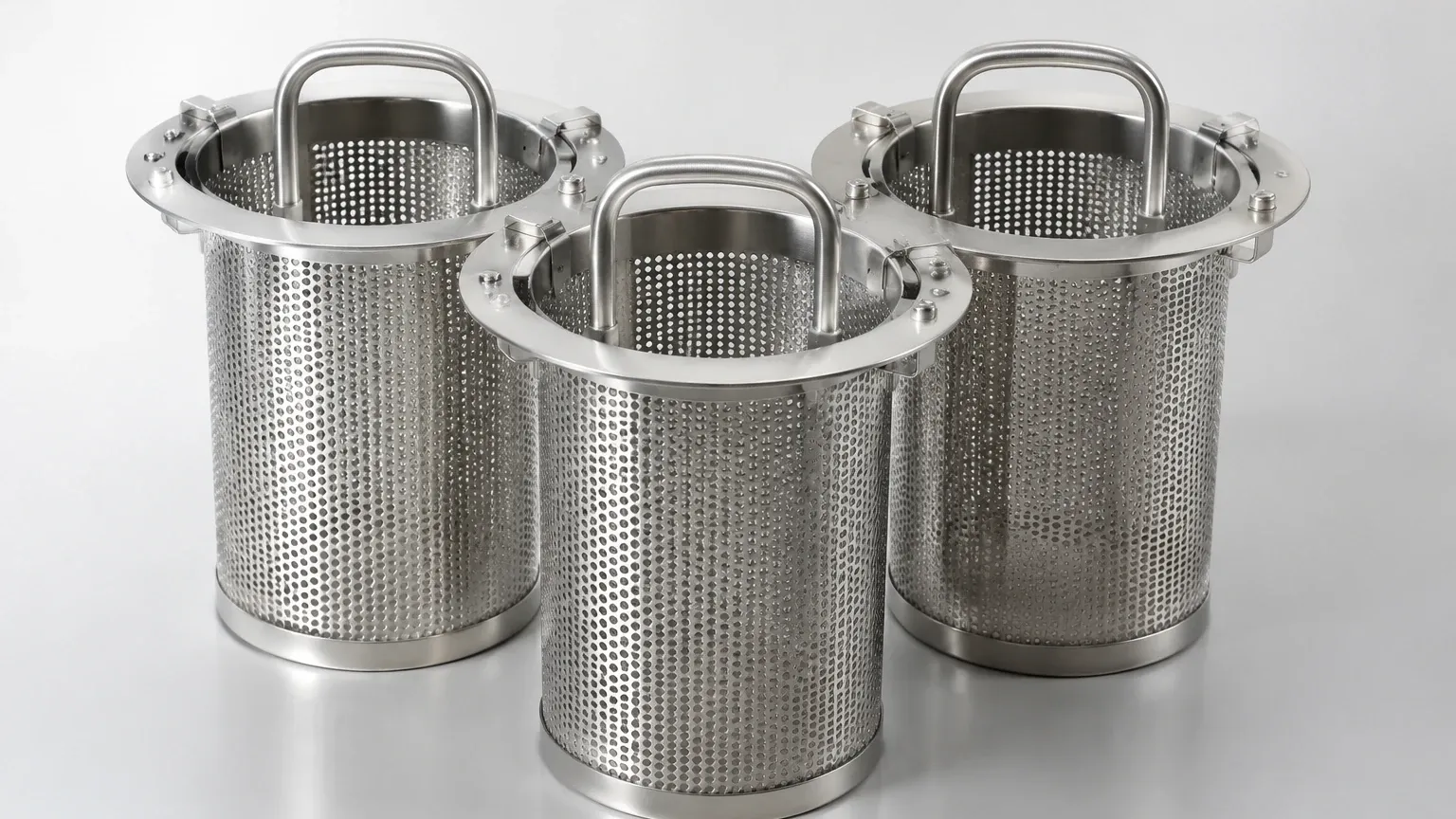
Beyond the housing, the internal basket—the core filtration element—must be engineered to withstand the differential pressure (Delta P) that occurs as debris accumulates. Kaifil specializes in manufacturing precision Strainers & Baskets that utilize reinforced wire mesh or perforated metal to ensure the basket does not collapse under high-pressure conditions.
Engineering Considerations: Flow Rate and Pressure Drop
One of the primary concerns for engineers when specifying 3 basket strainers is the impact on system hydraulics. Every component added to a piping system introduces resistance. In a 3-inch line, the flow velocity must be carefully managed to prevent cavitation or excessive energy loss.
The Importance of the Open Area Ratio
The efficiency of a basket strainer is often measured by its "Open Area Ratio" (OAR). This is the ratio of the total open area of the basket mesh to the internal cross-sectional area of the inlet pipe. A standard industrial 3-inch strainer should ideally have an OAR of at least 6:1. A higher OAR ensures that even as the basket begins to fill with contaminants, the pressure drop remains within acceptable limits, protecting the pump and maintaining process consistency.
Calculating Delta P
Pressure drop (Delta P) is the difference in pressure between the inlet and outlet of the strainer. For a clean 3 basket strainer, the initial pressure drop should be minimal—typically less than 2 PSI at the rated flow. Engineers must account for the viscosity of the fluid; thicker fluids like oils or resins will naturally result in a higher pressure drop than water, necessitating a larger basket surface area or a coarser mesh to maintain flow efficiency.
Configuration Options: Simplex vs. Duplex Systems
When integrating 3 basket strainers into a process, the operational duty cycle determines whether a simplex or duplex configuration is necessary.
Simplex Basket Strainers
A simplex strainer is used in systems where the flow can be intermittently stopped. When the basket reaches its dirt-holding capacity, the system is shut down, the pressure is relieved, and the basket is removed for cleaning. These are common in batch processing or systems with redundant piping loops.
Duplex Basket Strainers
In continuous flow applications—such as cooling water systems or 24/7 chemical production—a duplex configuration is required. A duplex system consists of two 3-inch strainer housings connected by a diverting valve. When one basket becomes clogged, the operator can switch the flow to the clean chamber without interrupting the process. This ensures zero downtime and constant protection for downstream components.
Mesh and Perforation Selection for 3-Inch Systems
The filtration accuracy of 3 basket strainers is determined by the internal basket lining. The selection of the mesh size is a balance between the required cleanliness of the fluid and the frequency of maintenance.
1. Perforated Plate: Used for coarse filtration (straining). Common hole sizes range from 1/32" to 1/4". These are ideal for removing large debris like scale, stones, or welding slag.
2. Wire Mesh Liners: For finer filtration, the perforated basket is lined with stainless steel wire mesh. This can range from 20 mesh (approx. 840 microns) down to 400 mesh (approx. 37 microns).
3. Magnetic Inserts: In hydraulic or machining applications, magnetic rods can be added to the basket to capture fine ferrous particles that might pass through the mesh.
Engineers should specify the "micron rating" based on the smallest particle that could damage the most sensitive downstream component. However, over-specifying (choosing a mesh that is too fine) will lead to rapid clogging and increased maintenance costs.
Application-Specific Requirements
Different industries impose unique demands on the design of 3 basket strainers. Understanding these nuances is essential for long-term reliability.
Chemical and Petrochemical
In these sectors, chemical compatibility is the priority. Gasket and seal materials must be chosen carefully. While EPDM or Nitrile might suffice for water, aggressive solvents or high-temperature fluids may require Viton (FKM) or PTFE-encapsulated seals to prevent leaks and environmental hazards.
Food, Beverage, and Pharmaceutical
For these applications, the 3 basket strainers must meet sanitary standards. This involves high-grade SS316L construction with polished internal surfaces (often Ra < 0.8 µm) to prevent bacterial growth. The design must be "dead-leg" free, ensuring that no stagnant fluid remains in the housing, and must be compatible with Clean-in-Place (CIP) protocols.
Water Treatment and Desalination
Large-scale water systems often use 3-inch strainers as pre-filters for membrane systems. In seawater applications, specialized alloys or high-grade stainless steels are used to resist the corrosive effects of salt water, ensuring the longevity of the filtration infrastructure.
Maintenance, Cleaning, and Total Cost of Ownership
The total cost of ownership (TCO) of 3 basket strainers is not just the initial purchase price; it includes the labor costs for cleaning and the potential costs of system downtime.
* Differential Pressure Gauges: Installing DP gauges across the strainer is the most effective way to monitor performance. Operators should clean the basket once the pressure drop reaches a pre-defined limit (usually 10-15 PSI above the clean drop).
* Ease of Access: For 3-inch systems, quick-opening covers (such as swing-bolt or clamp-style) are highly recommended over bolted-flange covers. They significantly reduce the time required to service the basket.
* Spare Baskets: Maintaining a stock of spare baskets allows for immediate replacement. The dirty basket can then be cleaned offline using ultrasonic baths or high-pressure washing without keeping the system idle.
Customization and Procurement with Kaifil
As a professional manufacturer, Kaifil understands that standard off-the-shelf solutions do not always meet the rigorous demands of specialized industrial processes. When sourcing 3 basket strainers, engineers should confirm several key factors with the manufacturer to ensure the product is fit for purpose.
Before finalizing a purchase, it is vital to provide the manufacturer with the following data:
* Fluid Properties: Viscosity, temperature, and chemical composition.
* Flow Conditions: Minimum, normal, and maximum flow rates (GPM or m³/h).
* Contaminant Profile: The type of solids being removed and the expected loading.
* Connection Standards: Whether the system requires ANSI flanges, NPT threads, or sanitary tri-clamp fittings.
Kaifil’s engineering team works closely with global customers to develop high-performance filtration components that meet these specific parameters. From custom basket dimensions to specialized material coatings, the focus remains on durability and precise filtration performance. For those seeking reliable, industrial-grade solutions, you can Review product options and application support to find the exact configuration required for your project.
By prioritizing technical accuracy in the selection of 3 basket strainers, industrial operators can ensure the longevity of their equipment, reduce unplanned maintenance, and maintain the highest levels of process efficiency. Whether it is a single simplex unit or a complex duplex system, the right strainer is an investment in the reliability of the entire fluid handling infrastructure.
