


Engineering Guide to Stainless Steel Wire Mesh Pleated Filter Cartridges
In industrial filtration, the balance between high flow rates, low pressure drop, and long-term durability is a critical engineering challenge. The stainless steel wire mesh pleated filter cartridge has emerged as a primary solution for demanding applications where polymer-based filters fail due to temperature, chemical incompatibility, or structural requirements. By utilizing advanced pleating techniques, these components maximize the effective filtration area within a compact footprint, offering significant operational advantages over standard Wire Mesh Filter Cylinders & Tubes.
This guide examines the technical specifications, selection criteria, and engineering considerations necessary for integrating pleated stainless steel cartridges into industrial fluid and gas systems.
1. Structural Design and Engineering Principles
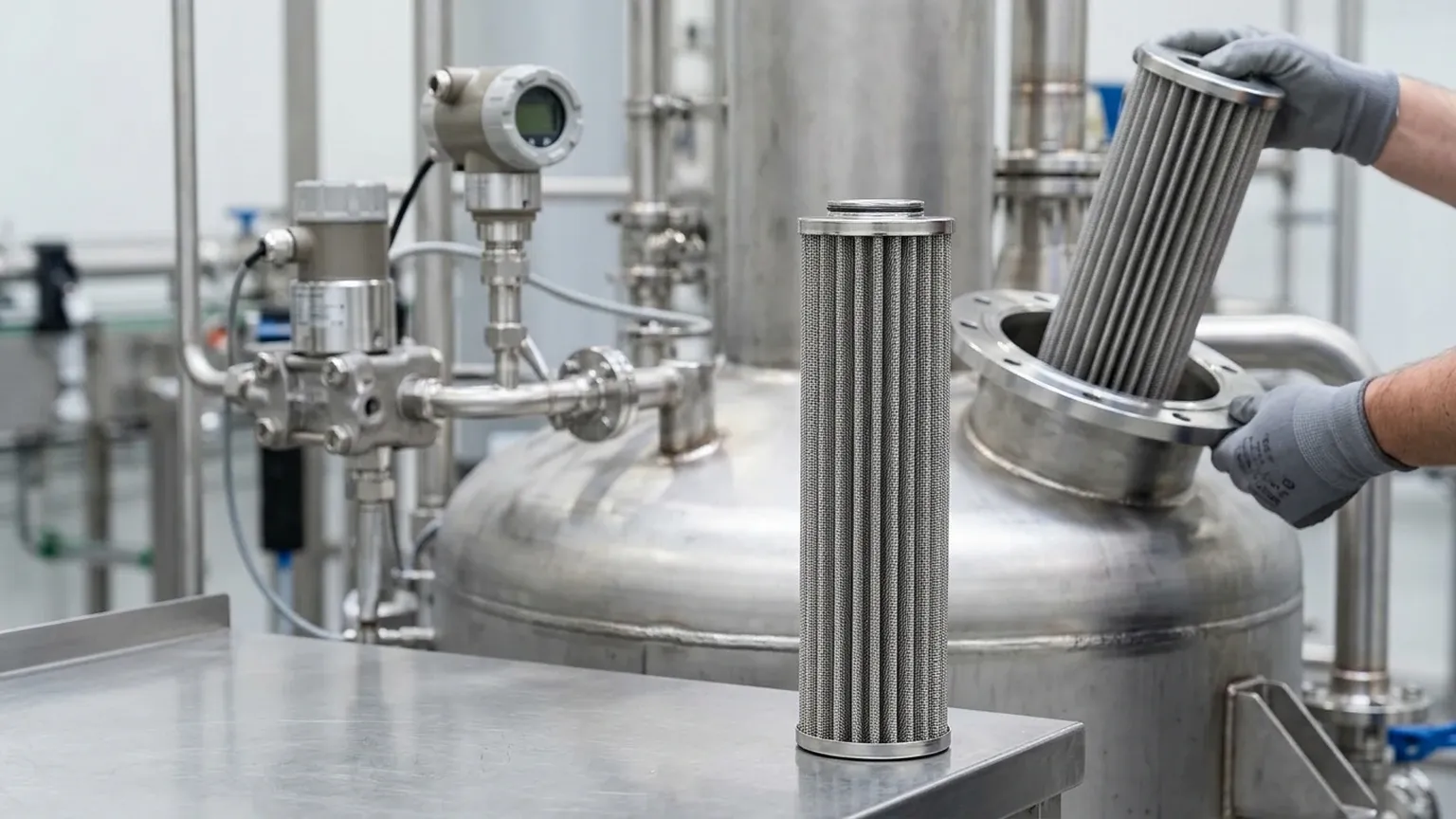
The core advantage of a pleated filter is its geometry. While a standard cylindrical filter is limited by its outer surface area, a pleated design folds the filter media into a series of ridges and valleys. This configuration can increase the surface area by 300% to 1,000% compared to a smooth-walled cylinder of the same dimensions.
Multi-Layer Construction
A high-performance stainless steel wire mesh pleated filter cartridge is rarely composed of a single layer of mesh. Instead, it utilizes a composite structure:
* Outer Support Layer: A coarse mesh or perforated metal sleeve that protects the pleats from mechanical damage during handling and provides initial structural rigidity against outward flow.
* Filtration Layer: The primary stainless steel wire mesh, woven to specific micron ratings. This layer determines the filtration efficiency and particle retention characteristics.
* Inner Support Layer: A secondary mesh layer that prevents the pleats from collapsing under high differential pressure (ΔP) and ensures the drainage of filtered fluid into the center core.
* Internal Core: A perforated stainless steel tube that provides the ultimate structural backbone, capable of withstanding the full system pressure in the event of a total filter blockage.
Pleat Density and Geometry
Engineers must balance pleat density (number of pleats per inch) with the viscosity of the fluid. If pleats are packed too tightly, the "blind spots" at the base of the pleats can lead to stagnant zones, reducing the effective area and making cleaning more difficult. Conversely, too few pleats fail to capitalize on the potential for increased flow capacity.
2. Material Selection and Chemical Compatibility
Material integrity is the foundation of industrial filtration. Kaifil utilizes high-grade alloys to ensure performance in corrosive or high-temperature environments.
AISI 304 vs. 316L
* AISI 304: Suitable for general industrial applications, water treatment, and mildly corrosive environments. It offers excellent mechanical strength and cost-effectiveness.
* AISI 316L: The preferred choice for chemical processing, pharmaceuticals, and marine environments. The addition of molybdenum and a lower carbon content provides superior resistance to pitting and crevice corrosion, particularly in the presence of chlorides.
Thermal Stability
Unlike polypropylene or polyester cartridges, which typically lose structural integrity above 60°C to 80°C, stainless steel pleated cartridges can operate at temperatures exceeding 300°C (depending on the gasket material). This makes them indispensable for steam filtration, hot oil systems, and polymer melt applications.
3. Performance Metrics: Micron Ratings and Pressure Drop
When specifying a stainless steel wire mesh pleated filter cartridge, engineers must distinguish between nominal and absolute filtration ratings.
Filtration Efficiency
* Nominal Rating: Indicates the ability of the filter to retain a majority of particles (typically 60% to 90%) of a specific micron size. This is often used for pre-filtration stages.
* Absolute Rating: Refers to the diameter of the largest hard spherical particle that will pass through the filter under specific test conditions. In high-precision industrial processes, absolute ratings are required to ensure the protection of downstream equipment like high-pressure pumps or spray nozzles.
Pressure Drop Dynamics
The Clean Pressure Drop (CPD) is the initial resistance across the filter when it is first installed. A pleated design significantly lowers the CPD because the flow velocity through any single point on the mesh is reduced due to the expanded surface area. As particles accumulate, the Terminal Pressure Drop (TPD) is reached—this is the point at which the filter must be cleaned or replaced to prevent system failure or media deformation.
4. Installation Constraints and Housing Integration
Successful integration of pleated cartridges requires precise alignment with existing filter housings. Several end-cap configurations are standardized across the industry to ensure a leak-proof seal:
* Double Open End (DOE): Features flat gaskets on both ends; requires a tie-rod assembly within the housing to compress the gaskets.
* Code 7 (226 O-ring/Fin): Utilizes two 226 O-rings and a locking tab (bayonet) to ensure the cartridge is securely seated, preventing bypass even under high-vibration conditions.
* 222 O-ring/Flat: Common in pharmaceutical and food applications, providing a reliable seal without the need for locking tabs.
Gasket Material Selection
The choice of O-ring or gasket material must match the process fluid. Common options include:
* Viton (FKM): High temperature and chemical resistance.
* EPDM: Excellent for steam and water applications.
* PTFE/Teflon: Near-universal chemical resistance but lower elasticity.
* Silicone: Preferred for food-grade and pharmaceutical processes.
5. Maintenance and Cleaning Protocols
One of the primary reasons engineers select Wire Mesh Filter Cylinders & Tubes in a pleated format is the ability to regenerate the media. Unlike disposable depth filters, stainless steel cartridges are a capital investment intended for long-term use.
Cleaning Methods
1. Backwashing: Reversing the flow of fluid through the cartridge to dislodge surface-bound contaminants. This is most effective for surface-loading mesh.
2. Ultrasonic Cleaning: Using high-frequency sound waves in a detergent bath to create cavitation bubbles that remove fine particles trapped deep within the pleats.
3. Chemical Cleaning: Utilizing acids, alkalis, or solvents to dissolve organic or mineral scaling. This requires careful verification that the cleaning agent is compatible with the 304 or 316L steel.
4. Burn-off/Pyrolysis: For heavy polymer or resin applications, controlled heating can carbonize the contaminants, which are then removed via ultrasonic cleaning.
6. Application Risks and Technical Boundaries
While robust, pleated stainless steel cartridges are subject to specific engineering limits that must be managed to avoid premature failure.
Differential Pressure Limits
Every cartridge has a maximum allowable differential pressure. If the ΔP exceeds the structural limit of the inner core or the pleat support, the pleats may "flatten" or the core may collapse. In liquid applications, water hammer (pressure surges) can also cause fatigue in the wire mesh welds. Engineers should specify a design that accounts for at least 1.5x the maximum expected system pressure.
Fatigue and Media Migration
In high-cycle applications where flow is frequently started and stopped, the wire mesh can undergo mechanical fatigue. It is essential to ensure that the mesh is properly sintered or securely welded to the end caps to prevent media migration—where small fragments of the filter itself enter the downstream flow.
Bypass Risks
The most common failure in filtration is not a failure of the media, but a failure of the seal. If the cartridge is incorrectly sized for the housing or if the O-rings are damaged during installation, the fluid will take the path of least resistance, bypassing the filter entirely. Regular inspection of seals is a mandatory maintenance step.
7. Procurement Guide: Information for International Buyers
When sourcing a stainless steel wire mesh pleated filter cartridge for a global project, providing comprehensive technical data is essential to ensure the component meets site requirements. Buyers should confirm the following with the manufacturer:
* Micron Rating Requirement: Specify if the requirement is absolute or nominal.
* Flow Rate and Viscosity: Provide the maximum flow rate (GPM or m³/h) and the fluid viscosity (cP or SSU) at operating temperature.
* Dimensions: Confirm Outer Diameter (OD), Inner Diameter (ID), and overall length (including end caps).
* End Cap Style: Specify the exact code (e.g., Code 7, DOE, NPT threaded).
* Operating Environment: Detail the maximum operating temperature and the chemical composition of the fluid.
* Certification Needs: Determine if the application requires FDA compliance for food contact, 3A sanitary standards, or specific pressure vessel certifications (like ASME or PED).
Conclusion
The stainless steel wire mesh pleated filter cartridge represents a sophisticated intersection of material science and mechanical design. For industrial engineers, these components offer a reusable, high-efficiency alternative to disposable media, capable of performing in environments that would compromise other materials. By understanding the nuances of pleat geometry, material compatibility, and maintenance protocols, technical teams can optimize their filtration systems for maximum uptime and minimal total cost of ownership.
Whether for protecting sensitive hydraulic valves or ensuring the purity of a pharmaceutical batch, the selection of the correct Wire Mesh Filter Cylinders & Tubes configuration is a critical step in industrial process design.
Download Stainless Steel Wire Mesh Pleated Filter Cartridge as a PDF
