


Wire Mesh Air Conditioner Filter: An Engineering Guide to Industrial HVAC Filtration
In industrial environments, air conditioning and ventilation systems serve a purpose far beyond occupant comfort. They are critical components of process control, equipment cooling, and environmental safety. Standard synthetic or fiberglass filters often fail to meet the rigorous demands of chemical processing plants, offshore platforms, or high-temperature manufacturing facilities. This is where the wire mesh air conditioner filter becomes an essential engineering choice.
By utilizing stainless steel alloys and precision weaving techniques, these filters provide a level of durability, reusability, and chemical resistance that disposable media cannot match. For engineers and procurement specialists, understanding the technical nuances of Wire Mesh Filter Cylinders & Tubes and flat mesh panels is vital for optimizing system performance and reducing long-term operational costs.
1. Operating Principles of Metal Mesh Filtration
Industrial wire mesh filters operate primarily through surface filtration. Unlike depth media (such as thick fiberglass mats) that trap particles throughout the material's thickness, wire mesh captures contaminants on a single, predictable plane. This mechanism offers several engineering advantages in HVAC applications.
Mechanical Sieve Effect
The primary capture mechanism is the mechanical sieve. The aperture size—determined by the mesh count and wire diameter—defines the absolute filtration rating. In a wire mesh air conditioner filter, the precision of the weave ensures that any particle larger than the pore size is blocked, providing a consistent barrier against ingress.
Inertial Impaction and Interception
At higher air velocities, smaller particles that might theoretically pass through the apertures are often captured via inertial impaction. As the air stream deviates to pass around the solid wires, heavier particles maintain their trajectory and collide with the metal surface. This is particularly relevant in industrial intake systems where dust loading is high.
Low Pressure Drop ($ΔP$)
One of the most critical metrics for HVAC engineers is the pressure drop across the filter. A high initial $ΔP$ forces fans to work harder, increasing energy consumption and wear. Stainless steel wire mesh offers a high open-area percentage, allowing for high flow rates with minimal resistance. This efficiency is a hallmark of Wire Mesh Filter Cylinders & Tubes, which are often designed to maximize surface area within a compact footprint.
2. Material Selection and Environmental Compatibility
Selecting the right alloy is the most significant factor in the longevity of a wire mesh air conditioner filter. Industrial environments often present corrosive challenges that would degrade standard aluminum or galvanized steel filters in weeks.
Stainless Steel 304
Grade 304 is the standard for most industrial applications. It offers excellent resistance to oxidation and is suitable for general manufacturing environments. It provides the structural integrity needed to withstand high-pressure airflows without deforming.
Stainless Steel 316 and 316L
For facilities located near coastal areas (salt air) or chemical processing plants involving chlorides, Grade 316 is the preferred specification. The addition of molybdenum enhances resistance to pitting and crevice corrosion. 316L (low carbon) is used when the filter components require extensive welding, as it prevents sensitisation and maintains corrosion resistance at the weld joints.
Specialized Alloys
In extreme cases involving high-temperature exhaust or highly acidic atmospheres, alloys like Inconel or Monel may be used. However, for the vast majority of industrial HVAC and air intake needs, 300-series stainless steel provides the optimal balance of performance and cost.
3. Structural Design: Cylinders, Tubes, and Panels
The physical configuration of the filter is dictated by the housing and the required air volume. While flat panels are common in standard air handling units (AHUs), many industrial systems utilize more complex geometries.
Wire Mesh Filter Cylinders & Tubes
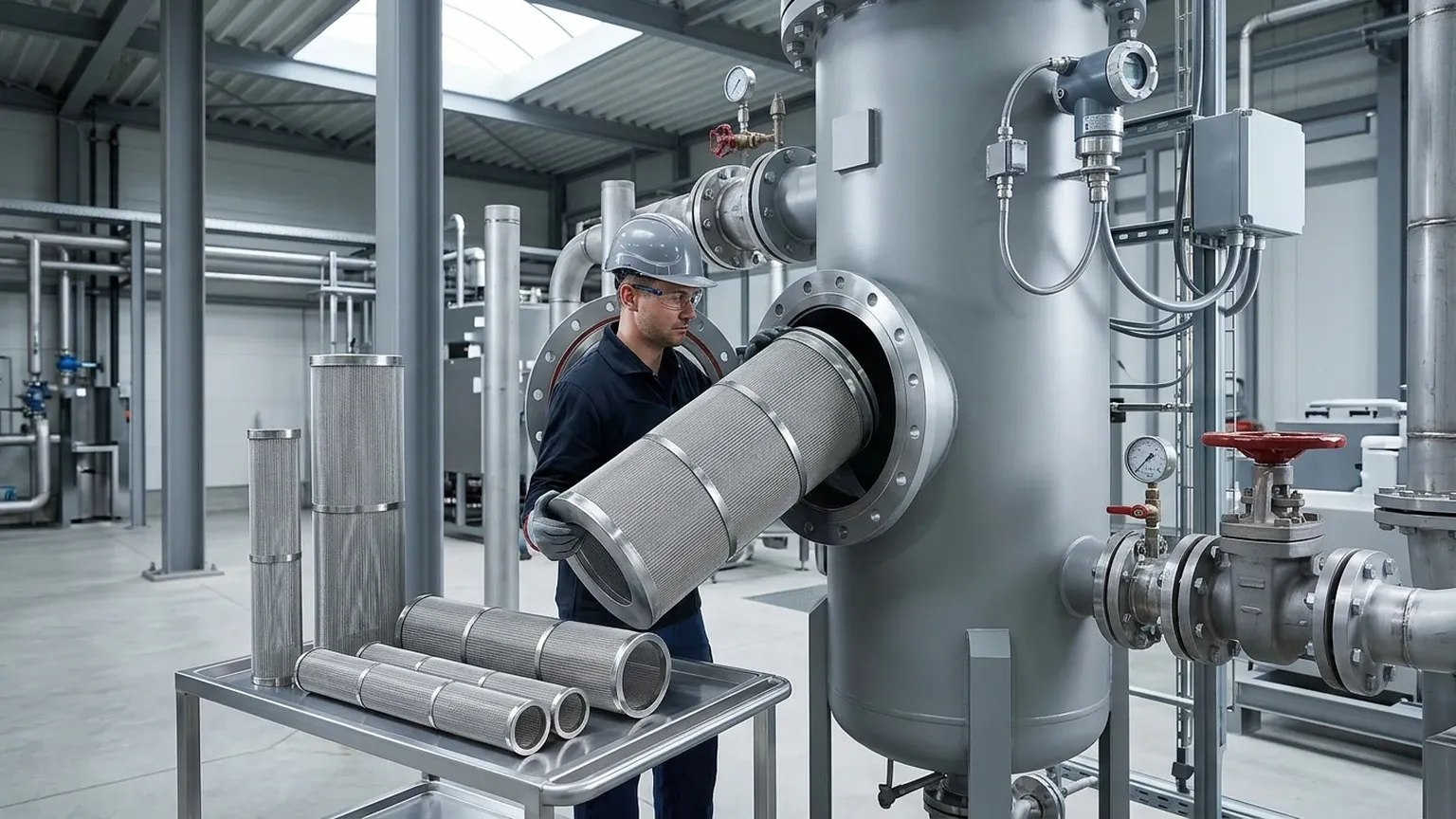
In heavy-duty air intake systems or specialized filtration units, Wire Mesh Filter Cylinders & Tubes are frequently employed. The cylindrical shape provides a superior strength-to-weight ratio, allowing the filter to withstand significant differential pressure without collapsing. These tubes can be constructed with multiple layers—such as a fine inner mesh for filtration supported by a coarser outer mesh or perforated metal for structural rigidity.
Pleated vs. Flat Mesh
To increase the Effective Filtration Area (EFA) without increasing the filter's external dimensions, the wire mesh can be pleated. Pleating a wire mesh air conditioner filter can increase the surface area by 3 to 5 times, significantly extending the time between cleaning cycles and further reducing the pressure drop.
4. Performance Metrics and Selection Criteria
When specifying a wire mesh filter for an industrial HVAC system, engineers must look beyond simple dimensions. The following technical parameters define the filter's suitability for a specific process.
Mesh Count and Aperture Size
Mesh count refers to the number of wires per linear inch. A higher mesh count results in smaller apertures. For HVAC applications, the goal is usually to capture large particulate matter (dust, lint, insects) that could clog secondary fine filters or damage sensitive cooling coils. Common specifications range from 10 mesh (coarse) to 100 mesh (fine).
Wire Diameter and Open Area
The diameter of the wire influences both the strength of the mesh and the "open area" percentage. The open area is calculated as:
$$Open Area \% = \frac{(Aperture Size)^2}{(Aperture Size + Wire Diameter)^2} \times 100$$
A higher open area percentage correlates with lower energy costs but may result in a more fragile mesh if the wire diameter is too thin.
Air Velocity and Face Velocity
Engineers must ensure the filter can handle the system's design air velocity (typically measured in feet per minute or meters per second). If the velocity is too high for the chosen mesh, it can cause "vibration fatigue" in the wires or lead to particle re-entrainment, where captured dust is blown through the mesh by the force of the air.
5. Maintenance, Cleaning, and Total Cost of Ownership (TCO)
The primary driver for adopting a wire mesh air conditioner filter in an industrial setting is the transition from a "consumable" model to an "asset" model.
The Cleaning Process
Unlike synthetic filters that must be discarded once loaded, stainless steel mesh is fully regenerable. Depending on the contaminant, cleaning methods include:
* Compressed Air: For dry, loose dust.
* High-Pressure Water/Steam: For stubborn particulates.
* Ultrasonic Cleaning: The gold standard for restoring mesh to its original pressure drop specifications, especially for fine mesh counts.
* Chemical Soaking: Used when the filter is coated in oils or greases (common in food processing or machining environments).
Longevity and Sustainability
A high-quality stainless steel filter can last for years, if not decades, with proper maintenance. This eliminates the recurring procurement costs of disposable filters and significantly reduces the waste stream of a facility. In the context of ISO 14001 or other sustainability initiatives, the use of permanent metal filtration is a measurable improvement in environmental impact.
Total Cost of Ownership (TCO)
While the initial purchase price of Wire Mesh Filter Cylinders & Tubes is higher than that of polyester or cardboard-framed filters, the TCO over five years is typically much lower. When factoring in the costs of replacement media, labor for frequent changes, disposal fees, and the energy savings from a lower average pressure drop, the ROI (Return on Investment) for metal mesh is often realized within the first 12 to 18 months.
6. Engineering Constraints and Application Risks
While highly effective, wire mesh filters are not a universal solution for every air quality requirement. Engineers must be aware of specific constraints:
* Sub-micron Filtration: Wire mesh is generally not suitable for HEPA-level filtration (capturing 0.3-micron particles). In these cases, the wire mesh should be used as a "pre-filter" to protect the expensive HEPA stage from large debris.
* Weight Considerations: Stainless steel is significantly heavier than synthetic media. Support frames and housing must be engineered to handle the static load, especially in large-scale installations.
* Gasketing and Sealing: A filter is only as good as its seal. In industrial HVAC units, bypass air (air that leaks around the filter) can negate the benefits of the mesh. High-temperature silicone or EPDM gaskets are usually required to ensure a tight fit within the filter rack.
7. Procurement Checklist for International Buyers
When sourcing a wire mesh air conditioner filter from a specialized manufacturer like Kaifil, providing precise technical data is essential for a successful OEM or custom project. Buyers should confirm the following details:
1. Material Grade: Specify 304, 316, or 316L based on the chemical environment.
2. Mesh Specifications: Define the mesh count and wire diameter. If the micron rating is the priority, specify the absolute vs. nominal filtration requirement.
3. Structural Reinforcement: For high-pressure systems, specify if the mesh requires a backing of expanded metal or a perforated core.
4. Dimensional Tolerances: Industrial housings often have tight tolerances. Ensure the manufacturer can meet $\pm$ 0.5mm or better if required.
5. End Fittings: For Wire Mesh Filter Cylinders & Tubes, define the connection type (e.g., flanged, threaded, or open-ended).
6. Certification: Request material test reports (MTRs) to verify the alloy composition and quality standards.
Conclusion
The transition to stainless steel wire mesh in industrial air conditioning and intake systems represents a shift toward engineering efficiency and long-term reliability. By selecting the appropriate mesh geometry, alloy, and structural design, facilities can ensure consistent airflow, protect downstream equipment, and achieve a significantly lower total cost of ownership. Whether the application requires simple flat panels or complex Wire Mesh Filter Cylinders & Tubes, the technical advantages of metal filtration provide a robust solution for the most demanding industrial environments.
