


Commercial Strainer Baskets
In industrial fluid handling systems, the integrity of downstream equipment—such as pumps, valves, flow meters, and heat exchangers—depends heavily on the efficiency of primary filtration. Commercial strainer baskets serve as the critical first line of defense, designed to remove large-scale particulate matter and debris from liquids. Unlike fine membrane filters used for polishing, these baskets are engineered for high-volume flow and high-dirt-holding capacity, making them indispensable in sectors ranging from chemical processing to food and beverage production.
Selecting the right Strainers & Baskets involves more than matching a pipe diameter. It requires a deep understanding of fluid dynamics, material science, and the specific mechanical stresses of an industrial environment. This guide examines the technical nuances of commercial strainer baskets, providing engineers and procurement teams with the factual basis needed to optimize system performance and longevity.
Understanding the Role of Commercial Strainer Baskets in Industrial Systems
The primary function of a strainer basket is to intercept solids that could cause mechanical failure or process contamination. In a commercial or industrial context, these components are typically housed within simplex or duplex strainer bodies. The basket design is preferred in applications where high flow rates and low pressure drops are required, as the large surface area of the basket allows for significant particulate accumulation before cleaning is necessary.
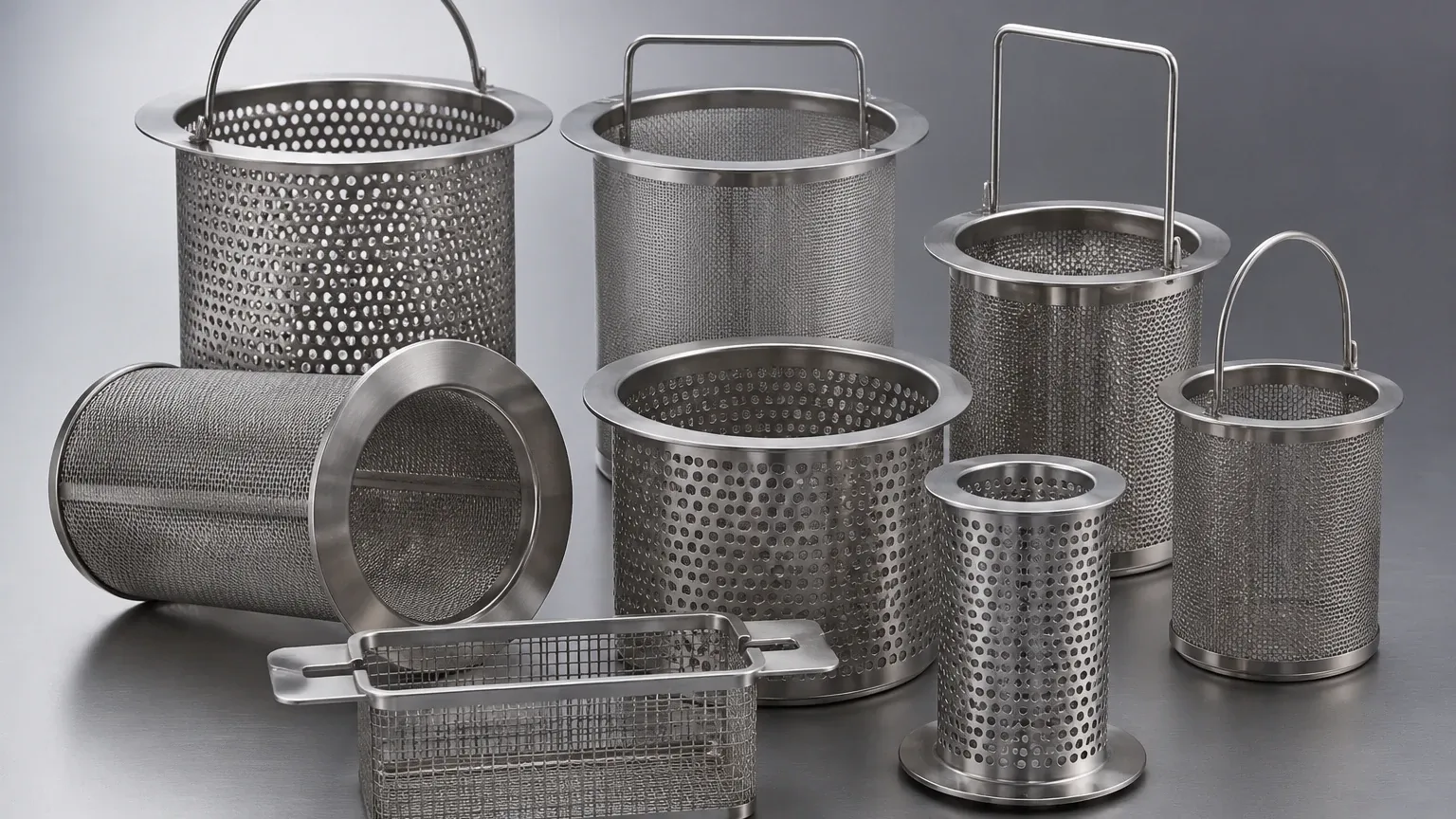
Commercial strainer baskets are categorized by their configuration and the nature of the debris they are intended to capture. While some are designed for "coarse" straining—removing stones, scale, or welding slag—others are lined with fine wire mesh to capture smaller contaminants. The choice between a standard perforated basket and a mesh-lined basket depends entirely on the required filtration accuracy and the viscosity of the fluid being processed.
Engineering Specifications and Material Selection
Material integrity is the most significant factor in the service life of a strainer. Because these components are often exposed to corrosive chemicals, high temperatures, and abrasive particles, stainless steel is the industry standard.
Stainless Steel Grades
* SS304: Suitable for general industrial use, water treatment, and food processing where moderate corrosion resistance is required.
* SS316/316L: Specified for more demanding environments, such as marine applications or chemical processing involving chlorides and acids. The addition of molybdenum provides superior resistance to pitting and crevice corrosion.
Construction Methods
The structural stability of commercial strainer baskets is achieved through a combination of a heavy-duty perforated metal support and, if necessary, a fine wire mesh lining. The perforated metal provides the mechanical strength to withstand differential pressure, while the mesh dictates the filtration level. High-quality baskets utilize precision welding techniques, such as TIG or spot welding, to ensure that the mesh remains bonded to the support structure even under high-velocity flow conditions.
Key Performance Metrics: Flow Rate and Pressure Drop
For an engineer, the most critical technical consideration is the "Open Area Ratio." This is the ratio between the total open area of the strainer basket holes and the cross-sectional area of the inlet pipe. A common industry benchmark for a well-designed strainer is an open area ratio of at least 4:1. A higher ratio results in several operational advantages:
1. Lower Initial Pressure Drop: A larger open area allows fluid to pass through with minimal resistance, reducing the load on pumps.
2. Extended Cleaning Cycles: More surface area means the basket can hold more debris before the differential pressure reaches a critical level.
3. Reduced Velocity: Lowering the velocity of the fluid as it passes through the mesh reduces the risk of "particle bypass," where flexible or high-speed contaminants are forced through the openings.
When the pressure drop (ΔP) across the strainer increases significantly, it indicates that the basket is reaching its holding capacity. Monitoring this metric is essential to prevent basket collapse or pump cavitation.
Industrial Applications for High-Performance Strainers
Commercial strainer baskets are utilized across diverse industries, each with unique engineering requirements:
* Chemical and Petrochemical: Baskets must resist aggressive solvents and high temperatures. In these environments, precision-engineered stainless steel components prevent contaminants from damaging sensitive catalytic reactors and high-pressure valves.
* Food and Beverage: This sector requires hygienic designs. Strainer baskets must be manufactured with smooth finishes (often electropolished) to prevent bacterial growth and ensure they can be easily cleaned during CIP (Clean-in-Place) cycles.
* Water Treatment and HVAC: Large-scale commercial strainer baskets protect cooling towers and municipal water systems from organic debris, sand, and scale. These applications often prioritize high flow capacity and ease of manual maintenance.
* Pulp and Paper: The presence of fibrous materials requires baskets with specific perforation patterns to prevent "plugging" or blinding of the filter media.
Identifying Risks and Preventing Component Failure
Failure to correctly specify a strainer basket can lead to costly system downtime. Engineers should be aware of the following common risks:
Mechanical Collapse
If a basket becomes completely clogged and the pump continues to operate, the resulting differential pressure can exceed the structural limits of the basket. This leads to buckling or tearing, allowing all captured debris to flush downstream instantly. Specifying a reinforced basket or a heavy-gauge perforated support is a standard preventive measure for high-pressure systems.
Media Blinding
In applications involving fats, oils, or fibrous materials, the mesh can become "blinded" or coated, leading to a rapid rise in pressure. Selecting a basket with a specific weave—such as a plain Dutch weave or a twilled weave—can help mitigate this by providing a more structured path for the fluid.
Corrosion Fatigue
Even stainless steel can fail if exposed to the wrong chemical environment or if there is stagnant fluid left in the strainer during shutdowns. Ensuring that the material grade matches the fluid's chemical profile is non-negotiable for long-term reliability.
Critical Considerations Before Purchasing Custom Strainers
Before finalizing a purchase for commercial strainer baskets, technical teams should confirm several key parameters with the manufacturer to ensure the component is fit for purpose:
1. Micron Rating vs. Perforation Size: Determine if the application requires simple debris removal (measured in inches or millimeters of perforation) or fine filtration (measured in microns).
2. Gasket and Seal Compatibility: The basket seating surface must have a reliable seal to prevent bypass. Ensure the gasket material (EPDM, Viton, PTFE) is compatible with the process fluid and temperature.
3. Burst Pressure Requirements: Confirm the maximum allowable differential pressure the basket can withstand before structural deformation occurs.
4. Handle and Lift Configurations: For large commercial baskets, the weight of the debris can be substantial. Specifying heavy-duty handles or lifting lugs is essential for operator safety during maintenance.
5. Custom Dimensions: In many retrofit scenarios, standard off-the-shelf baskets may not fit existing strainer housings. Custom manufacturing allows for precise adjustments to the flange diameter, basket depth, and taper angle.
Maintenance Protocols and Total Cost of Ownership
The total cost of ownership for a strainer is not defined by the purchase price, but by the efficiency of its maintenance and its durability. A well-engineered stainless steel basket can be cleaned and reused for years, whereas lower-quality components may require frequent replacement due to mesh separation or corrosion.
Cleaning Methods
* Manual Cleaning: Removing the basket and using a high-pressure water jet or soft brush. This is standard for simplex strainers.
* Ultrasonic Cleaning: For baskets used in fine filtration (low micron ratings), ultrasonic baths can remove embedded particles that manual cleaning cannot reach.
* Chemical Soaking: Used in applications where the contaminant is a resin, adhesive, or organic buildup that requires a solvent to dissolve.
Regular inspection of the basket for signs of thinning metal, broken welds, or distorted mesh is critical. If any structural compromise is found, the basket should be replaced immediately to avoid catastrophic downstream damage.
By focusing on high-quality materials and precise engineering specifications, industrial facilities can ensure that their commercial strainer baskets provide reliable, long-term protection for their most valuable equipment. Whether for a new installation or a critical replacement, understanding these technical boundaries is the key to maintaining an efficient and safe fluid handling system.
