


Basket Strainer Element
In industrial fluid handling systems, the basket strainer element serves as the critical functional component within a strainer housing, designed to remove unwanted solids from liquids or gases. Unlike Y-strainers, which are typically used for smaller amounts of debris, basket strainers are engineered for systems requiring higher flow rates and a greater dirt-holding capacity. For engineers and procurement specialists, selecting the correct basket strainer element is not merely a matter of sizing; it involves a complex evaluation of material compatibility, structural integrity, and filtration efficiency to ensure the protection of downstream equipment such as pumps, valves, and heat exchangers.
As a specialized manufacturer, Kaifil provides high-performance Strainers & Baskets tailored to the rigorous demands of chemical processing, water treatment, and food production. Understanding the technical nuances of these elements is essential for optimizing system uptime and reducing total cost of ownership.
The Role of the Basket Strainer Element in Industrial Filtration
The primary function of a basket strainer element is to provide a large surface area for the entrapment of particulates while maintaining a low pressure drop. The "basket" geometry allows for a significant volume of debris to be collected before cleaning is required, making it ideal for batch processes or systems with high solid loading.
In a typical installation, the fluid enters the top or side of the strainer housing and flows through the center of the basket. The solids are retained within the basket, while the clean fluid passes through the perforated or mesh walls and exits the outlet. Because the debris is contained inside the element, removal and cleaning are simplified, as the contaminants are lifted out with the basket, preventing them from falling back into the downstream piping.
Engineering Specifications and Material Selection
The performance and longevity of a basket strainer element depend heavily on the materials used in its construction. Industrial environments often involve corrosive fluids, high temperatures, or strict sanitary requirements, necessitating the use of high-grade alloys.
Stainless Steel Grades
Stainless steel is the industry standard due to its mechanical strength and resistance to oxidation.
- SS304: Suitable for general-purpose applications, including water treatment and mild chemical processing.
- SS316/316L: Offers superior resistance to pitting and crevice corrosion, particularly in chloride-rich environments or acidic media. It is the preferred choice for pharmaceutical and marine applications.
- Specialty Alloys: For extreme environments involving highly aggressive chemicals, elements may be fabricated from Monel, Hastelloy, or Duplex stainless steel to prevent premature failure.
Filtration Media: Perforation vs. Mesh
A basket strainer element is usually constructed in one of two ways, or a combination of both:
1. Perforated Plate: This provides the structural backbone of the element. Perforation sizes typically range from 1/32" to 1/2" or larger. It is used for coarse filtration where large debris is the primary concern.
2. Wire Mesh Lining: For finer filtration requirements, a stainless steel wire mesh is sintered or spot-welded to the interior or exterior of the perforated metal. This allows for filtration ratings down to the micron level (e.g., 20 to 400 mesh) while the perforated plate provides the necessary burst strength to withstand differential pressure.
Calculating Performance: Flow Rate and Differential Pressure
One of the most critical engineering considerations when specifying a basket strainer element is the Clean Pressure Drop ($ΔP$). An undersized element or one with an insufficient open area will cause a significant drop in pressure, forcing pumps to work harder and increasing energy consumption.
The Open Area Ratio
The efficiency of a strainer is often measured by its "Open Area Ratio" (OAR). This is the ratio between the total open area of the basket holes and the cross-sectional area of the inlet pipe. A common industry standard is an OAR of 6:1 or 8:1. A higher ratio ensures that the strainer can operate longer between cleaning cycles without significantly impacting the system's flow dynamics.
Viscosity Impacts
When dealing with high-viscosity fluids, such as oils, resins, or syrups, the pressure drop across the basket strainer element increases exponentially. In these cases, engineers must specify larger baskets with coarser mesh or increased surface area to maintain the required flow velocity without cavitating the pump.
Structural Design and Customization Options
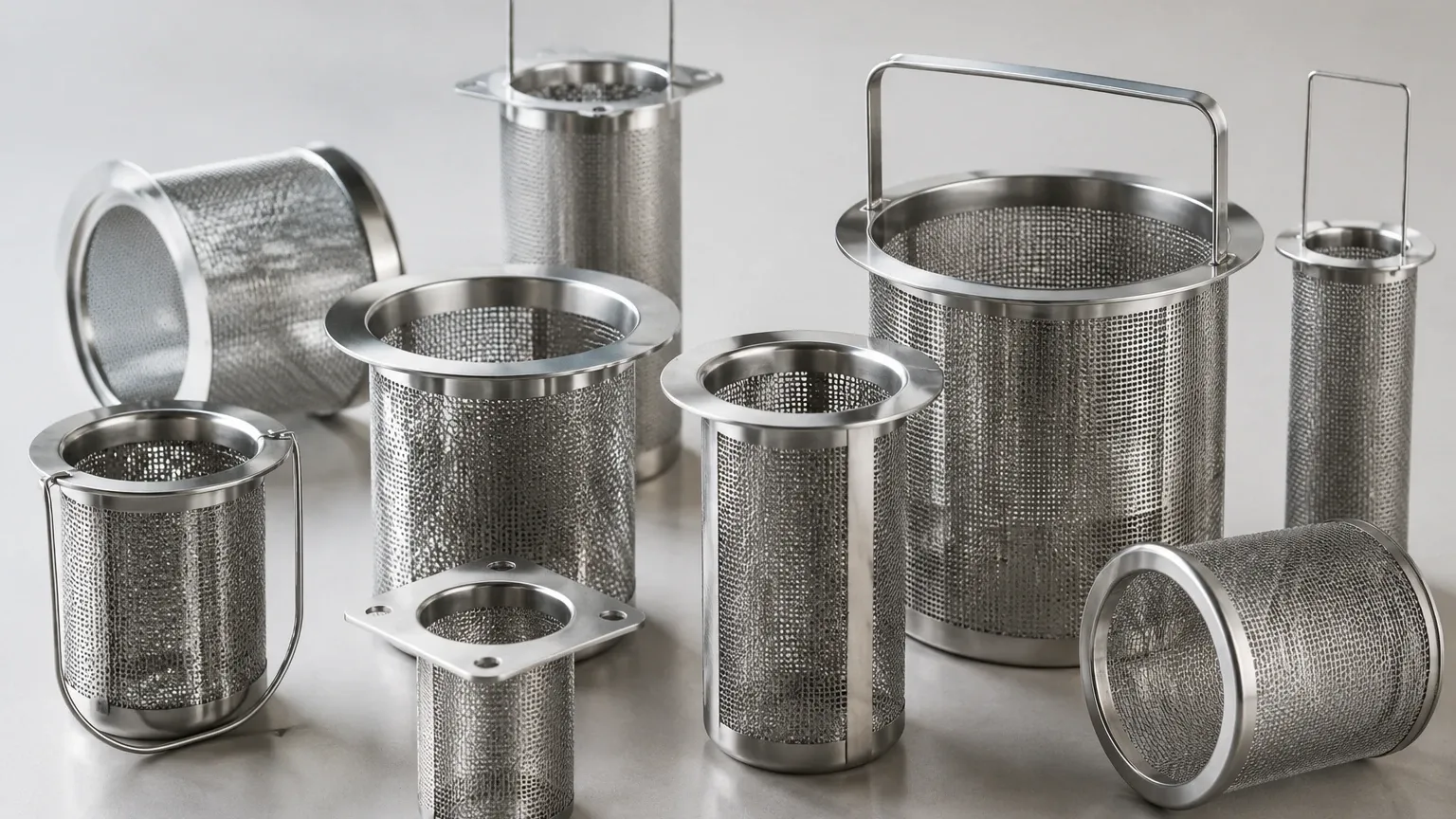
Industrial applications often require customized basket designs to fit existing housings or to meet specific operational workflows. Kaifil specializes in OEM and customized filtration solutions, ensuring that every basket strainer element is engineered for its specific environment.
Handle and Lifting Mechanisms
Since basket strainers are often serviced manually, the handle design is a vital ergonomic and functional feature. Options include:
- Bail Handles: Standard for easy lifting.
- Slant Handles: Designed for housings with side-entry ports where a standard handle might obstruct the flow or lid closure.
- Threaded Taps: For elements that require mechanical lifting assistance in large-scale industrial housings.
Reinforcement and Support
In high-pressure systems, the risk of element collapse is a major concern. To prevent this, baskets can be reinforced with internal or external support cages, longitudinal ribs, or heavy-duty rings. These reinforcements ensure that the element maintains its shape even when heavily loaded with debris or subjected to sudden pressure surges.
Sealing and Gaskets
To prevent fluid bypass, the basket must seat perfectly within the housing. This is achieved through precision-machined flanges or the use of O-rings and gaskets. Common materials include Buna-N, EPDM, Viton, and PTFE, selected based on the chemical compatibility and temperature of the process fluid.
Maintenance and Cleaning Protocols
The effective lifespan of a basket strainer element is dictated by the maintenance regime. Because these are mechanical barriers, they will eventually clog, leading to an increase in differential pressure.
Monitoring Differential Pressure
It is highly recommended to install differential pressure gauges across the strainer housing. A general rule of thumb is that the basket should be removed and cleaned when the pressure drop reaches 5 to 10 psi above the clean reading. Allowing the pressure drop to exceed 20 psi can lead to element deformation or "media migration," where the mesh begins to tear and allow contaminants through.
Cleaning Procedures
Stainless steel basket elements are typically cleanable and reusable. Cleaning methods include:
- Backwashing: Using a high-pressure hose to flush debris from the outside-in (opposite of the flow direction).
- Ultrasonic Cleaning: For fine mesh elements where particles are lodged deep within the weave.
- Chemical Bathing: To dissolve organic buildup or scale that cannot be removed mechanically.
Industry-Specific Requirements and Compliance
Different sectors impose unique constraints on the design of a basket strainer element:
- Food & Beverage: Elements must be fabricated with smooth, crevice-free welds and comply with FDA or 3-A sanitary standards to prevent bacterial growth.
- Oil & Gas: High-strength construction is required to handle high-velocity flows and heavy sludge.
- Pharmaceutical: Precise micron ratings and high-grade finishes (often electropolished) are necessary to ensure product purity and ease of sterilization.
Factors to Confirm Before Purchasing a Basket Strainer Element
Before finalizing a specification for a basket strainer element, engineering and purchasing teams should confirm the following technical data points to ensure compatibility and performance:
1. Fluid Characteristics: What is the chemical composition, temperature, and viscosity of the fluid? This dictates the alloy and seal selection.
2. Contaminant Profile: What is the size and nature of the solids being removed? Are they hard, abrasive particles or soft, fibrous materials? This determines the mesh size and the need for reinforcement.
3. Flow Dynamics: What is the maximum and minimum flow rate? This is essential for calculating the required open area and avoiding excessive pressure drop.
4. Housing Dimensions: If purchasing a replacement element, precise measurements of the flange diameter, basket height, and seat type are critical to prevent bypass.
5. Total Cost of Ownership: While a lower-cost element may seem attractive, a high-quality stainless steel basket with a higher OAR will often save money through reduced energy costs and longer service intervals.
By focusing on these technical parameters, organizations can ensure that their filtration systems remain efficient and reliable. Kaifil’s expertise in manufacturing custom stainless steel filtration components allows for the development of Strainers & Baskets that meet the most demanding industrial specifications, providing a dependable solution for complex filtration challenges.
