


Strainer Basket in Spanish
In the globalized landscape of industrial manufacturing and procurement, technical precision extends beyond engineering drawings to the very language used in international trade. For engineers and procurement specialists sourcing high-performance filtration components, understanding the terminology for a strainer basket in spanish is more than a linguistic exercise; it is a critical step in ensuring that technical specifications are accurately communicated across borders. As a leading manufacturer of stainless steel filtration solutions, Kaifil recognizes that whether a client requests a "canasta de filtro" or a "cesta de colador," the underlying requirement for durability, precision, and efficiency remains the same.
Strainers & Baskets serve as the primary line of defense in piping systems, protecting downstream equipment such as pumps, valves, and heat exchangers from damage caused by particulate matter. This article explores the technical nuances of strainer baskets, their material engineering, and the importance of localized terminology in global industrial applications.
Understanding the Terminology: Strainer Basket in Spanish
When operating in Spanish-speaking markets or collaborating with engineering firms in Latin America and Spain, the term strainer basket in spanish typically translates to *canasta filtrante* or *cesta de filtro*. In more specific industrial contexts, you may encounter terms like *colador de canasta* for the assembly or *malla filtrante* when referring specifically to the mesh lining.
In technical procurement, using the correct terminology helps prevent errors in material selection and sizing. For example, a "canasta de acero inoxidable" (stainless steel basket) must be further defined by its grade—304 or 316—and its filtration rating. Miscommunication in these early stages can lead to the acquisition of components that fail to meet the chemical resistance or pressure requirements of the application. By standardizing technical vocabulary, global teams can ensure that the Strainers & Baskets they receive match the exact engineering intent of the system design.
Engineering Specifications and Material Selection
The performance of a strainer basket is fundamentally tied to its material composition and structural integrity. In industrial environments, stainless steel is the preferred material due to its mechanical strength and resistance to environmental stressors.
Stainless Steel Grades
1. SS304: This is the standard grade for general-purpose filtration. It offers excellent corrosion resistance in most atmospheric and water treatment applications. It is widely used in the food and beverage industry where sanitary conditions are paramount.
2. SS316/316L: For more demanding environments, such as chemical processing or marine applications, SS316 is utilized. The addition of molybdenum provides enhanced resistance to chlorides and pitting. The "L" variant (low carbon) is often preferred for components requiring extensive welding to prevent carbide precipitation.
Filtration Media Types
Strainer baskets generally employ two types of filtration media, often used in combination:
* Perforated Metal: This provides the structural skeleton of the basket. The hole size and pattern (staggered or straight) determine the initial filtration level and the mechanical strength of the unit.
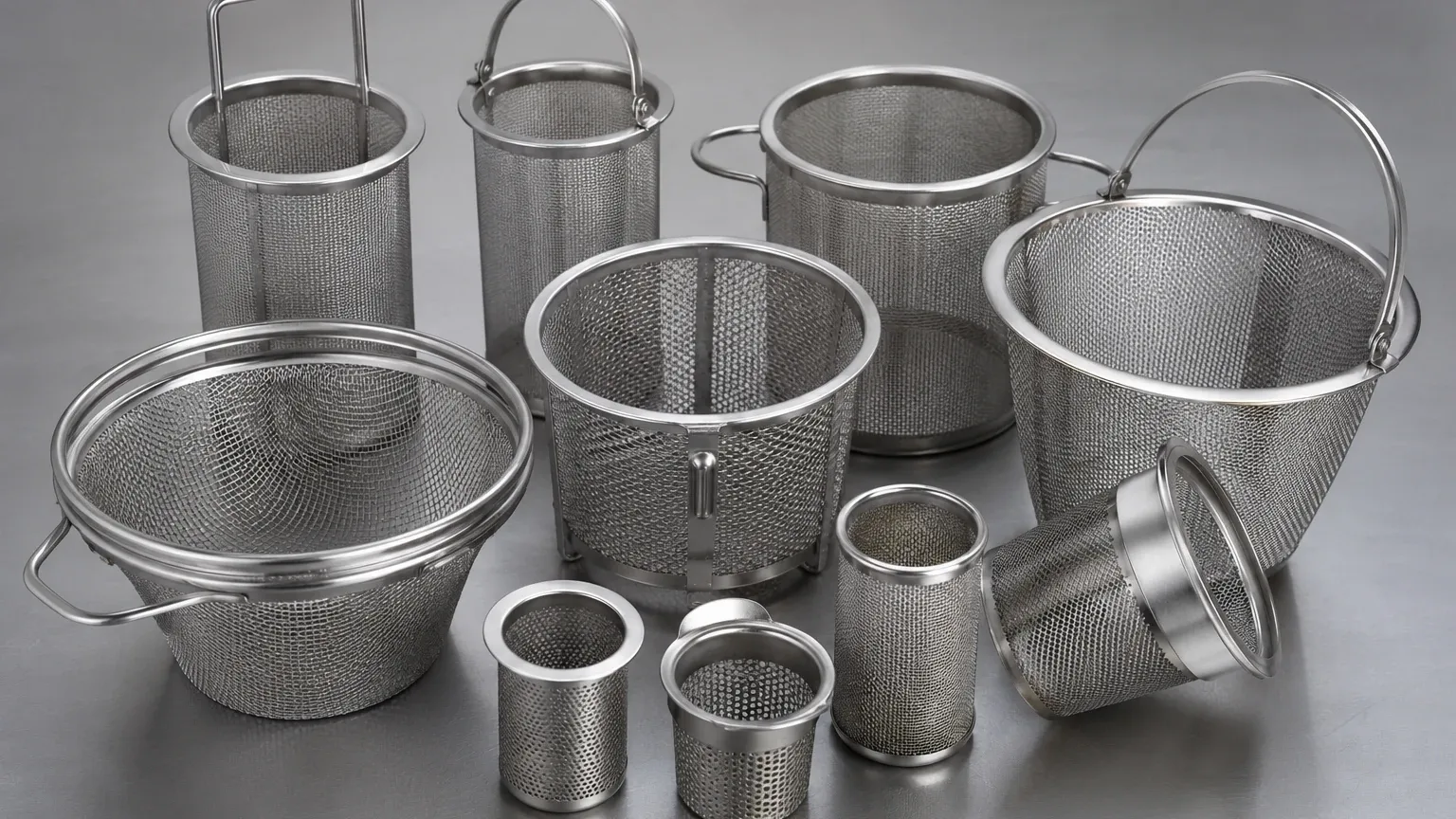
* Wire Mesh Lining: For finer filtration requirements, a stainless steel wire mesh is sintered or spot-welded to the interior or exterior of the perforated basket. This allows for the removal of much smaller particles while maintaining the rigidity provided by the perforated plate.
Key Design Considerations for Industrial Baskets
When specifying Strainers & Baskets, engineers must evaluate several design factors to optimize flow and minimize maintenance downtime.
Open Area Ratio
The "open area" is the total area of the holes in the basket expressed as a percentage of the total surface area. A higher open area ratio typically results in a lower initial pressure drop across the filter. For industrial applications, a ratio of 6:1 (the area of the basket openings relative to the cross-sectional area of the inlet pipe) is often targeted to ensure long service intervals between cleanings.
Structural Reinforcement
In high-pressure or high-viscosity applications, the basket may be subject to significant differential pressure as it becomes loaded with debris. Design features such as heavy-duty support ribs, reinforced handles, and thicker gauge metals are essential to prevent basket collapse. The choice between a flat-bottom basket and a slant-top basket also depends on the housing configuration and the ease of removal required by the site operators.
Handle and Seal Configurations
Ease of maintenance is a critical B2B consideration. Baskets can be designed with various handle types—including fixed bars, swing handles, or even grip-holes—to facilitate quick removal. Furthermore, the sealing surface at the top of the basket must be precisely machined or fitted with an appropriate gasket (such as EPDM, Viton, or PTFE) to prevent fluid bypass, ensuring that 100% of the media passes through the filtration zone.
Performance Evaluation: Pressure Drop and Flow Rate
One of the most common questions engineers face before purchasing industrial filters is how the component will affect system hydraulics. The pressure drop ($ΔP$) is a function of the fluid's velocity, viscosity, and the effective open area of the strainer basket.
As the strainer basket in spanish (*canasta filtrante*) collects debris, the open area decreases, leading to an increase in differential pressure. It is standard practice to install differential pressure gauges upstream and downstream of the strainer. A common guideline is to initiate a cleaning cycle once the pressure drop reaches 5-10 psi above the clean-running pressure. Failure to monitor this can result in reduced flow rates, pump cavitation, or even structural failure of the basket media.
Customization and OEM Capabilities
Standard off-the-shelf baskets often fail to meet the unique constraints of specialized industrial equipment. This is where custom manufacturing becomes essential. Kaifil specializes in providing tailored solutions that address specific application challenges:
* Custom Dimensions: Matching exact housing diameters and depths to ensure a snug fit and zero bypass.
* Multi-Stage Filtration: Designing baskets with multiple layers of different mesh sizes to capture a broad range of particle sizes in a single pass.
* Magnetic Inserts: Adding magnetic rods to the center of the basket to capture fine ferrous particles that might otherwise pass through a standard mesh.
* Specialized Coatings: Applying PTFE or other industrial coatings to improve release properties when filtering sticky or high-viscosity fluids.
By working closely with an OEM partner, purchasing teams can ensure that the Strainers & Baskets they procure are optimized for their specific operational parameters, leading to a lower total cost of ownership (TCO) through extended service life and reduced equipment wear.
Application-Specific Requirements
Different industries impose different standards on filtration components. A strainer basket in spanish used in a pharmaceutical plant in Mexico City will have different compliance requirements than one used in a hydraulic system in Spain.
Food and Beverage
In these applications, sanitary design is non-negotiable. This involves using SS316L material, ensuring all welds are ground smooth (to prevent bacterial growth), and utilizing FDA-approved gasket materials. The baskets must be easy to clean and often require electropolishing to achieve a specific surface roughness (Ra) value.
Chemical Processing
Chemical compatibility is the primary concern here. Engineers must verify that the stainless steel grade and the sealing materials can withstand the specific pH levels and temperatures of the process fluid. In highly corrosive environments, even the welding wire used during fabrication must be carefully selected to match or exceed the corrosion resistance of the base metal.
Water Treatment
For large-scale water treatment, the volume of debris can be significant. Baskets in these systems are often larger and require robust handles for mechanical lifting. The focus is on high flow rates and the ability to withstand constant exposure to moisture without oxidation.
Maintenance and Replacement Cycles
A common engineering concern is the expected lifespan of a strainer basket. While stainless steel is inherently durable, it is not indestructible. The replacement cycle depends on:
1. Cleaning Frequency: Frequent manual cleaning or high-pressure backwashing can eventually cause fatigue in the wire mesh.
2. Abrasive Particles: High-velocity fluids containing abrasive solids can lead to "erosion-corrosion," thinning the metal over time.
3. Chemical Attack: Unexpected changes in process chemistry can lead to localized pitting.
Regular inspection of the basket for signs of mesh fraying, distorted frames, or compromised seals is essential. Keeping a stock of replacement Strainers & Baskets on-site is a standard risk-mitigation strategy to prevent extended downtime during a filtration failure.
Conclusion: Bridging the Gap in Global Procurement
Whether you are searching for a strainer basket in spanish to fulfill a contract in a Spanish-speaking region or you are an engineer looking for the highest quality Strainers & Baskets for a domestic project, the focus must remain on technical excellence. Accurate terminology, combined with a deep understanding of material science and hydraulic design, allows for the selection of filtration components that truly protect industrial assets.
Kaifil remains committed to supporting global engineering teams with precision-engineered stainless steel filtration solutions. By focusing on the technical details—from mesh counts and alloy grades to the nuances of international terminology—we help our clients achieve reliable, cost-effective, and high-performance filtration in every application.
