


Strainer Basket Installation
In industrial filtration, the effectiveness of a system is as much a product of precise installation as it is of high-quality component manufacturing. Strainers & Baskets act as the critical frontline defense for downstream equipment, protecting pumps, valves, and heat exchangers from particulate damage. However, even a precision-engineered stainless steel basket can fail to perform if it is incorrectly seated or if the installation environment is not properly prepared.
For engineers and maintenance professionals, understanding the technical nuances of strainer basket installation is essential for maintaining system integrity, minimizing pressure drop, and extending the service life of both the filter element and the broader mechanical system. This guide provides a technical overview of the installation process, engineering considerations, and best practices for ensuring optimal filtration performance.
The Role of Strainers & Baskets in Industrial Process Protection
Before beginning the installation process, it is vital to understand the structural role of the basket within the housing. Unlike standard disposable filters, industrial strainers are designed for durability and high-volume flow. They typically consist of a perforated metal support structure lined with a fine wire mesh. The goal is to maximize the "Open Area Ratio"—the ratio between the open area of the basket and the cross-sectional area of the inlet pipe. A well-designed basket often maintains a ratio of at least 6:1 to ensure that the pressure drop remains manageable even as the basket begins to collect debris.
Proper installation ensures that the fluid path is forced entirely through the filtration media. If the basket is not seated correctly, fluid will follow the path of least resistance, leading to "bypass." In high-precision industries such as pharmaceutical or chemical processing, even a minor bypass can result in contaminated batches or catastrophic equipment failure downstream.
Engineering Considerations Before Installation
Successful installation begins long before the basket is placed in the housing. Engineers must verify several technical parameters to ensure compatibility:
1. Material Compatibility: Verify that the basket material (typically Grade 304 or 316L stainless steel) is compatible with the process fluid. Corrosive chemicals or high-temperature steam require specific alloys to prevent premature degradation.
2. Differential Pressure ($ΔP$) Limits: Every strainer basket has a maximum allowable differential pressure. During installation, ensure that the system is equipped with calibrated pressure gauges on both the inlet and outlet sides. This allows operators to monitor the "clean" pressure drop immediately after installation.
3. Flow Direction: Most basket strainers are designed for "inside-out" flow. This means the fluid enters the center of the basket and exits through the mesh, trapping debris inside the basket for easy removal. Installing a basket in a system where the flow direction is reversed can cause the mesh to collapse or burst, as the internal support structure is not designed for external pressure.
4. Mesh Micron Rating: Confirm that the micron rating of the basket matches the process requirements. Using a mesh that is too fine will lead to rapid clogging and frequent maintenance, while a mesh that is too coarse will fail to protect downstream components.
Comprehensive Strainer Basket Installation Guide
Following a standardized strainer basket installation procedure is the most effective way to prevent mechanical failure. The following steps outline the professional approach to seating a basket in a standard industrial housing.
Step 1: Housing Preparation and Inspection
Before introducing the new basket, the housing must be thoroughly cleaned. Residual debris from previous cycles can prevent the basket from seating flush against the flange. Inspect the internal sealing surfaces for pitting, corrosion, or scratches. Even a minor imperfection on the sealing seat can allow fluid to bypass the basket.
Step 2: Basket Integrity Check
Inspect the new or cleaned basket for any signs of transit damage or structural fatigue. Check the wire mesh for pinholes or separations at the weld points. For baskets used in high-pressure applications, ensure the handle (or bail) is securely attached, as this component often plays a role in holding the basket down against the flow velocity.
Step 3: Seating the Basket
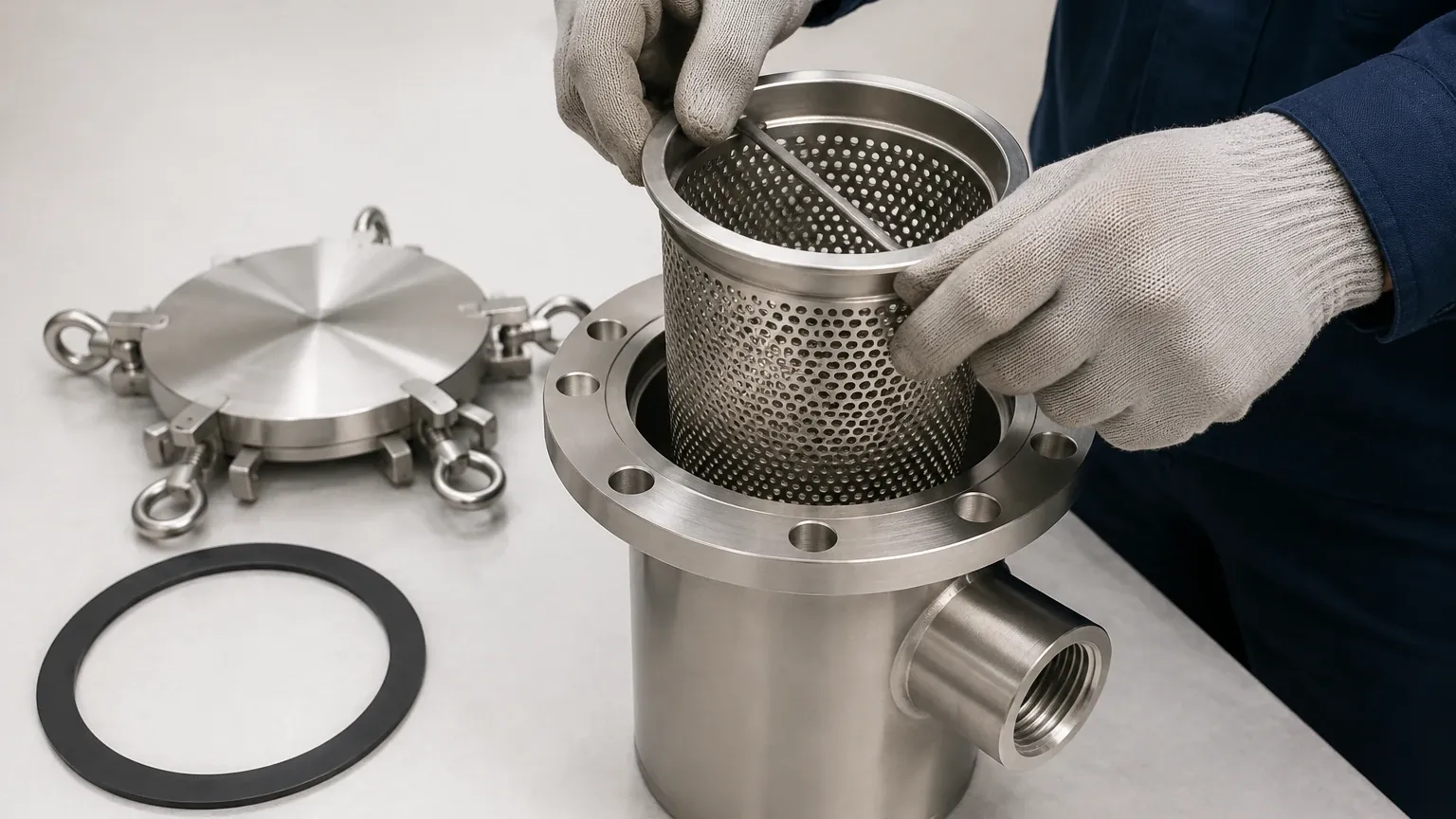
Lower the basket into the housing, ensuring it is perfectly vertical. The top flange of the basket must rest evenly on the internal ledge of the housing. In many designs, the basket handle is engineered to be slightly taller than the basket rim so that when the housing cover is closed, the lid applies downward pressure on the handle. This "hold-down" mechanism prevents the basket from "floating" or shifting when the system is pressurized.
Step 4: Gasket and Seal Placement
Most industrial strainers rely on an O-ring or a flat gasket to create a leak-proof seal between the basket flange and the housing. Ensure the seal is made of a material compatible with the process fluid (e.g., Viton, EPDM, or PTFE). The seal should be lightly lubricated if the application allows, and it must be seated without twists or kinks.
Ensuring Sealing Integrity and Preventing Fluid Bypass
One of the most common failures in strainer basket installation is the failure to achieve a perfect seal. Bypass occurs when the process fluid travels around the basket rather than through it. This is often caused by:
* Incorrect Gasket Thickness: If a gasket is too thin, the housing lid will not apply sufficient compression to hold the basket in place.
* Misalignment: If the basket is tilted even slightly, the flange will not create a uniform seal, leaving a gap for debris to pass through.
* Deformed Flanges: Over time, the internal flange of the housing can warp due to thermal cycling. Regular inspection of the housing seat is required to ensure it remains perfectly flat.
To test for bypass after installation, engineers often perform a "bubble point" test or use a tracer fluid in specialized applications. In standard industrial settings, monitoring the differential pressure is the most practical method; if the pressure drop is significantly lower than the manufacturer’s "clean" rating, it is a strong indicator that fluid is bypassing the filtration media.
Post-Installation Commissioning and System Startup
Once the basket is installed and the housing lid is secured, the system must be brought online gradually. Rapidly opening valves can create a "water hammer" effect or a sudden pressure surge that can deform the basket mesh.
1. Venting the System: Open the vent valve on the top of the housing to allow air to escape as the housing fills with fluid. Trapped air can cause turbulence and inconsistent filtration.
2. Gradual Pressurization: Slowly open the inlet valve to allow the housing to reach operating pressure. Once the air is fully vented and the housing is full, slowly open the outlet valve.
3. Baseline Recording: Record the initial differential pressure. This "Clean $ΔP$" serves as the baseline for all future maintenance. If the baseline is higher than expected, it may indicate that the basket is already partially blinded or that the flow rate exceeds the basket’s design capacity.
Monitoring Performance and Determining Replacement Cycles
The longevity of a Strainers & Baskets installation depends on the solids loading of the process fluid and the mechanical stress placed on the mesh. A well-installed basket should only be removed when the differential pressure reaches the manufacturer’s recommended "dirty" limit (typically between 10 and 15 psi above the clean baseline).
Frequent removal and re-installation increase the risk of damaging the seals or the basket flange. Therefore, it is recommended to use high-capacity baskets in high-load applications to extend the time between maintenance cycles. When the basket is removed for cleaning, it should be inspected for "blinded" areas—sections of the mesh where particles are permanently lodged. If more than 20% of the mesh surface is blinded, the basket should be replaced to prevent excessive pressure drop and potential structural collapse.
Customization and OEM Solutions for Complex Systems
In many industrial environments, standard off-the-shelf baskets may not meet the specific requirements of the application. Factors such as high viscosity, extreme temperatures, or unique housing geometries require customized filtration solutions.
Kaifil specializes in manufacturing custom stainless steel filtration components that address these specific engineering challenges. Whether the application requires reinforced heavy-duty baskets for hydraulic systems or precision-grade wire mesh for pharmaceutical processing, customization allows for the optimization of the basket's structural integrity and filtration efficiency.
When designing a custom basket, engineers should confirm the following with the manufacturer:
* Support Cage Thickness: For high-pressure applications, the perforated support cage must be thick enough to resist buckling.
* Mesh Layering: Sintered multi-layer mesh can provide both fine filtration and high mechanical strength, which is ideal for applications with frequent backwashing or high-velocity flow.
* Handle Design: Custom handles can be engineered to ensure a perfect fit with existing housing lids, eliminating the risk of basket float.
By focusing on the technical details of strainer basket installation and selecting the appropriate materials and designs, industrial facilities can significantly reduce downtime and protect their most valuable mechanical assets. Proper installation is not merely a maintenance task; it is a critical engineering step in ensuring process reliability and product quality.
