


Basket Strainer Images
In the field of industrial filtration, visual documentation serves as a critical bridge between theoretical engineering specifications and physical performance. For procurement managers and mechanical engineers, reviewing basket strainer images is not merely an aesthetic exercise; it is a vital part of the technical vetting process. High-resolution imagery provides essential data regarding weld integrity, material finish, structural reinforcement, and the precision of the filtration media—details that are often summarized but not fully articulated in a standard data sheet.
When sourcing Strainers & Baskets, the ability to interpret visual cues can prevent costly installation errors and premature equipment failure. This guide examines how to analyze basket strainer images from a technical perspective, ensuring that the components selected meet the rigorous demands of chemical, pharmaceutical, and hydraulic applications.
The Role of Visual Documentation in Industrial Filtration Procurement
In a B2B context, the search for basket strainer images is typically driven by the need to verify a supplier's manufacturing capabilities. Engineering teams use these images to confirm that the physical product aligns with the CAD drawings and the specified Bill of Materials (BOM).
Visual evidence helps engineers assess the "open area ratio" of the basket. While a data sheet might state a percentage, an image allows an engineer to see the distribution of perforations or the tightness of the wire mesh weave. This is crucial for calculating potential pressure drops across the system. Furthermore, images allow for a preliminary check of the housing compatibility. By viewing the flange faces and the handle configurations, an engineer can determine if the basket can be easily extracted during maintenance cycles without interfering with the strainer housing's cover or internal seals.
Key Technical Features to Identify in Basket Strainer Images
When evaluating basket strainer images, several key components should be scrutinized to ensure they meet industrial standards.
1. Media Type and Configuration
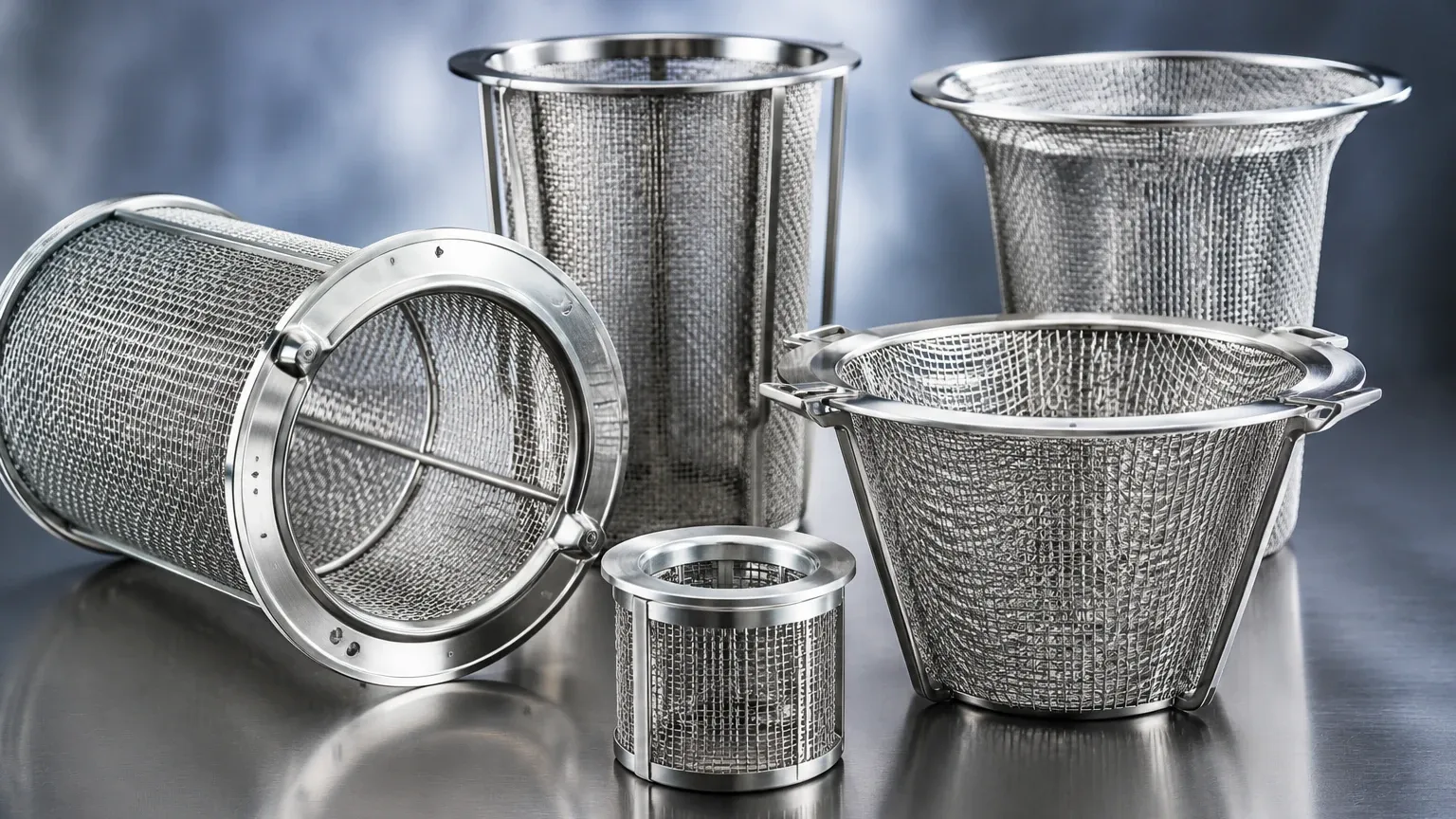
Images should clearly show whether the strainer utilizes a perforated metal sheet, a woven wire mesh, or a combination of both (mesh-lined perforated baskets). In high-pressure applications, the image should reveal a heavy-duty perforated backup tube that supports a finer inner mesh. This dual-layer construction is essential for preventing the fine mesh from collapsing under high differential pressure.
2. Handle and Lifting Mechanisms
For large-scale industrial strainers, the method of extraction is a safety and efficiency concern. Technical images allow engineers to inspect the handle design—whether it is a standard bail handle, a heavy-duty rod handle, or a cross-bar design. The strength of the attachment points for these handles is a common failure point; therefore, clear images of the handle-to-basket welds are necessary to verify durability.
3. Sealing Surfaces
The top ring or flange of the basket is where the seal is formed against the strainer housing. Images should be checked for the flatness and smoothness of this surface. Any burrs, irregularities, or warping visible in the image could indicate a risk of bypass, where unfiltered fluid escapes around the edges of the basket rather than passing through the media.
Assessing Material Quality and Surface Treatments Visually
Stainless steel is the industry standard for most corrosive or high-purity environments, but not all stainless steel finishes are equal. When reviewing basket strainer images, the surface finish provides clues about the manufacturing process and the component's suitability for specific environments.
* Pickled and Passivated Finishes: These often appear matte grey. This treatment is essential for removing free iron from the surface and maximizing the corrosion resistance of 304 or 316L stainless steel. Images showing a consistent, non-reflective matte finish suggest proper chemical cleaning.
* Electropolished Finishes: In the food, beverage, and pharmaceutical industries, a mirror-like, electropolished finish is often required. Images of electropolished baskets should show a high degree of reflectivity and the absence of microscopic pits. This finish reduces the risk of bacterial growth and makes the basket easier to clean during CIP (Clean-In-Place) cycles.
* Material Identification: While 304 and 316 stainless steel look nearly identical, high-quality production images often include stamped heat numbers or material grade markings on the flange. Engineers should look for these markings in basket strainer images to ensure traceability and compliance with project specifications.
Evaluating Welding Integrity and Structural Reinforcement
The structural integrity of a basket strainer is defined by its welds. Because these components are subjected to constant flow and occasional pressure surges, the welding must be of the highest industrial caliber.
When examining basket strainer images, engineers should look for the following:
* Continuous Seam Welds: Longitudinal seams in the perforated metal or mesh should be continuously welded, not just spot-welded. A continuous weld ensures there are no gaps where large particles can bypass the filter.
* TIG vs. Spot Welding: Tungsten Inert Gas (TIG) welding is preferred for stainless steel filtration components because it provides a clean, strong, and precise bond. Images should show smooth, uniform weld beads without signs of "sugar" (oxidation) or excessive heat tint, which can weaken the metal.
* Reinforcement Bands: For baskets used in high-viscosity or high-flow applications, look for images that show longitudinal or circumferential reinforcement bands. These bands prevent the basket from deforming under the weight of the captured solids.
Identifying Custom Design Variations for Specific Applications
Standard off-the-shelf strainers often fail to meet the specific requirements of complex industrial systems. This is where customized Strainers & Baskets become necessary. Visual documentation is the best way to confirm that custom modifications have been implemented correctly.
Slant-Bottom vs. Flat-Bottom Designs
Images can quickly confirm the geometry of the basket. A slant-bottom design is often used in offset piping configurations to maximize the collection area, while flat-bottom baskets are standard for vertical flow paths.
Pleated Mesh Inserts
In applications requiring a very high filtration surface area within a small footprint, engineers might specify pleated mesh. Basket strainer images of pleated designs allow the engineer to verify the pleat count and the uniformity of the pleat spacing, both of which affect the dirt-holding capacity and the time between cleaning cycles.
Magnetic Inserts
For hydraulic or lube oil systems, baskets may include magnetic rods to capture fine ferrous particles. Images are used to verify the placement and mounting method of these magnets, ensuring they are positioned in the flow path for maximum effectiveness without obstructing the main fluid stream.
Common Pitfalls When Relying on Digital Imagery for Selection
While basket strainer images are invaluable, they can also be misleading if not interpreted correctly. There are several risks that procurement teams should be aware of during the visual review phase.
1. Stock Photos vs. Actual Production Photos: Many suppliers use generic stock images that do not represent the actual product being shipped. Engineers should request "as-built" or production-run photos to verify the specific details of their order. A stock photo may show a heavy-duty handle, while the actual product may arrive with a thin wire bail.
2. Lack of Scale: Without a reference point, it is difficult to judge the size of a basket from an image. A basket designed for a 2-inch pipe can look remarkably similar to one designed for a 12-inch pipe. Technical images should ideally include a scale bar or be taken alongside a standard measurement tool to confirm dimensions.
3. Lighting and Shadows: Poor lighting can hide defects such as cracks in the mesh or incomplete welds. High-quality basket strainer images should be taken under bright, diffused light to eliminate harsh shadows that might obscure the internal surfaces of the basket.
Technical Checklist: Verifying Specifications via Production Photos
Before finalizing a purchase or approving a submittal, engineers should use the following checklist when reviewing basket strainer images provided by the manufacturer:
* Mesh/Perforation Accuracy: Does the hole size or mesh count appear consistent with the micron rating ordered?
* Seam Alignment: Are the seams straight and fully penetrated by the weld?
* Flange Integrity: Is the top ring thick enough to withstand the clamping force of the housing cover?
* Cleanliness: Is the basket free of metal shavings, oils, or polishing compounds? (Crucial for pharmaceutical and food applications).
* Design Features: Are the specific features—such as slanted bottoms, specialized handles, or reinforcement bars—clearly visible and correctly positioned?
By prioritizing the review of detailed basket strainer images, industrial professionals can ensure they receive filtration components that are not only dimensionally accurate but also built to withstand the rigors of their specific operating environments. Whether for simple water treatment or complex chemical processing, the visual verification of quality is a non-negotiable step in modern industrial procurement.
