


Basket Strainer India
In the landscape of industrial fluid handling, the protection of downstream equipment is a critical engineering priority. Whether in chemical processing plants, pharmaceutical labs, or large-scale water treatment facilities, the presence of particulate matter can lead to catastrophic pump failure, clogged valves, and compromised product quality. For technical professionals sourcing a basket strainer india or seeking high-performance filtration components globally, understanding the intersection of material science, hydraulic design, and manufacturing precision is essential.
Industrial Strainers & Baskets serve as the primary line of defense in piping systems. Unlike Y-strainers, which are often used for smaller pipelines with lower debris loading, basket strainers are designed for larger volumes and higher dirt-holding capacities. This article examines the technical nuances of these components, providing engineers and purchasing teams with the factual data required to optimize their filtration infrastructure.
The Fundamental Engineering of Strainers & Baskets
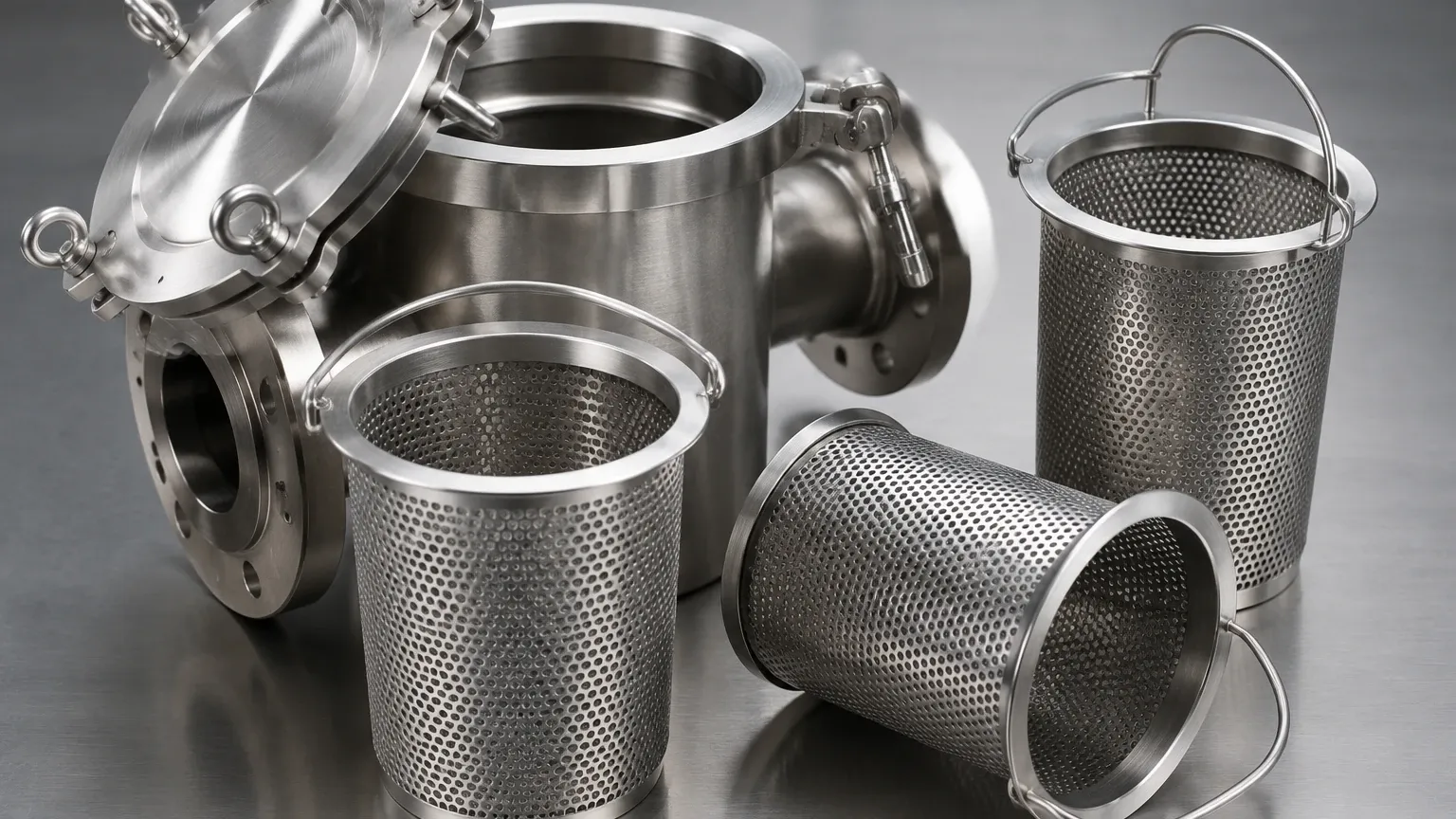
A basket strainer is a closed vessel with a removable screen element (the basket) that intercepts solid contaminants from a flowing liquid or gas. The design is inherently focused on ease of maintenance; the "top-entry" configuration allows the internal basket to be removed for cleaning without dismantling the entire piping system.
From an engineering perspective, the efficiency of a basket strainer is measured by its "Open Area Ratio" (OAR). This is the ratio between the total open area of the strainer screen and the cross-sectional area of the inlet pipe. A high OAR (typically 6:1 or 8:1) ensures that the system experiences minimal pressure drop even as the basket begins to collect debris. When sourcing a basket strainer india, engineers must confirm that the internal basket geometry is optimized for the specific flow velocity of their application to prevent turbulence and mechanical stress on the mesh.
Material Selection and Chemical Compatibility
The longevity of a filtration system depends heavily on the metallurgy of both the housing and the internal element. Kaifil specializes in custom stainless steel solutions, which are preferred in demanding industrial environments due to their superior corrosion resistance and structural integrity.
1. SS304/SS304L: The industry standard for general-purpose applications, including water treatment and food processing. It offers excellent resistance to atmospheric corrosion and many organic and inorganic chemicals.
2. SS316/SS316L: Containing molybdenum, this grade is essential for environments involving chlorides or high-salinity fluids. It is the preferred choice for pharmaceutical and chemical processing where localized corrosion (pitting) is a risk.
3. Specialty Alloys: For highly aggressive media, materials like Hastelloy or Duplex stainless steel may be required.
Beyond the housing, the selection of the filter media—whether perforated plate, single-layer wire mesh, or multi-layer sintered mesh—must align with the required filtration accuracy. Perforated plates provide the structural skeleton, while fine wire mesh defines the micron rating. In high-pressure applications, a reinforced basket design is necessary to prevent the mesh from collapsing under the differential pressure generated by a clogged screen.
Evaluating Simplex vs. Duplex Basket Strainers
When designing a system, the choice between simplex and duplex configurations is dictated by the permissible downtime of the process.
Simplex Basket Strainers
Simplex strainers are used in systems where the flow can be safely interrupted. When the pressure drop across the strainer reaches a predetermined limit (usually indicated by a differential pressure gauge), the system is shut down, the vessel is depressurized, and the basket is cleaned. These are cost-effective solutions for batch processes or intermittent operations.
Duplex Basket Strainers
In continuous-flow industries—such as power generation, oil refining, or large-scale cooling water systems—stopping the flow is not an option. Duplex strainers consist of two separate strainer chambers connected by a diverter valve. When one basket requires cleaning, the flow is diverted to the clean chamber without interrupting the process. This ensures 100% uptime and protects sensitive downstream components around the clock. For many looking for a basket strainer india for critical infrastructure, the duplex model is the standard for reliability.
Critical Design Parameters: Pressure Drop and Flow Velocity
One of the most common mistakes in filter selection is undersizing the unit to save on initial capital costs. This leads to high clean pressure drops (ΔP) and frequent cleaning cycles, which increase the total cost of ownership.
Engineers must calculate the expected pressure drop using the fluid's viscosity, specific gravity, and flow rate. As viscosity increases, the pressure drop across a given mesh size rises exponentially. For high-viscosity fluids like resins, heavy oils, or syrups, a larger strainer body or a coarser mesh may be required to maintain hydraulic efficiency.
Furthermore, the velocity of the fluid at the inlet should generally be kept between 1.5 to 3 meters per second for liquids. Exceeding these velocities can cause erosion of the internal components and may force smaller particles through the mesh, compromising filtration quality.
Quality Standards and Certification for the Indian Market
Sourcing a basket strainer india requires a rigorous audit of the manufacturer’s quality management systems. Because these components are pressure vessels, they must often comply with international codes such as ASME Section VIII, Division 1.
Key quality benchmarks include:
* Hydrostatic Testing: Ensuring the housing can withstand 1.5 times the maximum allowable working pressure (MAWP) without leakage or deformation.
* Dye Penetrant Inspection: Checking welds for surface cracks or porosity, especially in stainless steel fabrications.
* Material Traceability: Providing Mill Test Reports (MTRs) to verify the chemical composition and mechanical properties of the steel used.
* Surface Finish: In the pharmaceutical and food sectors, the internal and external surfaces must be polished (often to a Ra < 0.8 μm) and passivated to prevent bacterial growth and ensure sanitary operation.
Customization and OEM Solutions for Specialized Applications
Standard off-the-shelf strainers rarely meet the exact needs of complex industrial layouts. Customization is where manufacturers like Kaifil provide the most value. Engineering teams often require specific modifications, such as:
* Custom Connection Types: While ANSI flanges are standard, some systems require DIN, JIS, or sanitary tri-clamp connections.
* Offset Nozzles: To accommodate existing piping heights or space constraints.
* Heating Jackets: Essential for fluids that solidify at room temperature, such as bitumen or certain food fats.
* Automated Blow-down Valves: To allow for the removal of heavy sludge from the bottom of the basket without opening the cover.
By working with an OEM partner, purchasing teams can ensure that the Strainers & Baskets they receive are "plug-and-play," reducing installation labor costs and eliminating the need for on-site piping modifications.
Maintenance Protocols for Industrial Filtration Components
The performance of a basket strainer is only as good as its maintenance regime. A well-designed system should include a differential pressure (DP) gauge across the inlet and outlet. A common rule of thumb is to clean the basket when the ΔP reaches 5-10 psi over the clean pressure drop.
Cleaning Procedures
1. Isolation: Close the inlet and outlet valves.
2. Venting: Open the vent valve to relieve internal pressure. This is a critical safety step, especially with hazardous chemicals.
3. Draining: Open the drain valve to empty the vessel.
4. Extraction: Open the cover (using quick-opening swing bolts if equipped) and lift the basket.
5. Inspection: Check the basket for signs of mechanical fatigue or bypass. Inspect the O-ring or gasket for compression set or chemical degradation.
For fine wire mesh baskets, ultrasonic cleaning is often recommended over manual scrubbing to ensure that particles lodged deep within the weave are removed without damaging the delicate wires.
Total Cost of Ownership (TCO) Considerations
When evaluating a basket strainer india or any international supplier, the purchase price is only one component of the TCO. Engineers must factor in:
* Durability: A cheaper, thinner-walled housing may fail due to vibration or corrosion within a few years, whereas a high-quality stainless steel unit can last decades.
* Consumables: The cost and availability of replacement baskets and gaskets.
* Labor: How quickly can the basket be changed? A quick-opening cover may save hundreds of labor hours over the life of the product.
* Energy Costs: A poorly designed strainer with a high permanent pressure drop forces pumps to work harder, significantly increasing electricity consumption.
Conclusion
Selecting the right industrial filtration solution requires a balance of hydraulic performance, material compatibility, and ease of maintenance. Whether you are searching for a basket strainer india to support local infrastructure or require a custom-engineered solution for a global project, focusing on technical specifications and manufacturing quality is the only way to ensure long-term system reliability.
Kaifil continues to support global industries by providing precision-engineered stainless steel filtration components. By adhering to strict quality standards and offering extensive OEM customization, we help engineers protect their most valuable equipment and optimize their fluid processes. For detailed technical specifications and to explore our range of customized solutions, please visit our dedicated section on Strainers & Baskets.
