


Basket Strainer vs Filter
In industrial fluid handling systems, the terms "strainer" and "filter" are often used interchangeably, yet they represent distinct categories of equipment with different engineering objectives, performance characteristics, and maintenance requirements. For engineers and procurement teams, understanding the nuances of a basket strainer vs filter is critical to optimizing system longevity, protecting downstream equipment, and ensuring product quality.
Choosing the wrong component can lead to excessive pressure drops, frequent downtime for cleaning, or, in the worst case, catastrophic failure of sensitive components like pumps, spray nozzles, and heat exchangers. This article examines the technical differences between these two solutions and provides a framework for selecting the appropriate technology for specific industrial applications.
Defining the Components: Basket Strainers and Industrial Filters
To distinguish between the two, one must look at the primary intent of the installation. While both devices utilize a media—often stainless steel wire mesh or perforated plate—to remove solids from a liquid or gas stream, their operational roles differ significantly.
What is a Basket Strainer?
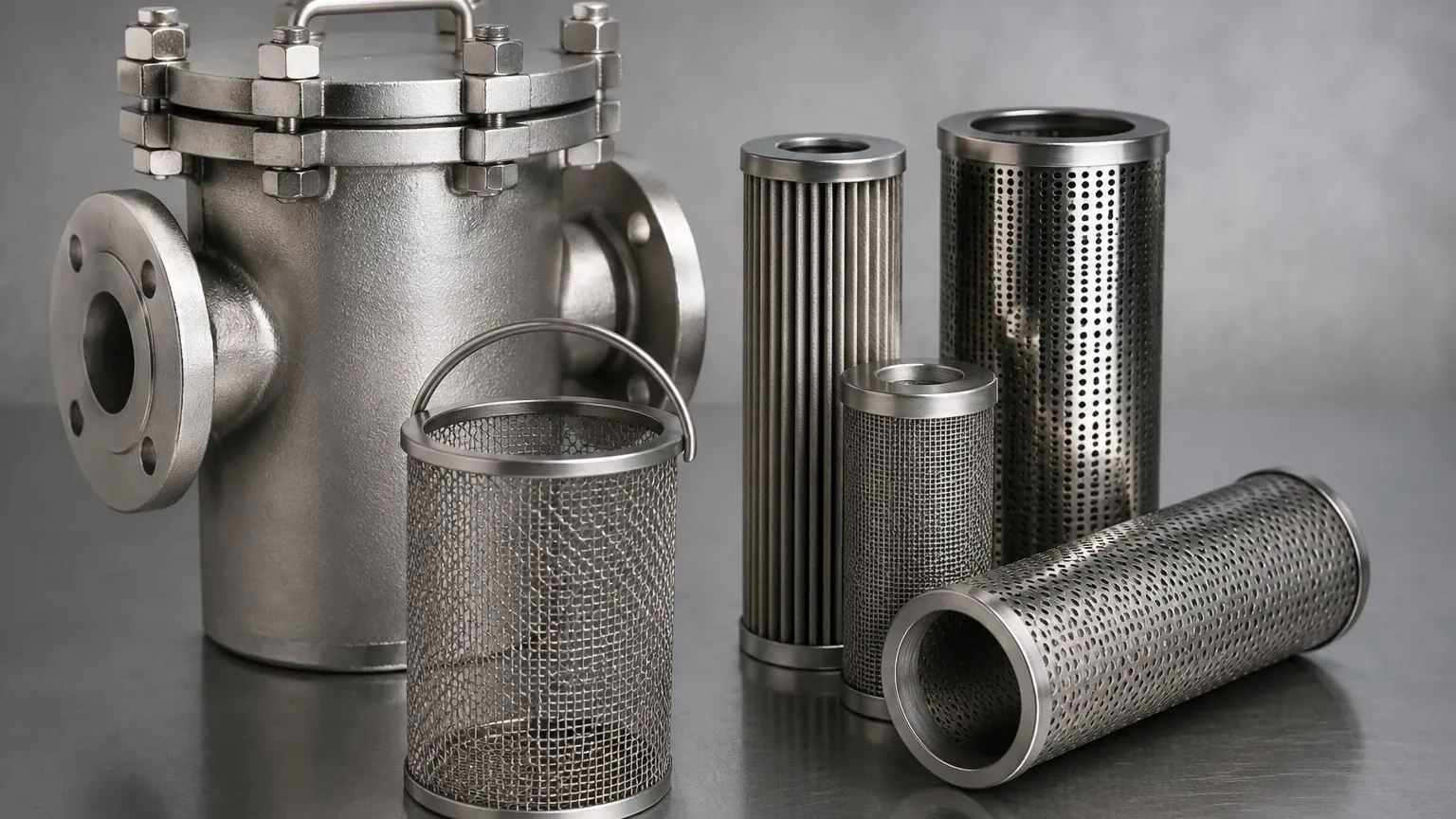
Strainers & Baskets are typically regarded as "coarse" filtration devices. Their primary function is to protect downstream mechanical components from large debris, such as scale, weld slag, or foreign objects. A basket strainer features a removable, bucket-shaped screen that allows for high dirt-holding capacity. Because they are designed to handle larger particles, they generally offer a lower pressure drop and can operate for longer periods before requiring cleaning.
What is an Industrial Filter?
An industrial filter is designed for the removal of much finer particulate matter, often to meet specific purity standards or to protect processes that are sensitive to microscopic contaminants. Filters typically utilize media with much smaller pore sizes, such as pleated stainless steel cartridges, multi-layered sintered mesh, or specialized filter bags. The goal of a filter is often the refinement of the fluid itself rather than the mere protection of hardware.
Technical Comparison: Basket Strainer vs Filter
When evaluating a basket strainer vs filter, several technical parameters must be analyzed to determine which is suitable for the process conditions.
1. Particle Size and Micron Rating
The most fundamental difference lies in the size of the particles being targeted.
* Strainers: Generally used for removing particles larger than 200 microns (approximately 75 mesh). While some fine-mesh strainers can reach 50 microns, they are primarily intended for "macro-filtration."
* Filters: Typically designed for "micro-filtration," targeting particles from 0.5 microns up to 200 microns. If a process requires the removal of particles invisible to the naked eye, a filter is the necessary choice.
2. Pressure Drop (Delta P)
Pressure drop is the loss of fluid pressure as it passes through the filtration media.
* Strainers: Because the openings in a basket strainer are relatively large, the initial clean pressure drop is minimal. This makes them ideal for high-flow suction lines where maintaining Net Positive Suction Head (NPSH) for pumps is critical.
* Filters: Due to the tighter media, filters create a higher resistance to flow. As the filter cake builds up, the pressure drop increases more rapidly than in a strainer, necessitating more frequent monitoring and maintenance.
3. Solids Loading Capacity
A basket strainer is specifically engineered to hold a significant volume of solids. The "basket" design provides a large surface area-to-pipe-area ratio (often 6:1 or higher), allowing it to collect substantial debris without significantly impeding flow. In contrast, many high-precision filters have less internal volume for solids collection, focusing instead on the efficiency of particle capture on the surface or within the depth of the media.
Material Selection and Durability in Corrosive Environments
In sectors such as chemical processing, pharmaceuticals, and food production, the material of construction is as important as the filtration rating. Stainless steel is the industry standard due to its corrosion resistance, thermal stability, and ease of sterilization.
Stainless Steel Grades
* 304 Stainless Steel: Suitable for general industrial use, water treatment, and less corrosive chemical environments. It provides excellent structural integrity for basket strainers.
* 316/316L Stainless Steel: Contains molybdenum, which provides superior resistance to chlorides and pitting. This is the preferred material for filters and strainers in marine environments, pharmaceutical manufacturing, and acidic chemical processing.
Media Types
Custom filtration solutions often involve different types of stainless steel media. Perforated metals are common in heavy-duty basket strainers for structural support, while woven wire mesh is used for both strainers and filters to achieve specific micron ratings. For high-pressure or high-temperature applications, sintered metal mesh provides the necessary rigidity and precision.
Maintenance Cycles and Operational Impact
The decision between a basket strainer vs filter heavily influences the total cost of ownership (TCO) through maintenance and downtime.
Cleaning vs. Replacement
Most basket strainers are designed to be permanent components of the piping system. The internal basket is removed, cleaned (often by hand or backwashing), and reinstalled. This makes strainers a cost-effective long-term solution for high-debris applications.
Filters, particularly cartridge-based systems, may involve disposable media. While stainless steel filter cartridges are cleanable (often via ultrasonic baths or chemical cleaning), the process is more intensive than rinsing a strainer basket. Engineers must weigh the cost of replacement cartridges or specialized cleaning against the performance benefits of finer filtration.
System Downtime
Simplex strainers and filters require the flow to be shut down for cleaning. If continuous operation is required, duplex configurations are used. A duplex basket strainer allows the operator to divert flow to a clean chamber while the dirty basket is serviced, ensuring zero interruption to the process.
Engineering Selection Criteria for Fluid Systems
To make an informed decision, engineers should confirm the following parameters before selecting between a strainer and a filter:
1. Nature of the Contaminant: Is the debris hard, soft, fibrous, or gelatinous? Hard, large particles are best handled by a basket strainer. Fine, silty, or deformable particles usually require a filter.
2. Flow Rate and Velocity: High-velocity systems can cause particle bypass or damage fine filter media. Strainers are generally more robust in high-flow scenarios.
3. Viscosity of the Medium: Highly viscous fluids (like heavy oils or resins) create significant pressure drops. A coarse strainer may be the only viable option to prevent pump cavitation, even if finer filtration is desired.
4. Operating Pressure and Temperature: Ensure the housing and the internal elements are rated for the maximum system temperature and pressure, including potential surges (water hammer).
5. Downstream Sensitivity: If the fluid is feeding a high-pressure spray nozzle with a 100-micron orifice, a 50-micron filter is mandatory to prevent clogging. If the fluid is simply entering a large storage tank, a 200-mesh strainer may suffice.
Industry-Specific Applications
Food and Beverage
In this sector, cleanliness and hygiene are paramount. Basket strainers are often used at the beginning of the process to remove large organic solids from raw ingredients. Finer stainless steel filters are used later in the process for "polishing" the product to ensure clarity and remove microbial contaminants.
Chemical Processing
Chemical plants often deal with aggressive fluids and varying temperatures. Stainless steel strainers protect expensive alloy pumps from pipe scale. Precision filters are used to ensure that catalysts remain uncontaminated and that final chemical products meet purity specifications.
Hydraulic Systems
Hydraulic fluids must be kept extremely clean to prevent wear on precision valves and actuators. Here, filters are the standard, often placed in the return line or as a kidney-loop system to maintain a specific ISO cleanliness code.
Customization and OEM Solutions for Filtration Challenges
Standard off-the-shelf components do not always meet the rigorous demands of specialized industrial processes. Customization is often required to balance the trade-offs found in the basket strainer vs filter debate.
Custom manufacturing allows for the optimization of the filtration area, the integration of specific flange types, and the selection of specialized mesh weaves. For instance, a "heavy-duty" basket can be reinforced with a perforated metal shroud to withstand high differential pressures that would collapse a standard mesh screen. Similarly, custom filter cartridges can be designed to fit existing housings while providing improved flow characteristics or higher dirt-holding capacity.
Working with a manufacturer that understands the engineering behind material selection and filtration mechanics ensures that the component provided is not just a commodity, but a solution tailored to the specific hydraulic and chemical challenges of the application.
Conclusion
The choice between a basket strainer vs filter is defined by the required level of protection and the allowable pressure drop within a system. Strainers serve as the first line of defense, handling high volumes of large debris with minimal maintenance. Filters provide the precision necessary for high-purity applications and the protection of sensitive downstream equipment.
By carefully evaluating particle size, fluid properties, and operational goals, engineers can implement a filtration strategy that maximizes equipment uptime and minimizes long-term costs. Whether the application calls for a standard duplex strainer or a custom-engineered stainless steel filter element, the focus must remain on the technical requirements of the fluid and the mechanical limits of the system.
