


L Wire Mesh
In industrial filtration, material selection is the most critical factor determining the longevity and efficiency of a system. Among the various alloys used in the fabrication of Wire Mesh Filter Cylinders & Tubes, "L" grade stainless steel—specifically 316L and 304L—stands as the industry standard for demanding environments. This guide examines the technical properties of l wire mesh, its role in precision filtration components, and the engineering considerations necessary for selecting the right configuration for chemical, pharmaceutical, and food processing applications.
Understanding the "L" in L Wire Mesh
The designation "L" in stainless steel alloys such as 316L or 304L signifies "Low Carbon." In standard 316 stainless steel, the carbon content is typically capped at 0.08%. In 316L, this is reduced to 0.03% or less. While this difference may seem marginal, it is technically significant during the manufacturing of Wire Mesh Filter Cylinders & Tubes.
When stainless steel is heated to temperatures between 425°C and 870°C (800°F–1600°F)—a range common during welding—carbon reacts with chromium to form chromium carbides at the grain boundaries. This process, known as sensitization, depletes the chromium levels near the boundaries, leaving the material vulnerable to intergranular corrosion. By using l wire mesh, engineers ensure that the filter remains resistant to corrosion even after the intensive welding required to form cylindrical shapes or attach end fittings. For international buyers, specifying 316L is often a prerequisite for filters used in marine environments or acidic chemical processing where standard alloys would fail prematurely.
Structural Design of Wire Mesh Filter Cylinders & Tubes
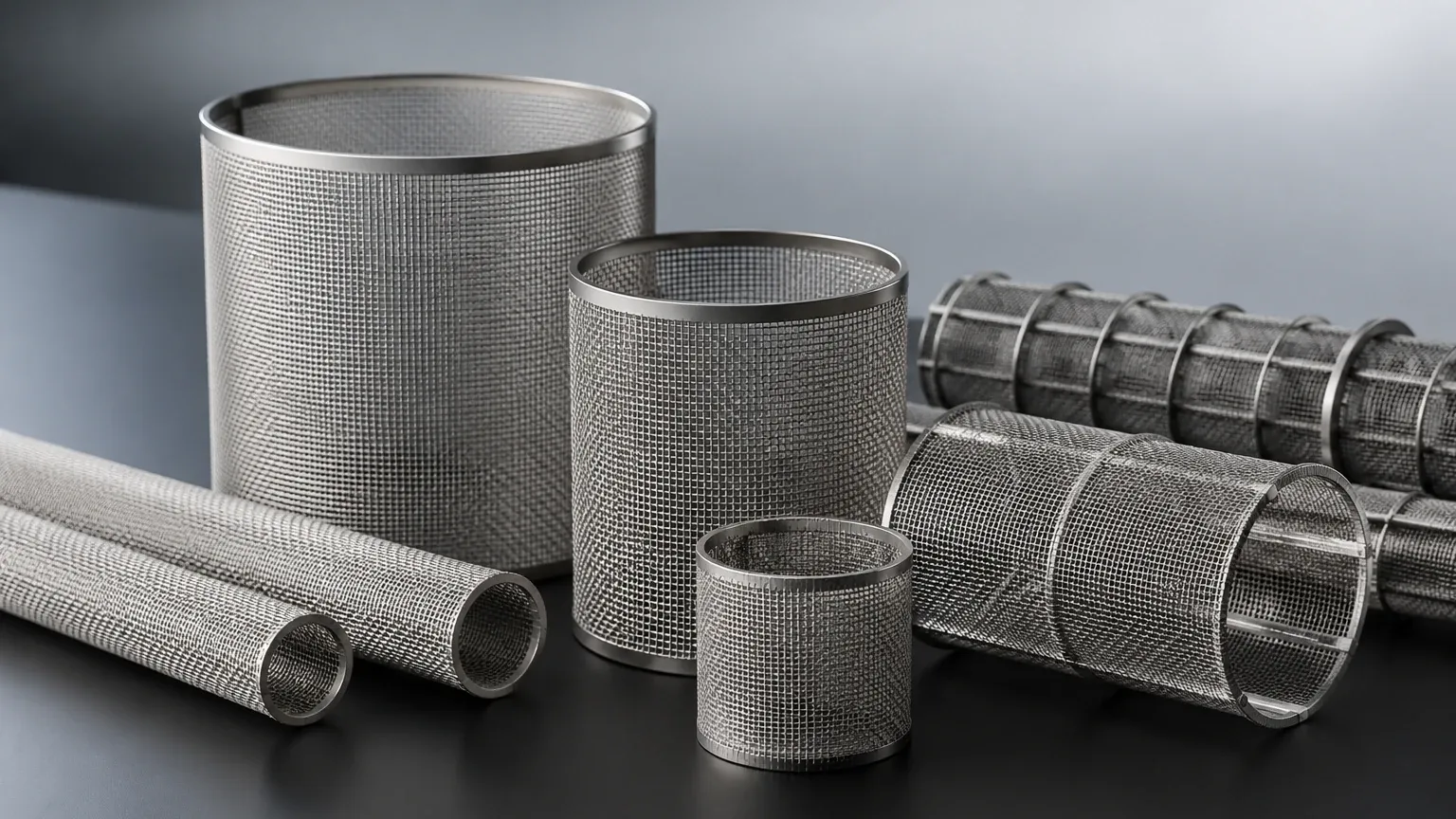
Filter cylinders and tubes are rarely composed of a single layer of mesh. Depending on the pressure requirements and the required filtration fineness, these components are engineered using several structural approaches:
Single-Layer vs. Multi-Layer Construction
Single-layer tubes are used in low-pressure applications or as primary strainers. However, for precision filtration, multi-layer sintered or bonded structures are preferred. In these designs, a fine l wire mesh filtration layer is sandwiched between coarser support layers. This provides the mechanical strength necessary to withstand high differential pressures without compromising the pore size.
Pleated vs. Plain Cylinders
To increase the effective filtration area within a fixed footprint, engineers often specify pleated designs. A pleated cylinder can offer three to five times the surface area of a plain cylindrical tube. This results in lower flux rates (velocity through the mesh), which reduces the pressure drop and significantly extends the service life between cleaning cycles.
Support Cores and Outer Guards
For high-viscosity fluids or high-pressure hydraulic systems, Wire Mesh Filter Cylinders & Tubes are often reinforced with an internal perforated metal core. This core prevents the mesh from collapsing under the weight of the fluid or accumulated contaminants. In some cases, an outer guard is also added to protect the delicate mesh during installation and handling.
Weave Patterns and Filtration Efficiency
The performance of l wire mesh is dictated by its weave pattern. Each pattern offers a different balance of flow rate, mechanical strength, and particle retention.
1. Plain Weave: The most common pattern where wires cross over and under each other. It provides high flow rates and is easy to clean, making it suitable for simple straining tasks.
2. Twill Weave: Each shute wire passes over and under two warp wires. This allows for thicker wires to be used for a given mesh count, increasing the durability of the filter tube.
3. Plain Dutch Weave: This uses larger diameter warp wires and smaller shute wires driven closely together. It creates a dense, strong mesh with high filtration accuracy, often used in high-pressure environments.
4. Twill Dutch Weave: Combining twill and dutch techniques, this weave allows for the finest filtration levels (down to 1–5 microns) while maintaining the structural integrity required for cylindrical forming.
When selecting a weave for Wire Mesh Filter Cylinders & Tubes, engineers must calculate the "Open Area Percentage." A higher open area reduces initial pressure drop but may result in a more fragile mesh if the wire diameter is too small.
Engineering Selection Criteria for Industrial Buyers
When procuring filtration components, technical professionals must look beyond the basic dimensions. The following parameters are essential for a successful integration:
Chemical Compatibility
While 304L is suitable for many food-grade applications, 316L is required for environments containing chlorides or high-temperature acids. The addition of Molybdenum in 316L provides superior resistance to pitting and crevice corrosion, which is vital for long-term immersion in industrial solvents.
Micron Rating: Absolute vs. Nominal
It is critical to clarify whether the mesh is rated for absolute or nominal filtration. An absolute rating implies that 99.9% of particles larger than the specified micron size will be captured. A nominal rating is more of an average and may allow larger particles to pass through under certain pressure conditions. For pharmaceutical and high-purity chemical applications, absolute-rated l wire mesh is typically mandatory.
Temperature and Pressure Thresholds
Stainless steel maintains its structural integrity at much higher temperatures than synthetic filters. However, the maximum operating temperature of a filter tube is often limited by the sealing method (e.g., O-rings or adhesives) rather than the mesh itself. For extreme temperatures, all-welded constructions are necessary.
Installation and Maintenance Constraints
The longevity of Wire Mesh Filter Cylinders & Tubes depends heavily on correct installation and a rigorous maintenance schedule. Unlike disposable cartridges, stainless steel mesh filters are designed to be cleaned and reused, which significantly lowers the total cost of ownership (TCO).
Cleaning Methods
* Backwashing: Reversing the flow of the fluid to dislodge particles from the surface of the mesh.
* Ultrasonic Cleaning: Using high-frequency sound waves in a solvent bath to remove fine particles trapped deep within the weave of the l wire mesh.
* Chemical Cleaning: Using specific acids or alkalis to dissolve organic or inorganic scaling, provided the chemical is compatible with the 316L/304L alloy.
Replacement Indicators
Engineers should monitor the differential pressure (ΔP) across the filter. A sudden drop in ΔP may indicate a breach or "media migration," where the mesh has failed. Conversely, a ΔP that remains high even after cleaning suggests that the mesh has become permanently blinded by sub-micron particles or scale, requiring a full replacement of the cylinder.
Application-Specific Considerations
Food and Beverage Industry
In food processing, the primary concern is hygiene. l wire mesh is preferred because its smooth surface prevents bacterial growth and can withstand Clean-in-Place (CIP) procedures involving caustic chemicals and high-temperature steam.
Pharmaceutical Manufacturing
Precision is paramount here. Filter tubes must be manufactured to strict tolerances to ensure no bypass occurs. The use of 316L prevents metallic contamination of the product, and the mesh must often be certified as "burr-free" to prevent small metal fragments from entering the process stream.
Hydraulic and Oil Filtration
In hydraulic systems, the filter must withstand high-pressure pulses. The mechanical strength of the Wire Mesh Filter Cylinders & Tubes is the priority, often requiring heavy-duty internal cores and specialized twilled weaves to handle the viscosity of industrial oils.
Conclusion: Optimizing the Procurement Process
To ensure the performance of an industrial filtration system, the procurement of Wire Mesh Filter Cylinders & Tubes should be treated as an engineering collaboration rather than a simple commodity purchase. Buyers should provide manufacturers with the exact fluid composition, operating temperature, flow rate, and target particle size.
By specifying l wire mesh, companies invest in a component that offers superior weldability and corrosion resistance, reducing the risk of catastrophic failure and extending the intervals between maintenance. Whether for a new installation or a replacement part, understanding the nuances of material grade, weave pattern, and structural reinforcement is the key to achieving efficient, durable, and cost-effective filtration performance.
